
Bugsy
20.11.2022 18:13
The Fallout of FTX’s Collapse
All right, so let's talk about some of the fallout. It’s similar to the Three Arrows collapse. There's kind of a domino effect, and we're starting to see some of the contagion spread through the industry.
So BlockFi and Salt Lending both suspended operations. There's been a number of crypto firms, venture capital firms that have shut down. And some of the big ones have taken major hits… Multicoin Capital and Jump Capital are two that come to mind.
Then the biggest news to come out is Genesis Global suspending its lending operations. Genesis is part of the digital currency group run by Barry Silver. At one point it was worth over $10 billion. It’s in a tough situation because of GBTC, which is now at a 40%-plus discount to net asset value. And it can't easily get those funds, so it’s raising equity.
All right, so let's talk about some of the fallout. It’s similar to the Three Arrows collapse. There's kind of a domino effect, and we're starting to see some of the contagion spread through the industry.
So BlockFi and Salt Lending both suspended operations. There's been a number of crypto firms, venture capital firms that have shut down. And some of the big ones have taken major hits… Multicoin Capital and Jump Capital are two that come to mind.
Then the biggest news to come out is Genesis Global suspending its lending operations. Genesis is part of the digital currency group run by Barry Silver. At one point it was worth over $10 billion. It’s in a tough situation because of GBTC, which is now at a 40%-plus discount to net asset value. And it can't easily get those funds, so it’s raising equity.
Our concern is that if this doesn't go through, there may be spillover effects to the Gemini exchange. I'll talk about that more in a moment.
And then the other fallout is the regulatory scrutiny. So FTX is already being investigated in the Bahamas. It’s a criminal investigation. You have the SEC, DOJ, and the New York Attorney's Office all looking into FTX. And from what I'm hearing, there's going to be hearings starting within the next month.
So we're going to hear a lot more news coming out about FTX. And I'm sure a lot of it's going to be negative. That’s why the situation looks really bleak now. But it's not the entire story.
We’ve been focusing on FTX the whole time, but we haven't talked about blockchains, or the applications that run on them. And this whole time throughout 2022, throughout the FTX collapse, blockchains and the applications running on them have been operating as intended.
We've seen protocols like Aave and Compound perform just fine during tumultuous times. No blockchain is suspended. Smart contracts are still executing.
And then the other fallout is the regulatory scrutiny. So FTX is already being investigated in the Bahamas. It’s a criminal investigation. You have the SEC, DOJ, and the New York Attorney's Office all looking into FTX. And from what I'm hearing, there's going to be hearings starting within the next month.
So we're going to hear a lot more news coming out about FTX. And I'm sure a lot of it's going to be negative. That’s why the situation looks really bleak now. But it's not the entire story.
We’ve been focusing on FTX the whole time, but we haven't talked about blockchains, or the applications that run on them. And this whole time throughout 2022, throughout the FTX collapse, blockchains and the applications running on them have been operating as intended.
We've seen protocols like Aave and Compound perform just fine during tumultuous times. No blockchain is suspended. Smart contracts are still executing.
And what we're seeing in the wake of FTX is pretty interesting: There's a mass exodus off exchanges. We've seen over $5 billion in bitcoin and Ethereum come off exchanges, but it's not being liquidated. What we're seeing is a movement toward non-custodial wallets and DeFi.
Glassnode, a crypto research firm, noted that a lot of the bitcoin was going from exchange addresses to non-custodial addresses. And then we’ve seen a bump in activity on DeFi protocols. So in the week after FTX, for example, MakerDAO usage is up 33%. Aave usage is up 70%. Curve, a decentralized exchange, saw its usage grow 63%. And overall decentralized exchange volume has jumped 150%
Glassnode, a crypto research firm, noted that a lot of the bitcoin was going from exchange addresses to non-custodial addresses. And then we’ve seen a bump in activity on DeFi protocols. So in the week after FTX, for example, MakerDAO usage is up 33%. Aave usage is up 70%. Curve, a decentralized exchange, saw its usage grow 63%. And overall decentralized exchange volume has jumped 150%
So there's an important distinction to be made here. We have, on the one hand, the problems with FTX, and those center around fraud, poor risk management, and the actions of people… Whereas we have the blockchains operating just as intended.
And I think it's useful here to think about Enron. Enron was a massive fraud as well. It collapsed, and I think about $50 billion in value was wiped out. But it didn't destroy the energy business. It wasn't like the energy business is bad, or anything like that. It was just the company and the actions of the company.
It’s likewise with crypto. The actions of FTX have been horrible, and they’ve caused major losses. It doesn't mean crypto’s broken. It doesn't mean the blockchains are broken. Like I said, all those things continue to work as intended.
And I think it's useful here to think about Enron. Enron was a massive fraud as well. It collapsed, and I think about $50 billion in value was wiped out. But it didn't destroy the energy business. It wasn't like the energy business is bad, or anything like that. It was just the company and the actions of the company.
It’s likewise with crypto. The actions of FTX have been horrible, and they’ve caused major losses. It doesn't mean crypto’s broken. It doesn't mean the blockchains are broken. Like I said, all those things continue to work as intended.
How to Properly Manage Your Risk
OK, so let's talk about risk management in light of this situation.
To review, we recommend only investing 5% to 10% of your investible assets in crypto. And that's due to its volatile nature. Crypto provides an asymmetric risk-reward opportunity, so we can risk small amounts to make big money.
We also use small, uniform position sizes. That way if one of our positions does well, we get to take advantage of that. And if a couple don't do so well, that's OK because we have a portfolio.
When it comes to holding your assets, though, you want to think in terms of the amount of money you have invested.
So if you have just a small, speculative amount, then holding it on an exchange or hot wallet could be just fine.
OK, so let's talk about risk management in light of this situation.
To review, we recommend only investing 5% to 10% of your investible assets in crypto. And that's due to its volatile nature. Crypto provides an asymmetric risk-reward opportunity, so we can risk small amounts to make big money.
We also use small, uniform position sizes. That way if one of our positions does well, we get to take advantage of that. And if a couple don't do so well, that's OK because we have a portfolio.
When it comes to holding your assets, though, you want to think in terms of the amount of money you have invested.
So if you have just a small, speculative amount, then holding it on an exchange or hot wallet could be just fine.
If you have a medium amount, where you have enough funds where you'd be concerned about losing it, then you want to start considering using a hardware wallet for security.
And then if you have a really large amount, the kind of generational wealth that you want to pass down, you would want to consider multisignature wallets and using professional services.
When it comes to exchanges, we still recommend the U.S. exchanges: Coinbase and Kraken.
Coinbase is a public company under the purview of the SEC and audited by Deloitte.
Kraken’s the longest-running U.S. exchange. It’s been doing proof-of-reserves since 2014, and you can even go to your account and verify your balances yourself.
When it comes to Gemini, we recently issued an alert to move your funds off of it. The concern there’s its affiliation with Genesis, and potential contagion. So we're just trying to be extremely cautious there.
And then if you have a really large amount, the kind of generational wealth that you want to pass down, you would want to consider multisignature wallets and using professional services.
When it comes to exchanges, we still recommend the U.S. exchanges: Coinbase and Kraken.
Coinbase is a public company under the purview of the SEC and audited by Deloitte.
Kraken’s the longest-running U.S. exchange. It’s been doing proof-of-reserves since 2014, and you can even go to your account and verify your balances yourself.
When it comes to Gemini, we recently issued an alert to move your funds off of it. The concern there’s its affiliation with Genesis, and potential contagion. So we're just trying to be extremely cautious there.
I would also encourage you to check out our Crypto Corner. There we have guides on how to set up wallets. It's pretty straightforward to get your funds off an exchange and into a wallet if you need to. The key is to have a process for storing your private keys. Keep in mind that you don’t want to store them digitally – anywhere where a hacker could potentially get your information.
The People in Crypto Keep Building
All right, so I'm not going to sugarcoat it: This is a really tough time for the crypto industry. And it's certainly going to come under fire for the weeks and months to come. But it also reminds me of 2018 and 2019. Of course, the circumstances are different, but the feeling’s similar.
At that time, the ICO craze had died. Regulators had come in. A lot of the treasuries were liquidating their Ethereum and other cryptos. And it just looked bleak, kind of like how it does now.
But the people in crypto kept building. And on top of ICOs, they then built DeFi and NFTs and DAOs. And these things still excite me because these are the pillars of blockchain and Web 3.0.
With ICOs, DeFi, NFTs, and DAOs, you have global funding, you have global finance, you have digital ownership and a global coordination mechanism. So you have all the ingredients you need for Web 3.0. And if you combine that with some sensible regulation on the centralized side, then we have the groundwork for mainstream adoption.
So the FTX situation is really crappy right now. I know. But we just have to stick through it. Keep your head up, keep building, and I want you to have a great holiday season. Thank you.
The People in Crypto Keep Building
All right, so I'm not going to sugarcoat it: This is a really tough time for the crypto industry. And it's certainly going to come under fire for the weeks and months to come. But it also reminds me of 2018 and 2019. Of course, the circumstances are different, but the feeling’s similar.
At that time, the ICO craze had died. Regulators had come in. A lot of the treasuries were liquidating their Ethereum and other cryptos. And it just looked bleak, kind of like how it does now.
But the people in crypto kept building. And on top of ICOs, they then built DeFi and NFTs and DAOs. And these things still excite me because these are the pillars of blockchain and Web 3.0.
With ICOs, DeFi, NFTs, and DAOs, you have global funding, you have global finance, you have digital ownership and a global coordination mechanism. So you have all the ingredients you need for Web 3.0. And if you combine that with some sensible regulation on the centralized side, then we have the groundwork for mainstream adoption.
So the FTX situation is really crappy right now. I know. But we just have to stick through it. Keep your head up, keep building, and I want you to have a great holiday season. Thank you.
Bugsy
02.12.2022 17:10
Sale No. 2: ARK Fintech Innovation ETF (ARKF)
Another play that’s perfect for a growth market is the ARK Fintech Innovation ETF (ARKF).
Unfortunately, we’re not in a growth market anymore.
The fund has had an exceptional return during bull markets. But 2022 saw a massive meltdown in tech company valuations, including those held by ARK. And it will continue to hurt in 2023.
While we bought ARKF initially for its exposure to the growth of fintech and cryptocurrency transactions, that space has significantly cooled in the past year.
Even worse, the collapse of crypto brokerages is creating a Lehman-like moment for the sector. That will slow some fintech adoption trends, which are key to seeing big gains in the kinds of companies that ARK owns.
As for the bear market in crypto, it’s likely that we won’t see a full recovery until 2024.
Another play that’s perfect for a growth market is the ARK Fintech Innovation ETF (ARKF).
Unfortunately, we’re not in a growth market anymore.
The fund has had an exceptional return during bull markets. But 2022 saw a massive meltdown in tech company valuations, including those held by ARK. And it will continue to hurt in 2023.
While we bought ARKF initially for its exposure to the growth of fintech and cryptocurrency transactions, that space has significantly cooled in the past year.
Even worse, the collapse of crypto brokerages is creating a Lehman-like moment for the sector. That will slow some fintech adoption trends, which are key to seeing big gains in the kinds of companies that ARK owns.
As for the bear market in crypto, it’s likely that we won’t see a full recovery until 2024.
Bugsy
03.12.2022 09:37
Záhadná smrt ruského miliardáře. Zřítila se s ním helikoptéra - Seznam Zprávy
https://www.seznamzpravy.cz/clanek/zahranicni-zahadna-smrt-ruskeho-miliardare-zritila-se-s-nim-helikoptera-220304
https://www.seznamzpravy.cz/clanek/zahranicni-zahadna-smrt-ruskeho-miliardare-zritila-se-s-nim-helikoptera-220304

Kabi
17.01.2023 15:46
Zadne news na obzoru? 👀
❔ 1
👀 1
👍🏽 4
😢 4
🙏 1
Bugsy
11.03.2023 16:37
meměl jsem uplně dobrý konec roku 2022 a začatek roku roku roku 2023 je ještě horší. Moldavská vláda nás odstřihla od ruského plynu a stojí nám tam několik kontejneru s S19 pro
ale alespoň pár informací
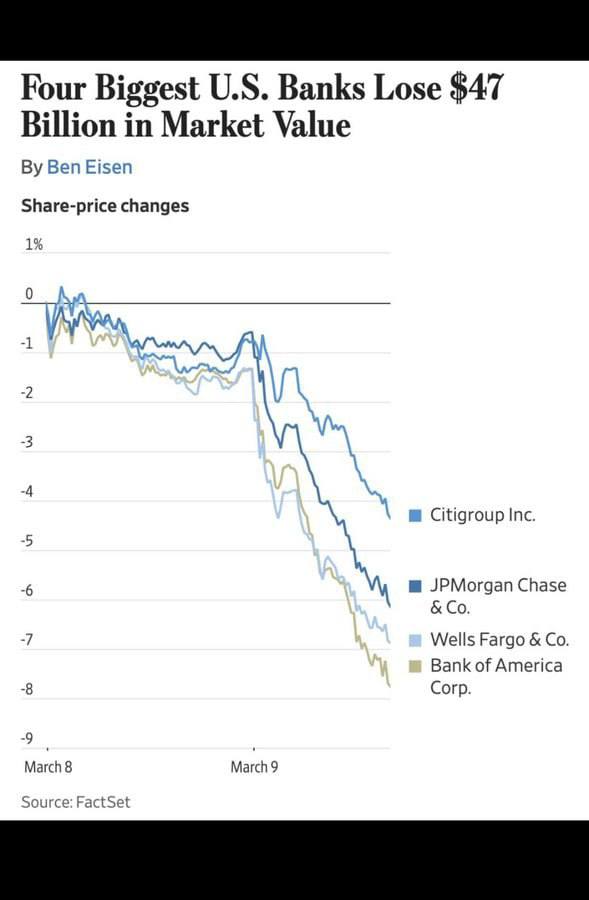
On March 10, we witnessed the biggest bank collapse since the 2008 Financial Crisis.
That’s when regulators shut down Silicon Valley Bank (SVB) after deposit outflows and a failed capital raise plunged the institution into crisis.
SVB was the 16th-largest bank in the nation, with $209 billion in assets. It’s the largest bank to fail since Seattle’s Washington Mutual during the height of the 2008 Financial Crisis. And behind Washington Mutual, it’s the second largest bank failure in U.S. history.
As of the end of December, SVB had roughly $209 billion in total assets and $175.4 billion in total deposits.
SVB was a major bank for venture-backed companies like the ones we own in Palm Beach Venture.
These types of companies were already under pressure due to higher interest rates and a slowdown for initial public offerings that made it more difficult to raise additional cash.
For many companies banking with SVB, it will take time before they can access any funds above the federally-insured $250,000 that they held with the bank. In the near term, that could cause them to miss payrolls and accounts payables.
That’s when regulators shut down Silicon Valley Bank (SVB) after deposit outflows and a failed capital raise plunged the institution into crisis.
SVB was the 16th-largest bank in the nation, with $209 billion in assets. It’s the largest bank to fail since Seattle’s Washington Mutual during the height of the 2008 Financial Crisis. And behind Washington Mutual, it’s the second largest bank failure in U.S. history.
As of the end of December, SVB had roughly $209 billion in total assets and $175.4 billion in total deposits.
SVB was a major bank for venture-backed companies like the ones we own in Palm Beach Venture.
These types of companies were already under pressure due to higher interest rates and a slowdown for initial public offerings that made it more difficult to raise additional cash.
For many companies banking with SVB, it will take time before they can access any funds above the federally-insured $250,000 that they held with the bank. In the near term, that could cause them to miss payrolls and accounts payables.
Some SVB customers beat the rush and withdrew funds earlier this week… while many others decided a complete collapse of SVB seemed unlikely. Hindsight is 20/20 but rushing to withdrawal proved to be correct.
I reached out to the private companies in our Venture portfolio to see if they had any exposure to SVB. And several of them replied before publication time.
Fortunately, none of them had any major exposure to SVB.
In fact, moments after SVB announced it was shutting its doors, cloud-based security provider Cloudastructure responded to us and let us know it banks with JPMorgan.
Paladin Power, a maker of home energy storage solutions, also quickly responded to let us know it has no exposure to SVB.
Crowdfunding data platform KingsCrowd had minimal prior exposure in its venture fund... but it was able to withdraw its assets before the bank announced its closure.
3D printer maker R3 Printing banked with SVB back in 2019… but ended that relationship the same year and is currently with Chase bank.
Neither Tropical Racing nor Coin and Card Auctions (CCA) had any exposure. In fact, CCA chose the crowdfunding path to avoid VCs and banks like SVB.
I reached out to the private companies in our Venture portfolio to see if they had any exposure to SVB. And several of them replied before publication time.
Fortunately, none of them had any major exposure to SVB.
In fact, moments after SVB announced it was shutting its doors, cloud-based security provider Cloudastructure responded to us and let us know it banks with JPMorgan.
Paladin Power, a maker of home energy storage solutions, also quickly responded to let us know it has no exposure to SVB.
Crowdfunding data platform KingsCrowd had minimal prior exposure in its venture fund... but it was able to withdraw its assets before the bank announced its closure.
3D printer maker R3 Printing banked with SVB back in 2019… but ended that relationship the same year and is currently with Chase bank.
Neither Tropical Racing nor Coin and Card Auctions (CCA) had any exposure. In fact, CCA chose the crowdfunding path to avoid VCs and banks like SVB.
We’ll continue updating as we hear back from executives.
Another good sign: SVB hasn’t been a name we’ve heard from our network as a go-to funder or custodian of funds.
To be clear: This isn’t a scenario like we saw during the 2008-09 Great Financial Crisis. However, we do anticipate SVB’s collapse will affect more than a handful of start ups and a fair number of VCs.
Ironically, there may be some great opportunities for us this year as this situation unwinds. Some quality companies will turn to Reg. A+ or Reg. CF offerings to fill gaps in their capital needs and they may be forced to do so at very attractive valuations.
Additionally, some companies will sell debt for pennies on the dollar, allowing smart operators to buy quality assets at a deep discount.
That’s similar to what the founders of Sky Quarry did less than two years ago when it purchased its refinery for pennies on the dollar.
Another good sign: SVB hasn’t been a name we’ve heard from our network as a go-to funder or custodian of funds.
To be clear: This isn’t a scenario like we saw during the 2008-09 Great Financial Crisis. However, we do anticipate SVB’s collapse will affect more than a handful of start ups and a fair number of VCs.
Ironically, there may be some great opportunities for us this year as this situation unwinds. Some quality companies will turn to Reg. A+ or Reg. CF offerings to fill gaps in their capital needs and they may be forced to do so at very attractive valuations.
Additionally, some companies will sell debt for pennies on the dollar, allowing smart operators to buy quality assets at a deep discount.
That’s similar to what the founders of Sky Quarry did less than two years ago when it purchased its refinery for pennies on the dollar.
This news is also a great reminder of how quickly the landscape can change in private markets as well as the importance of deep due diligence and risk management.
Remember, private deals aren’t listed on a public exchange, so we are unable to use stop losses. Similarly, small-cap stocks can be illiquid and are highly volatile, so we won’t use stop-losses in our small-cap portfolio either.
To mitigate risk, we instead use risk-adjusted position sizes. That means we place a set, uniform amount of capital in each recommendation. We don’t go all-in on any single trade.
Each private deal raise is different. For smaller investors, we recommend no more than the minimum amount required to invest in the deal.
Remember, private deals aren’t listed on a public exchange, so we are unable to use stop losses. Similarly, small-cap stocks can be illiquid and are highly volatile, so we won’t use stop-losses in our small-cap portfolio either.
To mitigate risk, we instead use risk-adjusted position sizes. That means we place a set, uniform amount of capital in each recommendation. We don’t go all-in on any single trade.
Each private deal raise is different. For smaller investors, we recommend no more than the minimum amount required to invest in the deal.
----------------------------------------
Today, we witnessed the collapse of Silicon Valley Bank, one of the nation’s largest banks. The markets reacted violently to this news.
Friends, I’m going to tell you right from the outset: You’ll see a lot of crazy headlines saying crypto was behind this bank run.
In today’s special video update, I’ll give you some perspective as to what’s actually going on in the markets.
Much of the negative price action we’re seeing in crypto and bitcoin really has nothing to do with the fundamentals of the underlying asset.
I’ll tell you the key metric I’m looking at when it comes to crypto… and why that number means this is an opportunistic sell-off.
Friends, I’m going to tell you right from the outset: You’ll see a lot of crazy headlines saying crypto was behind this bank run.
In today’s special video update, I’ll give you some perspective as to what’s actually going on in the markets.
Much of the negative price action we’re seeing in crypto and bitcoin really has nothing to do with the fundamentals of the underlying asset.
I’ll tell you the key metric I’m looking at when it comes to crypto… and why that number means this is an opportunistic sell-off.
-----------------------------------------
zítra sem dám přepis toho videa co dnes bude na Palm Beach
-------------------------------------------------------------
👍 5
💯 2
Bugsy
11.03.2023 23:19
Bugsy
12.03.2023 22:48

KryptoVláďa
12.03.2023 22:51
dlasi banka trhy se zelenaj 😄 blazinec
😂 1
Bugsy
12.03.2023 22:53
objem nerealizovaných nesplácených aktiv v bankovním systému USA činí 620 miliard USD.
V důsledku toho vyvolal pád banky Silicon Valley Bank minulý týden mezi investory záchvat paniky, protože upozornil na větší problém v bankovním sektoru: prohlubující se rozdíl mezi hodnotou, kterou velcí věřitelé přisuzují svým dluhopisům, a jejich skutečnou hodnotou na burze.
Pád SVB byl částečně způsoben poklesem hodnoty dluhopisů, které banka nakoupila v době konjunktury, kdy měla hodně klientských vkladů a potřebovala někde držet hotovost.
SVB však není jedinou institucí s tímto problémem. Podle Federální korporace pro pojištění vkladů (Federal Deposit Insurance Corporation) měly americké banky na konci roku 2022 aktiva s nerealizovanou ztrátou ve výši 620 miliard dolarů.
V důsledku toho vyvolal pád banky Silicon Valley Bank minulý týden mezi investory záchvat paniky, protože upozornil na větší problém v bankovním sektoru: prohlubující se rozdíl mezi hodnotou, kterou velcí věřitelé přisuzují svým dluhopisům, a jejich skutečnou hodnotou na burze.
Pád SVB byl částečně způsoben poklesem hodnoty dluhopisů, které banka nakoupila v době konjunktury, kdy měla hodně klientských vkladů a potřebovala někde držet hotovost.
SVB však není jedinou institucí s tímto problémem. Podle Federální korporace pro pojištění vkladů (Federal Deposit Insurance Corporation) měly americké banky na konci roku 2022 aktiva s nerealizovanou ztrátou ve výši 620 miliard dolarů.
Bugsy
12.03.2023 23:11
-------
Generální ředitel SVB prodal akcie za 3,6 milionu dolarů několik dní před krachem banky
-------
KryptoVláďa
12.03.2023 23:12
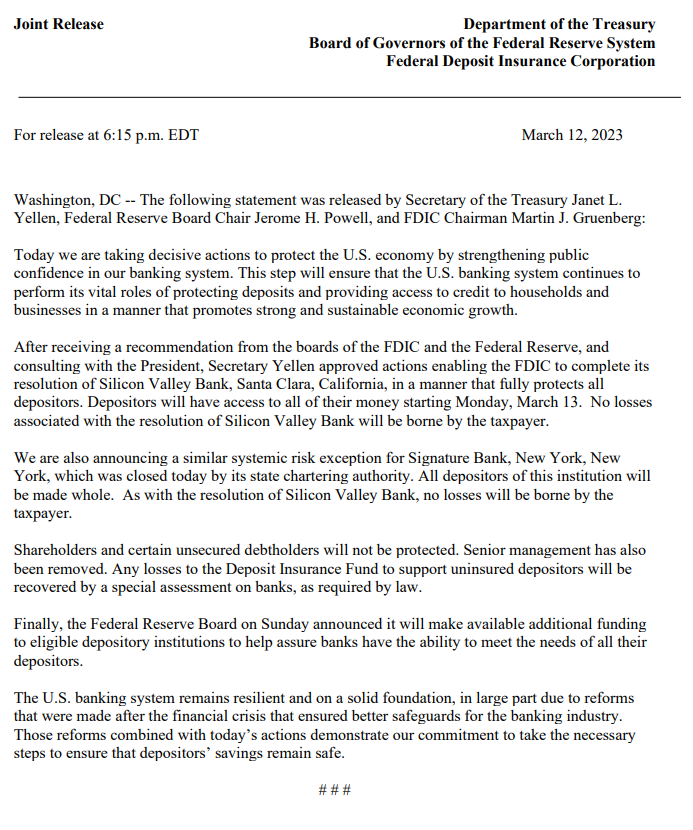
Fed will make available additional funding to eligible depository institutions
Fed prepared to use its full range of tools to support households and businesses
Fed prepared to use its full range of tools to support households and businesses
Bugsy
12.03.2023 23:15
↩
@KryptoVláďa
Fed will make available additional funding to eligible depository institutions
Fed prepared to use its full range of tools to support households and businesses
Fed prepared to use its full range of tools to support households and businesses
uvidíme komu pomužou a koho nechají padnout 👍
Bugsy
12.03.2023 23:26
EXCLUSIVE: Fed Steps In To Save Depositors Following SVB Failure; Is The Time To Buy Shares Of Regional Banks?
Share with others
This article was originally published on Friday, however it has been updated in light of recent announcements.
The Federal Reserve on Sunday announced that it will provide additional funding to eligible depository institutions to help them meet the needs of all their depositors, a move that will backstop depositors and protect financial institutions, including SVB Financial Group (NYSE:SIVB), and New York-based Signature Bank (NYSE:SBNY).
Regulators approved the additional funding through the creation of a new Bank Term Funding Program (BTFP), offering loans of up to one year in length to banks, and other eligible depository institutions pledging U.S. Treasuries, agency debt and mortgage-backed securities, and other qualifying assets as collateral.
Share with others
This article was originally published on Friday, however it has been updated in light of recent announcements.
The Federal Reserve on Sunday announced that it will provide additional funding to eligible depository institutions to help them meet the needs of all their depositors, a move that will backstop depositors and protect financial institutions, including SVB Financial Group (NYSE:SIVB), and New York-based Signature Bank (NYSE:SBNY).
Regulators approved the additional funding through the creation of a new Bank Term Funding Program (BTFP), offering loans of up to one year in length to banks, and other eligible depository institutions pledging U.S. Treasuries, agency debt and mortgage-backed securities, and other qualifying assets as collateral.
So, with the Fed stepping in to provide safegaurds to depositors, is it time to buy the recently beaten down shares of regional banks? Tim Melvin thinks so.
Silicon Valley Bank's focus on the venture capital industry was its downfall, Melvin, a regional bank trader, said on "Benzinga Live" Friday.
Silicon Valley Bank has been closed by the California Department of Financial Protection and Innovation and the Federal Deposit Insurance Corporation (FDIC) has been appointed as the bank's receiver.
SVB's parent company, SVB Financial Group (NASDAQ:SIVB), failed to raise enough cash to sustain operations, and the bank was closed by the California Department of Financial Protection Friday and taken over by the Federal Deposit Insurance Corp.
The companies most affected by SVB's collapse are venture capital-funded companies, especially in the tech startup space, Melvin said.
Silicon Valley Bank's focus on the venture capital industry was its downfall, Melvin, a regional bank trader, said on "Benzinga Live" Friday.
Silicon Valley Bank has been closed by the California Department of Financial Protection and Innovation and the Federal Deposit Insurance Corporation (FDIC) has been appointed as the bank's receiver.
SVB's parent company, SVB Financial Group (NASDAQ:SIVB), failed to raise enough cash to sustain operations, and the bank was closed by the California Department of Financial Protection Friday and taken over by the Federal Deposit Insurance Corp.
The companies most affected by SVB's collapse are venture capital-funded companies, especially in the tech startup space, Melvin said.
The FDIC will manage the bank's assets, securities and loans to recover as much as possible for depositors, who Melvin said will come first, while shareholders, bondholders and preferential investors are still up in the air.
The regional bank expert said expects that depositors will get all or most of their money back, although it will take some time.
In his view, SVB should have halted deposits for a few days to calm the run on the bank instead of letting it turn into total failure, adding that the bank put too much money into its securities portfolio.
Other regional banks like Western Alliance Bancorporation (NYSE:WAL) and PacWest Bancorp (NASDAQ:PACW), whose shares have dropped significantly, may not suffer the same fate as SVB, as they do not rely heavily on venture capital relationships, Melvin said.
The regional bank expert said expects that depositors will get all or most of their money back, although it will take some time.
In his view, SVB should have halted deposits for a few days to calm the run on the bank instead of letting it turn into total failure, adding that the bank put too much money into its securities portfolio.
Other regional banks like Western Alliance Bancorporation (NYSE:WAL) and PacWest Bancorp (NASDAQ:PACW), whose shares have dropped significantly, may not suffer the same fate as SVB, as they do not rely heavily on venture capital relationships, Melvin said.
Melvin On What Happens Now: Early stage venture capital funding has dried up for the affected companies, and if they had money in SVB, they're eligible to receive $250,000 under FDIC rules. Those funds could come as early as Monday, he said.
Melvin said that unlike SVB, which serviced early stage venture funds, Western and PacWest mostly cater to late-stage funds, so while there could be a temptation to bail out a fund if necessary, it would not represent the bulk of deposits at either of the banks.
Melvin said he considers the SVB issue an interesting situation that we will be studying for a long time due to how quickly it occurred -- and the fact that it probably did not have to happen.
The market was the root of the problem, in Melvin's view, as it marked everything on a quarterly basis, which led to freezing withdrawals and a flood of deposit requests the bank could not handle.
Melvin said that unlike SVB, which serviced early stage venture funds, Western and PacWest mostly cater to late-stage funds, so while there could be a temptation to bail out a fund if necessary, it would not represent the bulk of deposits at either of the banks.
Melvin said he considers the SVB issue an interesting situation that we will be studying for a long time due to how quickly it occurred -- and the fact that it probably did not have to happen.
The market was the root of the problem, in Melvin's view, as it marked everything on a quarterly basis, which led to freezing withdrawals and a flood of deposit requests the bank could not handle.
Fear can lead to fear, he told Benzinga. The deposit demand from venture capital and crypto should not be replicated across other industries around the country, but a bank run cannot be completely ruled out, Melvin said.
Melvin's 5 Bank Trade Ideas: Melvin named five regional banks that are currently trading under book value that could present themselves as opportunities for investors in the near future:
HomeStreet Inc (NASDAQ:HMST)
TFS Financial Corporation (NASDAQ:TFSL)
LCNB Corp. (NASDAQ:LCNB)
New York Community Bancorp, Inc. (NYSE:NYCB)
Horizon Bancorp Inc (NASDAQ:HBNC)
Melvin's 5 Bank Trade Ideas: Melvin named five regional banks that are currently trading under book value that could present themselves as opportunities for investors in the near future:
HomeStreet Inc (NASDAQ:HMST)
TFS Financial Corporation (NASDAQ:TFSL)
LCNB Corp. (NASDAQ:LCNB)
New York Community Bancorp, Inc. (NYSE:NYCB)
Horizon Bancorp Inc (NASDAQ:HBNC)
Bugsy
13.03.2023 19:28
Today, we want to give you an update on Silicon Valley Bank (SVB) and its impact on USDC, the dollar-backed stablecoin issued by Circle.
Last week, SVB experienced a bank run. And on March 10, regulators closed the bank.
It started last Wednesday when SVB made the surprising announcement that it needed to raise $2.25 billion to shore up its balance sheet.
The culprit was poor management of duration risk.
The bank had too much capital locked up in long-term investments. So, when it wasn’t able to meet withdrawal demands, it had to sell those investments for a $1.8 billion loss.
On top of that, once the news was out, depositors rushed to the exits, exacerbating the situation.
Last week, SVB experienced a bank run. And on March 10, regulators closed the bank.
It started last Wednesday when SVB made the surprising announcement that it needed to raise $2.25 billion to shore up its balance sheet.
The culprit was poor management of duration risk.
The bank had too much capital locked up in long-term investments. So, when it wasn’t able to meet withdrawal demands, it had to sell those investments for a $1.8 billion loss.
On top of that, once the news was out, depositors rushed to the exits, exacerbating the situation.
As a result, the California Department of Financial Protection and Innovation closed the bank. And it appointed the Federal Deposit Insurance Corp. (FDIC) as its receiver.
The news impacted Circle and USDC. Circle held $3.3 billion in cash reserves with SVB. Those funds represent roughly 8% of USDC’s $40 billion in reserves.
Investors feared the fallout from SVB would impact Circle’s ability to meet redemption requests. And centralized exchanges such as Coinbase and Binance temporarily paused USDC to U.S. dollar conversion.
As a result, USDC temporarily lost its peg to the dollar, falling to a low of $0.87.
On Saturday, Circle issued a statement that operations would resume as normal when banks open on Monday. It went on to say it would stand behind USDC and cover any shortfall using corporate resources.
The announcement helped USDC recover to roughly $0.97.
The news impacted Circle and USDC. Circle held $3.3 billion in cash reserves with SVB. Those funds represent roughly 8% of USDC’s $40 billion in reserves.
Investors feared the fallout from SVB would impact Circle’s ability to meet redemption requests. And centralized exchanges such as Coinbase and Binance temporarily paused USDC to U.S. dollar conversion.
As a result, USDC temporarily lost its peg to the dollar, falling to a low of $0.87.
On Saturday, Circle issued a statement that operations would resume as normal when banks open on Monday. It went on to say it would stand behind USDC and cover any shortfall using corporate resources.
The announcement helped USDC recover to roughly $0.97.
Then Sunday evening, the Treasury Department, Federal Reserve, and FDIC issued a joint statement that actions had been taken to protect all depositors. And depositors would have access to their money starting on Monday.
With that news, the peg has now been restored on USDC.
The events of the weekend may have you recalling UST, the algorithmic stablecoin of the Terra ecosystem that went to near $0 in May 2022. However, the USDC situation is vastly different from UST.
USDC is a well-regulated stablecoin backed by traditional U.S. financial institutions such as BNY Mellon and BlackRock.
Further, Circle is regulated in the U.S. by the Financial Crimes Enforcement Network (FinCEN) as a money service business. FinCEN is a bureau of the Treasury Department.
And USDC is 100% backed by cash and U.S. Treasuries.
With that news, the peg has now been restored on USDC.
The events of the weekend may have you recalling UST, the algorithmic stablecoin of the Terra ecosystem that went to near $0 in May 2022. However, the USDC situation is vastly different from UST.
USDC is a well-regulated stablecoin backed by traditional U.S. financial institutions such as BNY Mellon and BlackRock.
Further, Circle is regulated in the U.S. by the Financial Crimes Enforcement Network (FinCEN) as a money service business. FinCEN is a bureau of the Treasury Department.
And USDC is 100% backed by cash and U.S. Treasuries.
UST, on the other hand, wasn’t regulated. It was only partially backed by riskier cryptocurrencies. And its algorithm failed in a high-stress situation.
Even if the government didn’t step in, we believe USDC would have been able to recover.
As it were, Circle had withdrawn its funds from SVB prior to regulators taking it over. Based on past precedent, it’s likely that withdrawal would have been honored, making Circle whole.
Even if that didn’t happen, it’s estimated Circle would be able to recover 94% of its funds. And the shortfall – estimated at around $200 million – could be covered from interest from Circle’s Treasury positions.
This brings up the issue of whether this is a crypto problem or not. And it’s not.
Even if the government didn’t step in, we believe USDC would have been able to recover.
As it were, Circle had withdrawn its funds from SVB prior to regulators taking it over. Based on past precedent, it’s likely that withdrawal would have been honored, making Circle whole.
Even if that didn’t happen, it’s estimated Circle would be able to recover 94% of its funds. And the shortfall – estimated at around $200 million – could be covered from interest from Circle’s Treasury positions.
This brings up the issue of whether this is a crypto problem or not. And it’s not.
While some are positioning this as a problem with stablecoins, the more accurate view is that a regulated bank threatened the stability of stablecoins.
The issues stemmed from a regulated bank. And they were made worse by these centralized institutions being closed on the weekend.
We’ll continue to use stablecoins such as USDC and DAI when needed in Palm Beach Crypto Income.
Overall, this is a reminder that investing in cryptocurrency markets is volatile and risky.
That’s why we stress our risk management so often.
The issues stemmed from a regulated bank. And they were made worse by these centralized institutions being closed on the weekend.
We’ll continue to use stablecoins such as USDC and DAI when needed in Palm Beach Crypto Income.
Overall, this is a reminder that investing in cryptocurrency markets is volatile and risky.
That’s why we stress our risk management so often.
As a reminder, to mitigate risk, we use risk-adjusted position sizes. Since we take a venture capital approach to investing in crypto, we place a set, uniform amount of capital in each recommendation on any single trade.
Bugsy
16.03.2023 18:05
🤮Fed’s Loans Will Provide $2 Trillion of Liquidity
Bugsy
02.06.2023 09:43
----
The International Regulatory Landscape
It’s a very big day for Hong Kong. Its Securities and Futures Commission approved rules for retail trading crypto starting today, June 1. And you also have major platforms that are starting to apply for licenses now.
In the second half of 2023, we should expect to see retail trading in Hong Kong start to take place.
Why is that exciting news?
It's pretty big news because Hong Kong wants to become a global Web3 hub. And when you look at the Chinese economy, there's roughly $20 trillion in investable assets. So it's a big opportunity for crypto.
The other thing is it possibly opens the door for trading again in mainland China. It banned crypto in September 2021. And a lot of people think Hong Kong is the testing ground and gateway to possibly reintroducing crypto back to China.
In fact, China released its own white paper on Web3 on May 27. So the timing has people wondering if, in fact, crypto will come back to China. That's something we'll be watching for.
Moving on to Europe, the finance ministers approved MiCA, which stands for the Markets in Crypto Assets Regulation.
It’s a very big day for Hong Kong. Its Securities and Futures Commission approved rules for retail trading crypto starting today, June 1. And you also have major platforms that are starting to apply for licenses now.
In the second half of 2023, we should expect to see retail trading in Hong Kong start to take place.
Why is that exciting news?
It's pretty big news because Hong Kong wants to become a global Web3 hub. And when you look at the Chinese economy, there's roughly $20 trillion in investable assets. So it's a big opportunity for crypto.
The other thing is it possibly opens the door for trading again in mainland China. It banned crypto in September 2021. And a lot of people think Hong Kong is the testing ground and gateway to possibly reintroducing crypto back to China.
In fact, China released its own white paper on Web3 on May 27. So the timing has people wondering if, in fact, crypto will come back to China. That's something we'll be watching for.
Moving on to Europe, the finance ministers approved MiCA, which stands for the Markets in Crypto Assets Regulation.
It provides guidelines for cryptocurrency exchanges and wallet providers. But even though it's been approved, it won't actually take effect until July 2024.
This gives a framework for the whole European Union and the 27 countries within the European Union. That's one of the big benefits – the unified framework.
Not only that, it could be a template for other countries. In fact, SEC Commissioner Hester Peirce said MiCA should serve as an example for the U.S.
Moving beyond Europe, you also have Dubai. In March of 2022, it established its Virtual Assets Regulatory Authority (VARA). In February this year, it enacted its regulations. So it's become a very crypto friendly hub.
In fact, crypto exchange Bybit actually moved its headquarters there.
Also in that area, I know the UAE and Bahrain have also been pro-crypto.
In the UK, things are a little bit more uncertain there. But it too wants to become a global crypto asset technology hub.
In February this year, it released the outline for its plans. It’s largely going to follow its Financial Services and Markets Act 2000. So it’s going to follow its framework and hopefully make some changes that address crypto.
It’s in its comment phase. Firms like a16z and Polygon have contributed comments to the UK. Overall, the crypto community is feeling very positive toward the UK and believes it could become a good area for crypto companies.
This gives a framework for the whole European Union and the 27 countries within the European Union. That's one of the big benefits – the unified framework.
Not only that, it could be a template for other countries. In fact, SEC Commissioner Hester Peirce said MiCA should serve as an example for the U.S.
Moving beyond Europe, you also have Dubai. In March of 2022, it established its Virtual Assets Regulatory Authority (VARA). In February this year, it enacted its regulations. So it's become a very crypto friendly hub.
In fact, crypto exchange Bybit actually moved its headquarters there.
Also in that area, I know the UAE and Bahrain have also been pro-crypto.
In the UK, things are a little bit more uncertain there. But it too wants to become a global crypto asset technology hub.
In February this year, it released the outline for its plans. It’s largely going to follow its Financial Services and Markets Act 2000. So it’s going to follow its framework and hopefully make some changes that address crypto.
It’s in its comment phase. Firms like a16z and Polygon have contributed comments to the UK. Overall, the crypto community is feeling very positive toward the UK and believes it could become a good area for crypto companies.
---
Bugsy
06.06.2023 21:14
6.6.2023
What’s Going on With the SEC and Crypto?
SEC Chair Gary Gensler has pulled out his six-gun and is playing sheriff very late in the game. And he's going after people he really shouldn't be going after.
Yesterday, we saw this more than 130-page complaint against Binance. I haven't gone through all of it. I've skimmed through it.
And then today, he went after Coinbase saying the way it’s structured means it should be a broker dealer. Of course, they have a very different point of view on this.
We've seen prices come in a little bit. I'm looking at bitcoin trading at $25,000 and change and ETH trading at $1,800 and change. Really, the alt coins have been hit harder. The SEC came out and listed a number of coins saying that it thinks they're securities.
We own some of those coins. We don't really see an issue. We can easily trade them, either through DEXs or through the current exchanges that we have access to now.
And this is the bigger point I want to get to. China tried a similar way – this heavy-handed, broad-brush stroke − at adding regulation to crypto. And everybody just started using a VPN and trading crypto regardless.
What’s going to happen if Gensler keeps pushing the way that he's pushing is our entire crypto ecosystem of companies that support crypto are just going to move offshore.
SEC Chair Gary Gensler has pulled out his six-gun and is playing sheriff very late in the game. And he's going after people he really shouldn't be going after.
Yesterday, we saw this more than 130-page complaint against Binance. I haven't gone through all of it. I've skimmed through it.
And then today, he went after Coinbase saying the way it’s structured means it should be a broker dealer. Of course, they have a very different point of view on this.
We've seen prices come in a little bit. I'm looking at bitcoin trading at $25,000 and change and ETH trading at $1,800 and change. Really, the alt coins have been hit harder. The SEC came out and listed a number of coins saying that it thinks they're securities.
We own some of those coins. We don't really see an issue. We can easily trade them, either through DEXs or through the current exchanges that we have access to now.
And this is the bigger point I want to get to. China tried a similar way – this heavy-handed, broad-brush stroke − at adding regulation to crypto. And everybody just started using a VPN and trading crypto regardless.
What’s going to happen if Gensler keeps pushing the way that he's pushing is our entire crypto ecosystem of companies that support crypto are just going to move offshore.
💯 2
American investors and traders are going to go on the internet and Google, “How do I trade on a foreign exchange?” They're going to learn about VPNs the same way the Chinese did.
And you're just going to have a whole host of American traders using VPNs to access things like Binance.
The way Gensler is going about this is unenforceable for crypto in general. Because of its decentralized nature, because you're dealing with software, and because you're dealing with peer-to-peer, it's almost impossible to regulate in a very heavy-handed way. And Gensler's discovering that.
I think we've got to ask, “How much pressure does this put on a crypto market? Does this kill crypto? Is this the death blow that everybody's been scared about ever since I've been in crypto in 2016?”
And you're just going to have a whole host of American traders using VPNs to access things like Binance.
The way Gensler is going about this is unenforceable for crypto in general. Because of its decentralized nature, because you're dealing with software, and because you're dealing with peer-to-peer, it's almost impossible to regulate in a very heavy-handed way. And Gensler's discovering that.
I think we've got to ask, “How much pressure does this put on a crypto market? Does this kill crypto? Is this the death blow that everybody's been scared about ever since I've been in crypto in 2016?”
And the answer is a resounding no.
Just like the Chinese, Gary Gensler is going to realize there's only so far you can go in terms of how much regulatory pressure you put on this sector… Especially going after people who are trying to be compliant to the best of their ability.
American-based exchanges like Coinbase, Kraken, or Gemini… to go after those guys is just another level of dumb.
Why don't you take those resources and go after the people who are promoting these blatantly garbage Ponzi scheme coins. Why are you going after these American companies that have done everything in their power to remain compliant?
It comes down to institutional laziness, low hanging fruit. It's a lot of work to go after international criminals. It's much easier to go after an organization based here in the United States.
I've got nothing nice to say about Gary Gensler. I'm sure he's a perfectly fine human being. But in terms of his approach to crypto: Come in and talk to us and let's work together… And then you do that, and he comes after you with violations?
Come on. How is that fostering an environment of cooperation and of growth of this asset class?
You're criminalizing the entire asset class by forcing it to go offshore, where regulation isn't as strong, where transparency isn't as strong… But the genie is out of the bottle. People want to trade crypto and there's nothing any government can do about it.
And again, because of the decentralized peer-to-peer nature of it, no government can stop it. Anybody can use a VPN and get access to any crypto trading desk they want to. It doesn't matter where the crypto trading desk is in the world.
So a lot of this is very hollow. A lot of this is very grandstanding.
I don't know if Gensler has a political career he's trying to get ready for… But he’s imperiling America's position as a preeminent leader in this space. And that's a huge mistake.
Just like the Chinese, Gary Gensler is going to realize there's only so far you can go in terms of how much regulatory pressure you put on this sector… Especially going after people who are trying to be compliant to the best of their ability.
American-based exchanges like Coinbase, Kraken, or Gemini… to go after those guys is just another level of dumb.
Why don't you take those resources and go after the people who are promoting these blatantly garbage Ponzi scheme coins. Why are you going after these American companies that have done everything in their power to remain compliant?
It comes down to institutional laziness, low hanging fruit. It's a lot of work to go after international criminals. It's much easier to go after an organization based here in the United States.
I've got nothing nice to say about Gary Gensler. I'm sure he's a perfectly fine human being. But in terms of his approach to crypto: Come in and talk to us and let's work together… And then you do that, and he comes after you with violations?
Come on. How is that fostering an environment of cooperation and of growth of this asset class?
You're criminalizing the entire asset class by forcing it to go offshore, where regulation isn't as strong, where transparency isn't as strong… But the genie is out of the bottle. People want to trade crypto and there's nothing any government can do about it.
And again, because of the decentralized peer-to-peer nature of it, no government can stop it. Anybody can use a VPN and get access to any crypto trading desk they want to. It doesn't matter where the crypto trading desk is in the world.
So a lot of this is very hollow. A lot of this is very grandstanding.
I don't know if Gensler has a political career he's trying to get ready for… But he’s imperiling America's position as a preeminent leader in this space. And that's a huge mistake.
..
This Is a Buying Opportunity
Now, for us as investors, to my mind and to my view, this is an incredible opportunity.
Now, I've talked about bear markets before. I have an event going on this Wednesday night, June 7 at 8 p.m. ET. There, I’m specifically talking about the weakness that's going on in the market and how to take advantage of it and a series of things that are occurring that are actually going to bring billions of people into crypto.
For my money, this is a buying opportunity.
What do you do here? Continue to dollar-cost average into the coins that you love, continue to dollar-cost average into BTC. If we could get $20,000–22,000 on bitcoin, I think that's an opportunistic level where you can put more capital to work.
If you have capital on the sidelines that you're saying, “I really want to wait for a bit more of a cathartic selloff, you can use that $20,000–22,000 level on BTC.
Now, for us as investors, to my mind and to my view, this is an incredible opportunity.
Now, I've talked about bear markets before. I have an event going on this Wednesday night, June 7 at 8 p.m. ET. There, I’m specifically talking about the weakness that's going on in the market and how to take advantage of it and a series of things that are occurring that are actually going to bring billions of people into crypto.
For my money, this is a buying opportunity.
What do you do here? Continue to dollar-cost average into the coins that you love, continue to dollar-cost average into BTC. If we could get $20,000–22,000 on bitcoin, I think that's an opportunistic level where you can put more capital to work.
If you have capital on the sidelines that you're saying, “I really want to wait for a bit more of a cathartic selloff, you can use that $20,000–22,000 level on BTC.
Same thing with Ethereum. Anywhere between $1,200–1,500… If you see the coin pull back into that price, that's a place where you can put opportunistic capital to work. And I think you'll do very well in a very short period of time.
Because again, both of these coins have been incredibly well-bid.
Yes, some of the smaller coins… their bids are always going to be weaker when you have so-called “bad news” hit the market. And that's a great buying opportunity for much more of your risk capital. We're going to be taking advantage of that across all my publications.
But in terms of BTC and ETH, when you want to put bigger money to work – what I call opportunistic capital – you need to wait for a little bit more selling.
So again, BTC, $20,000–22,000, you can put opportunistic capital to work. Ethereum, $1,200–1,500, you can do the same there. I don't know if we're going to see it. I'm waiting for it. I'd love to put a little bit more money to work here.
I believe the patience will pay off. So don't chase here. Let the game come to you. This is just another day in crypto. Do not let this man Gary Gensler take even one iota of your brain space.
The genie is out of the bottle, whether they like it or not. Crypto is here. Hundreds of millions of people are trading it. Soon, billions of people are going to be trading it. And the regulatory organizations are going to have to figure out how to give these guys a little bit of room.
Because again, both of these coins have been incredibly well-bid.
Yes, some of the smaller coins… their bids are always going to be weaker when you have so-called “bad news” hit the market. And that's a great buying opportunity for much more of your risk capital. We're going to be taking advantage of that across all my publications.
But in terms of BTC and ETH, when you want to put bigger money to work – what I call opportunistic capital – you need to wait for a little bit more selling.
So again, BTC, $20,000–22,000, you can put opportunistic capital to work. Ethereum, $1,200–1,500, you can do the same there. I don't know if we're going to see it. I'm waiting for it. I'd love to put a little bit more money to work here.
I believe the patience will pay off. So don't chase here. Let the game come to you. This is just another day in crypto. Do not let this man Gary Gensler take even one iota of your brain space.
The genie is out of the bottle, whether they like it or not. Crypto is here. Hundreds of millions of people are trading it. Soon, billions of people are going to be trading it. And the regulatory organizations are going to have to figure out how to give these guys a little bit of room.
..
You’ve Got to Follow Institutional Incentives
Now, one last piece I do want to point out is this does have a bit of a smell to it. Because when I looked through the complaint against Binance – again, I didn't read every line – one area of it really struck me. There was a two-to-three-year period when the SEC is claiming that Binance made $11.5 billion in gross profit. So those are 11.5 billion reasons for the SEC…
In my opinion, I believe the SEC is an enforcement group to protect this big boy racket of Wall Street. It doesn’t really take down big firms. It goes after smaller people, smaller firms, and it’s the last to actually root out real corruption.
Anyway, that said, it looks to me as if Gensler is trying to clear the decks and clear the way so the bigger firms can come in and they can start eating that $11.5 billion in fees.
So if Gensler comes in and says, “Oh no, Binance is no good, you shouldn't be using it... In fact, we're going to block you from using Binance. We're going to force you to use a VPN if you want to use Binance. And if you connect to Binance with any of your American bank accounts, you're going to lose your bank account…” This is a way for him to clear the way for American institutions to offer all types of trading, all types of services, and for them to get the fees.
Is that far-fetched? I don't think so. Can I prove it? I'll never be able to prove it. Nobody will be able to prove it, and it's just my opinion. So hold your horses Gary Gensler. Nobody's saying you're actually doing that. I'm just saying it looks smelly, it looks dirty.
Now, one last piece I do want to point out is this does have a bit of a smell to it. Because when I looked through the complaint against Binance – again, I didn't read every line – one area of it really struck me. There was a two-to-three-year period when the SEC is claiming that Binance made $11.5 billion in gross profit. So those are 11.5 billion reasons for the SEC…
In my opinion, I believe the SEC is an enforcement group to protect this big boy racket of Wall Street. It doesn’t really take down big firms. It goes after smaller people, smaller firms, and it’s the last to actually root out real corruption.
Anyway, that said, it looks to me as if Gensler is trying to clear the decks and clear the way so the bigger firms can come in and they can start eating that $11.5 billion in fees.
So if Gensler comes in and says, “Oh no, Binance is no good, you shouldn't be using it... In fact, we're going to block you from using Binance. We're going to force you to use a VPN if you want to use Binance. And if you connect to Binance with any of your American bank accounts, you're going to lose your bank account…” This is a way for him to clear the way for American institutions to offer all types of trading, all types of services, and for them to get the fees.
Is that far-fetched? I don't think so. Can I prove it? I'll never be able to prove it. Nobody will be able to prove it, and it's just my opinion. So hold your horses Gary Gensler. Nobody's saying you're actually doing that. I'm just saying it looks smelly, it looks dirty.
If, after all these years, now you're coming out with these complaints... At the same point in time, every major American institution is beginning to offer access to bitcoin and Ethereum to all of their clients... How long before they'll have full trading platforms where they'll have access to offer all of these “security tokens,” which they're not? American companies will essentially have the monopoly on that trading.
We're not that far away from that.
Friends, you’ve got to follow the money and you’ve got to follow the incentives. And these incentives stink to high heaven.
What it looks to me is an early shot to clear the path for the industrialization of American institutions coming into this space and offering trading on every other coin that Binance offers trading on.
Why?
Because of the money. They want the money – the billions and billions of fees. And not only the billions in fees that Binance currently makes, but the hundreds of billions in fees that will be made in this space over the next several years as billions of people come into this space.
Who do you think wants to dominate that? The American industrial system. I'm talking about the Wall Street system.
They want to own it, lock, stock, and barrel. They're going to do their best to do that. It's going to be a process.
In terms of driving greater adoption, it's great for us. More people buy bitcoin. More people buy ETH. More people buy the alt coins. It's very good for us because we're in early.
Companies like Binance are going to have a tough time in terms of dealing with the American government. But Binance does not have a set location anywhere in the world. Everything they do is software based and you can't shut down the entire internet.
So I don't think Binance is being shut down anytime soon. Coinbase has both the political muscle and the financial muscle to fight Gensler. And I think they'll ultimately prevail. But it's going to be a long, drawn-out process.
For us as investors, what do we do? We take advantage of any weakness that comes into the market to add to our favorite positions and get involved opportunistically in bitcoin, should we see this selloff accelerate − which it may or may not. That remains to be seen.
Friends, you’ve got to follow the money and you’ve got to follow the incentives. And these incentives stink to high heaven.
What it looks to me is an early shot to clear the path for the industrialization of American institutions coming into this space and offering trading on every other coin that Binance offers trading on.
Why?
Because of the money. They want the money – the billions and billions of fees. And not only the billions in fees that Binance currently makes, but the hundreds of billions in fees that will be made in this space over the next several years as billions of people come into this space.
Who do you think wants to dominate that? The American industrial system. I'm talking about the Wall Street system.
They want to own it, lock, stock, and barrel. They're going to do their best to do that. It's going to be a process.
In terms of driving greater adoption, it's great for us. More people buy bitcoin. More people buy ETH. More people buy the alt coins. It's very good for us because we're in early.
Companies like Binance are going to have a tough time in terms of dealing with the American government. But Binance does not have a set location anywhere in the world. Everything they do is software based and you can't shut down the entire internet.
So I don't think Binance is being shut down anytime soon. Coinbase has both the political muscle and the financial muscle to fight Gensler. And I think they'll ultimately prevail. But it's going to be a long, drawn-out process.
For us as investors, what do we do? We take advantage of any weakness that comes into the market to add to our favorite positions and get involved opportunistically in bitcoin, should we see this selloff accelerate − which it may or may not. That remains to be seen.
💪 3
Bugsy
07.06.2023 16:25
---
Action to Take: Remove funds from Binance.US.
Today, we’re recommending readers remove their funds from Binance.US.
Yesterday, the Securities and Exchange Commission (SEC) asked a federal court to freeze the assets of Binance’s U.S. subsidiary.
This follows Monday’s announcement that the SEC is suing Binance and its CEO, Changpeng Zhao (CZ), for U.S. securities violations.
While this freeze targets Binance.US’s assets and not customer funds, we want to take caution and remove any funds from the exchange.
Following the SEC’s motion, Binance.US said the platform will continue to operate as normal, and it will defend itself in court.
We’ll continue to use the Binance.US exchange when needed. But after trading in or out of any token, we highly recommend removing your funds to a self-custody wallet.
As always, we highly encourage using a hardware wallet to take self-custody of your assets. You can find more information on our recommended wallets for storing your crypto assets in our Crypto Corner.
If you feel taking self-custody of your assets isn’t right for you, we recommend transferring them to either Coinbase or Kraken. Both are U.S.-based companies.
Coinbase is a highly regulated exchange that’s audited by Deloitte & Touche, one of the Big Four accounting firms.
And Kraken uses proof-of-reserves, which is an independent audit that ensures it holds the assets it claims to on your behalf.
Yesterday, the Securities and Exchange Commission (SEC) asked a federal court to freeze the assets of Binance’s U.S. subsidiary.
This follows Monday’s announcement that the SEC is suing Binance and its CEO, Changpeng Zhao (CZ), for U.S. securities violations.
While this freeze targets Binance.US’s assets and not customer funds, we want to take caution and remove any funds from the exchange.
Following the SEC’s motion, Binance.US said the platform will continue to operate as normal, and it will defend itself in court.
We’ll continue to use the Binance.US exchange when needed. But after trading in or out of any token, we highly recommend removing your funds to a self-custody wallet.
As always, we highly encourage using a hardware wallet to take self-custody of your assets. You can find more information on our recommended wallets for storing your crypto assets in our Crypto Corner.
If you feel taking self-custody of your assets isn’t right for you, we recommend transferring them to either Coinbase or Kraken. Both are U.S.-based companies.
Coinbase is a highly regulated exchange that’s audited by Deloitte & Touche, one of the Big Four accounting firms.
And Kraken uses proof-of-reserves, which is an independent audit that ensures it holds the assets it claims to on your behalf.
Bugsy
08.06.2023 05:47
Bugsy
10.06.2023 10:06
Bugsy
19.06.2023 08:49
Bugsy
24.06.2023 20:42

🤣 7
Bugsy
27.06.2023 20:19
Izraelský ministr obrany Yoav Gallant uvedl, že Izrael před několika dny zabavil digitální peněženky napojené na íránské Islámské revoluční gardy a Hizballáh a zabavil miliony dolarů v kryptoměnách.
Bugsy
14.07.2023 20:29
I Believe the Bitcoin ETF Is a Done Deal
This is another reason why I believe that the bitcoin ETF, in my mind, is a done deal. There’s no way, in my opinion, that Gensler can stand in the way of it.
Sure, he can drag his feet, he can try and do something. But we pull back that camera… Now that we have Larry Fink in the ring who’s actively going on television and shilling bitcoin… Let’s just drink that in for a second. We have to say, “Everything points that this is going to get approved.”
So what does that mean?
Once that gets approved, it gives cover for all of Wall Street to offer bitcoin to their clients. And they now have a regulated way to do it. Of course, they’re going to spin up their own funds as well. They don’t want to give Larry Fink all the fees. But then, they’re going to do Ethereum and some other coins.
And I have a theory on which other coins they’re going to do after Ethereum. I’m working on that right now with Houston Molnar in an issue that we’re putting together that will answer all of that.
There are three opportunities there that I think are seriously undervalued relative to the amount of institutional capital that I believe will be moving into them once that first bitcoin ETF in the U.S. gets approved.
This is another reason why I believe that the bitcoin ETF, in my mind, is a done deal. There’s no way, in my opinion, that Gensler can stand in the way of it.
Sure, he can drag his feet, he can try and do something. But we pull back that camera… Now that we have Larry Fink in the ring who’s actively going on television and shilling bitcoin… Let’s just drink that in for a second. We have to say, “Everything points that this is going to get approved.”
So what does that mean?
Once that gets approved, it gives cover for all of Wall Street to offer bitcoin to their clients. And they now have a regulated way to do it. Of course, they’re going to spin up their own funds as well. They don’t want to give Larry Fink all the fees. But then, they’re going to do Ethereum and some other coins.
And I have a theory on which other coins they’re going to do after Ethereum. I’m working on that right now with Houston Molnar in an issue that we’re putting together that will answer all of that.
There are three opportunities there that I think are seriously undervalued relative to the amount of institutional capital that I believe will be moving into them once that first bitcoin ETF in the U.S. gets approved.
Now, that might happen a lot sooner than we think because I was just reading this story here. “Europe’s first spot bitcoin ETF eyes 2023 debut after year-long delay.”
Jacob Asset Management got approval from the Guernsey Financial Commission in October 2021 and was set to debut on Euronext in July 2022. However, unprecedented market conditions caused by the collapse, caused the delay.
So where does that leave us?
Now, the asset manager told The Financial Times that it has decided to launch the ETF now because it has seen a gradual shift in demand compared with 2022.
The asset manager told CoinTelegraph that it’s still assessing the launch and it will share a date soon.
So we’re looking at a situation where this European ETF is going to launch, and then the pressure’s going to be for the American ETF to launch.
Because what do you want to have… Just give up that whole market to the European banking system and the European financial markets?
Jacob Asset Management got approval from the Guernsey Financial Commission in October 2021 and was set to debut on Euronext in July 2022. However, unprecedented market conditions caused by the collapse, caused the delay.
So where does that leave us?
Now, the asset manager told The Financial Times that it has decided to launch the ETF now because it has seen a gradual shift in demand compared with 2022.
The asset manager told CoinTelegraph that it’s still assessing the launch and it will share a date soon.
So we’re looking at a situation where this European ETF is going to launch, and then the pressure’s going to be for the American ETF to launch.
Because what do you want to have… Just give up that whole market to the European banking system and the European financial markets?
Larry Fink will be using every favor he has to be the first person to offer a U.S. regulated bitcoin trust. And the reason is simple. He will make billions and billions in fees for his firm. Imagine the guy raises a hundred billion dollars in bitcoin and bitcoin 10xs by the end of the decade. I actually think it’ll 15x by the end of the decade. That’s $1.5 trillion. And the fees on that are staggering.
So this is a massive juicy opportunity for Wall Street. Just like I said back in 2017 and 2018, it’s institutional greed. What are we betting on? We’re betting on institutional Wall Street greed. And if you bet in the direction of Wall Street greed, you will always make money.
Now, with bitcoin, it’s not a straight line. Goodness knows, we’ve been up, we’ve been down, we’ve been all over the place. That’s the price to pay for making life-changing money.
There’s much more money to be made ahead in bitcoin, Ethereum, and the altcoins now that the SEC has been defeated by XRP.
Look, don’t think that the SEC is just going to roll over and die, and that’s it. It’s going to come back, come up with appeals, and go after other people. It’s still going to try to be an impediment to the adoption of this technology.
So this is a massive juicy opportunity for Wall Street. Just like I said back in 2017 and 2018, it’s institutional greed. What are we betting on? We’re betting on institutional Wall Street greed. And if you bet in the direction of Wall Street greed, you will always make money.
Now, with bitcoin, it’s not a straight line. Goodness knows, we’ve been up, we’ve been down, we’ve been all over the place. That’s the price to pay for making life-changing money.
There’s much more money to be made ahead in bitcoin, Ethereum, and the altcoins now that the SEC has been defeated by XRP.
Look, don’t think that the SEC is just going to roll over and die, and that’s it. It’s going to come back, come up with appeals, and go after other people. It’s still going to try to be an impediment to the adoption of this technology.
But [yesterday was] an important victory. And the fact that Larry Fink and the financial interests that he represents have been orange-pilled – meaning that they’ve certainly seen the greed behind bitcoin – means that for the first time, you and I, bitcoin HODLers and long-term crypto investors, have the establishment actually rowing in our direction.
That’s the first time that’s happened ever. It’s huge. The money that will be made from here will be truly insane. The next three years are going to be nuts.
That’s the first time that’s happened ever. It’s huge. The money that will be made from here will be truly insane. The next three years are going to be nuts.
--
The Beauty of Allocating From Income
So how do we play it? Well, here’s what I’m doing…
I have my life set up where I have my earned income, I have my passive income. So basically, what I’ve been doing with my passive income is I’ve been buying bitcoin and Ethereum. The passive income comes in… bitcoin and Ethereum.
What I was doing was just throwing it in bonds. But now that I know that this ETF is going to happen, to me, it’s a no-brainer. I buy bitcoin, I buy Ethereum.
And I’m buying them 50-50. Before I used to do 80% bitcoin, 20% ETH. But the more that I’ve been using the Ethereum ecosystem – I’ve been very active in NFTs over the last month or so – I always knew this, but it’s really experientially hit me how important Ethereum is to the whole Web3 ecosystem. It’s the currency that runs Web3.
And I realized I’ve been under-positioned in ETH so that’s what I’m doing. Every time one of those dividend checks come in, every time one of the checks come in from one of the properties I own or one of the other income investments I have…50% BTC, 50% ETH. And then right into the cold wallet.
So how do we play it? Well, here’s what I’m doing…
I have my life set up where I have my earned income, I have my passive income. So basically, what I’ve been doing with my passive income is I’ve been buying bitcoin and Ethereum. The passive income comes in… bitcoin and Ethereum.
What I was doing was just throwing it in bonds. But now that I know that this ETF is going to happen, to me, it’s a no-brainer. I buy bitcoin, I buy Ethereum.
And I’m buying them 50-50. Before I used to do 80% bitcoin, 20% ETH. But the more that I’ve been using the Ethereum ecosystem – I’ve been very active in NFTs over the last month or so – I always knew this, but it’s really experientially hit me how important Ethereum is to the whole Web3 ecosystem. It’s the currency that runs Web3.
And I realized I’ve been under-positioned in ETH so that’s what I’m doing. Every time one of those dividend checks come in, every time one of the checks come in from one of the properties I own or one of the other income investments I have…50% BTC, 50% ETH. And then right into the cold wallet.
I don’t believe I have to say this anymore, but I clearly do: self-custody. Please, self-custody. And if you can’t self-custody, use Coinbase. If Coinbase is good enough for BlackRock, it should be good enough for you.
The beauty of this asset is that you can self-custody. I realize that’s not for everyone. But if you really care about your financial privacy and security, you’ll take the time to learn how to self-custody.
And if that’s just something where you’re like, “Teeka, I just can’t deal with that,” then use Coinbase.
Coinbase has certainly received the “good housekeeping” seal of approval. And the fact that the XRP case has been blocked by the judge and thrown out means that the case against Coinbase by the SEC is much weaker than what it was even a year ago.
I would expect some type of either negotiated settlement or for the SEC to quietly drop those charges. But we’ll see how that works out.
The bottom line is these assets are not going to go up in a straight line. They never do unless we’re in a raging bull market. And even then, you can drop 50%.
The key here is don’t try to judge this asset based on its volatility. It’s going to always be volatile… Not always, but for a long time. And there’s nothing we can do about that.
The beauty of this asset is that you can self-custody. I realize that’s not for everyone. But if you really care about your financial privacy and security, you’ll take the time to learn how to self-custody.
And if that’s just something where you’re like, “Teeka, I just can’t deal with that,” then use Coinbase.
Coinbase has certainly received the “good housekeeping” seal of approval. And the fact that the XRP case has been blocked by the judge and thrown out means that the case against Coinbase by the SEC is much weaker than what it was even a year ago.
I would expect some type of either negotiated settlement or for the SEC to quietly drop those charges. But we’ll see how that works out.
The bottom line is these assets are not going to go up in a straight line. They never do unless we’re in a raging bull market. And even then, you can drop 50%.
The key here is don’t try to judge this asset based on its volatility. It’s going to always be volatile… Not always, but for a long time. And there’s nothing we can do about that.
What I want you to do is go back and remember the reasons why these things have value and why they will go up – specifically bitcoin. It’s got a hard cap, it’s scarce, you can hold it yourself, you can transfer value. But the biggest price driver is always adoption.
And adoption is going through the roof by the end of this decade, which is not that far away. Billions of people will own crypto. Billions and billions will own and trade crypto.
What are you going to do at the end of the decade? Are you going to look back and say, “Thank goodness I listened to that Indian cue ball and put some money away. And now we’re set…” Or are you going to say, “Oh my God, why didn’t I listen to that English, Brooklyn, New York ex-stockbroker and buy bitcoin and Ethereum?”
I want you to really understand how important a place in history we are in right now.
There will be a time – and it could happen very quickly – where these prices just won’t make sense anymore. Bitcoin will be $150,000, $200,000, $250,000. Ethereum will be over $10,000, $15,000. You’re just not going to have the ability to make enormous amounts of money. And even with the altcoins, at some point, just like in the equity market, you won’t be able to take $200 and turn it into half a million. You could still do that in crypto, but it’s not going to be that way forever.
And adoption is going through the roof by the end of this decade, which is not that far away. Billions of people will own crypto. Billions and billions will own and trade crypto.
What are you going to do at the end of the decade? Are you going to look back and say, “Thank goodness I listened to that Indian cue ball and put some money away. And now we’re set…” Or are you going to say, “Oh my God, why didn’t I listen to that English, Brooklyn, New York ex-stockbroker and buy bitcoin and Ethereum?”
I want you to really understand how important a place in history we are in right now.
There will be a time – and it could happen very quickly – where these prices just won’t make sense anymore. Bitcoin will be $150,000, $200,000, $250,000. Ethereum will be over $10,000, $15,000. You’re just not going to have the ability to make enormous amounts of money. And even with the altcoins, at some point, just like in the equity market, you won’t be able to take $200 and turn it into half a million. You could still do that in crypto, but it’s not going to be that way forever.
So take a look at what you’re doing, take a look at some of your different investments, take a look at some of your things that are throwing off income that you can allocate into areas that would traditionally have more risk.
The beauty about allocating from income is that the income constantly replenishes.
So if I’m a complete moron and completely wrong, all the money that I’ve shoveled into BTC and ETH that have come in from my passive income… Even if it goes to zero – which it’s not – but if it did next year, all that money replenishes.
It’s really important. You take the bulk of your capital, put it in safe investments that generate income, and then you use the income from those safe assets into asymmetric risk and into riskier assets that give you the ability to grow your wealth.
The beauty of that approach is even if you have bad timing and your asymmetric investments just go to hell in a handbasket, you still have that core machine that is pumping out more money for you constantly.
That’s how you survive bad decisions. That’s how you survive from one bear market into the next bull market. That took me over 30 years to figure out. For a long time, I just was on that boom-and-bust cycle. That’ll never be the case again.
The beauty about allocating from income is that the income constantly replenishes.
So if I’m a complete moron and completely wrong, all the money that I’ve shoveled into BTC and ETH that have come in from my passive income… Even if it goes to zero – which it’s not – but if it did next year, all that money replenishes.
It’s really important. You take the bulk of your capital, put it in safe investments that generate income, and then you use the income from those safe assets into asymmetric risk and into riskier assets that give you the ability to grow your wealth.
The beauty of that approach is even if you have bad timing and your asymmetric investments just go to hell in a handbasket, you still have that core machine that is pumping out more money for you constantly.
That’s how you survive bad decisions. That’s how you survive from one bear market into the next bull market. That took me over 30 years to figure out. For a long time, I just was on that boom-and-bust cycle. That’ll never be the case again.
So a key thing is you’ve got to avoid leverage. No leverage. You don’t need leverage in crypto. The moves are so gigantic that using leverage is lunacy. Unless you’re a day trader and you’re literally sitting in front of the machine and you can move at lightning-fast speed, that’s the only way I could see leverage making sense. Outside of that, it just makes no sense to use leverage.
Alright, that’s enough. That’s the Teeka sermon for the day. It’s wonderful to connect with you. I’m very excited about the markets moving forward.
Again, no matter what happens, even tomorrow if we’re down 50%… Rejoice. I can see the light at the end of the tunnel, and it is not an oncoming train. We are so close to getting escape velocity in terms of the rest of the world coming into these assets and taking that leap into multi-billion people ownership of crypto. And it’s going to be amazing and we’re going to make an insane amount of money together and it’s going to be a lot of fun.
Alright, that’s enough. That’s the Teeka sermon for the day. It’s wonderful to connect with you. I’m very excited about the markets moving forward.
Again, no matter what happens, even tomorrow if we’re down 50%… Rejoice. I can see the light at the end of the tunnel, and it is not an oncoming train. We are so close to getting escape velocity in terms of the rest of the world coming into these assets and taking that leap into multi-billion people ownership of crypto. And it’s going to be amazing and we’re going to make an insane amount of money together and it’s going to be a lot of fun.
Bugsy
31.07.2023 18:30
//
Today, we’re exiting our remaining Curve Finance (CRV) position for an 86% total return.
We entered the position in December 2020 to capitalize on the rise of decentralized finance (DeFi). It was and still remains the leading decentralized exchange to swap assets tied to the same value like stablecoins.
Over the weekend, hackers found a bug in Curve Finance’s smart contracts and exploited it for $70 million.
While reports are circulating that the damage is contained, we’re going to exit out of caution and preserve our remaining capital.
In addition to the smart contract risks, its founder has a large loan against his CRV tokens. And if prices drop further, we could see his position liquidated. This would lead to even further selling pressure.
We sold 30% of our position in February 2021 for a 294% gain and we’re exiting the remaining position today for a 3% loss.
Combined, we’ll pocket an 86% return.
We’ll reevaluate Curve at a later date when the dust settles. And we can always add it back once uncertainty is lowered.
Action to Take: Sell Curve Finance (CRV) for an 86% combined gain.
U.S. investors can sell on Coinbase or Kraken. International investors can sell on Binance.
We entered the position in December 2020 to capitalize on the rise of decentralized finance (DeFi). It was and still remains the leading decentralized exchange to swap assets tied to the same value like stablecoins.
Over the weekend, hackers found a bug in Curve Finance’s smart contracts and exploited it for $70 million.
While reports are circulating that the damage is contained, we’re going to exit out of caution and preserve our remaining capital.
In addition to the smart contract risks, its founder has a large loan against his CRV tokens. And if prices drop further, we could see his position liquidated. This would lead to even further selling pressure.
We sold 30% of our position in February 2021 for a 294% gain and we’re exiting the remaining position today for a 3% loss.
Combined, we’ll pocket an 86% return.
We’ll reevaluate Curve at a later date when the dust settles. And we can always add it back once uncertainty is lowered.
Action to Take: Sell Curve Finance (CRV) for an 86% combined gain.
U.S. investors can sell on Coinbase or Kraken. International investors can sell on Binance.
//
Bugsy
06.08.2023 21:56
Otázka není jestli, ale kdy ?
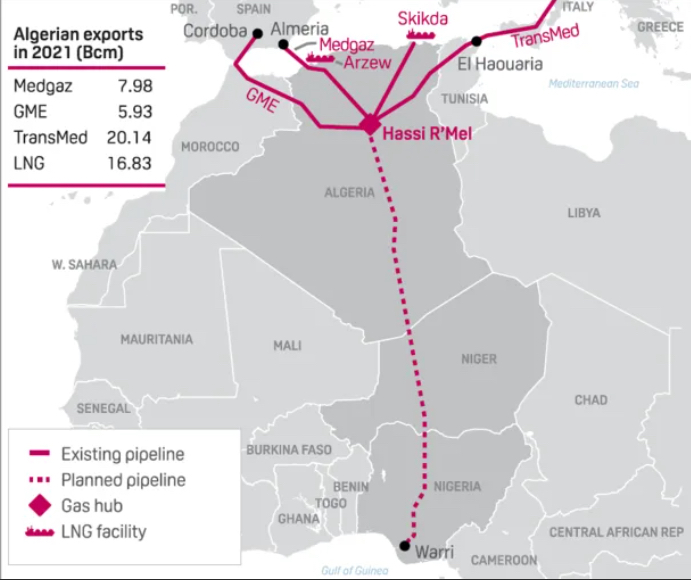
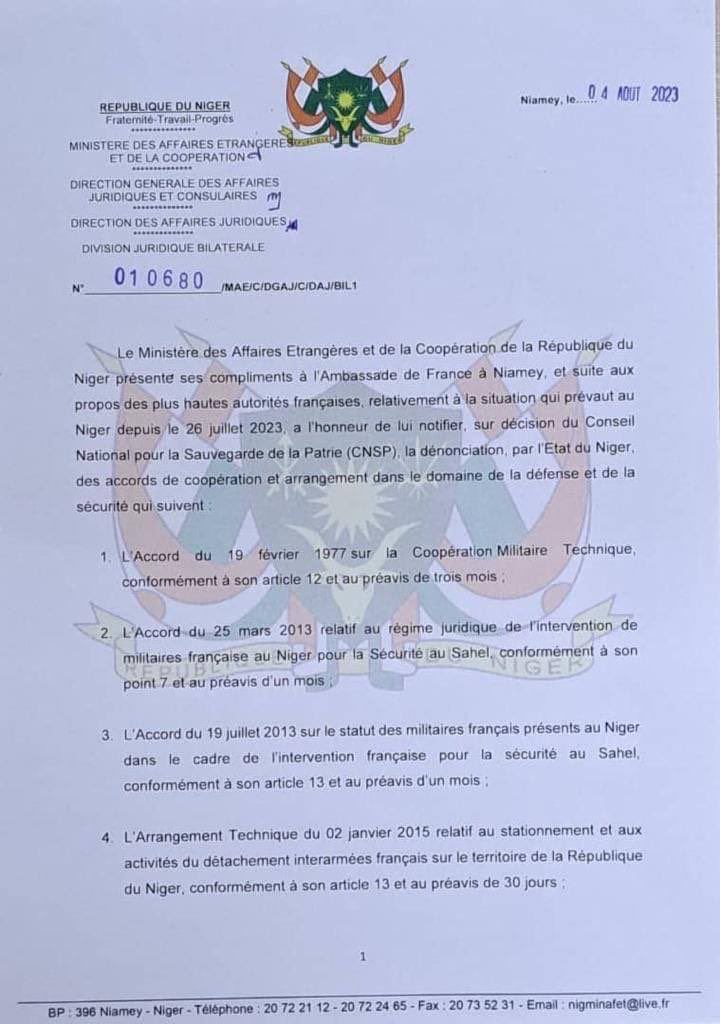
Bugsy
07.08.2023 07:58
Situace kolem Nigeru se nadále vyvíjí. Včera večer úřady oznámily uzavření vzdušného prostoru nad zemí a mluvčí vojenské vlády vydal prohlášení, že ECOWAS s podporou zahraničního kapitálu dokončil veškeré přípravy na zahájení rozsáhlé invaze do Nigeru.
Podle prohlášení Národní rady pro obranu vlasti probíhá předběžné rozmístění sil ECOWAS ve dvou západoafrických zemích. V reakci na to začala nigerská armáda posilovat hranice s Nigérií a Beninem a vláda vyzvala občany, aby byli připraveni "bránit vlast a nezávislost Nigeru".
📌 S největší pravděpodobností jsou všechny tyto hrozby a přesuny vojsk pokusem o vzájemné zastrašení a získání výhodnější pozice u jednacího stolu.
To mimo jiné potvrzuje i odmítnutí nigerijského senátu podpořit rozhodnutí prezidenta Boly Tinubua o invazi do Nigeru a všeobecná nejistota členů ECOWAS ohledně dalších kroků při řešení konfliktu. Bylo rozhodnuto svolat další zasedání, které by vyneslo konečný verdikt, ale nikdo neví, kdy se toto zasedání uskuteční.
Francie již začala jednat o logistice stažení svých jednotek z Nigeru. Podle našich informací byl na dnešní naléhavé jednání na velitelství armády odvolán z dovolené vrchní velitel francouzských ozbrojených sil Thierry Burkhardt a většina generálů. Tématem jednání je přesun z Nigeru do Čadu nebo přímo do Francie.
Italský ministr zahraničí Antonio Tajani rovněž vyzval ECOWAS k prodloužení ultimáta, protože "diplomatická cesta je v této situaci jediná správná".
Podle prohlášení Národní rady pro obranu vlasti probíhá předběžné rozmístění sil ECOWAS ve dvou západoafrických zemích. V reakci na to začala nigerská armáda posilovat hranice s Nigérií a Beninem a vláda vyzvala občany, aby byli připraveni "bránit vlast a nezávislost Nigeru".
📌 S největší pravděpodobností jsou všechny tyto hrozby a přesuny vojsk pokusem o vzájemné zastrašení a získání výhodnější pozice u jednacího stolu.
To mimo jiné potvrzuje i odmítnutí nigerijského senátu podpořit rozhodnutí prezidenta Boly Tinubua o invazi do Nigeru a všeobecná nejistota členů ECOWAS ohledně dalších kroků při řešení konfliktu. Bylo rozhodnuto svolat další zasedání, které by vyneslo konečný verdikt, ale nikdo neví, kdy se toto zasedání uskuteční.
Francie již začala jednat o logistice stažení svých jednotek z Nigeru. Podle našich informací byl na dnešní naléhavé jednání na velitelství armády odvolán z dovolené vrchní velitel francouzských ozbrojených sil Thierry Burkhardt a většina generálů. Tématem jednání je přesun z Nigeru do Čadu nebo přímo do Francie.
Italský ministr zahraničí Antonio Tajani rovněž vyzval ECOWAS k prodloužení ultimáta, protože "diplomatická cesta je v této situaci jediná správná".
🤞 1
Bugsy
14.08.2023 11:20
pozor na SCAM
mailem začalo chodit tohle oznamení o vyplacení aktiv CELSIUS
scam scam scam

jiricepelka
14.08.2023 18:52
Bugsy
15.08.2023 07:12
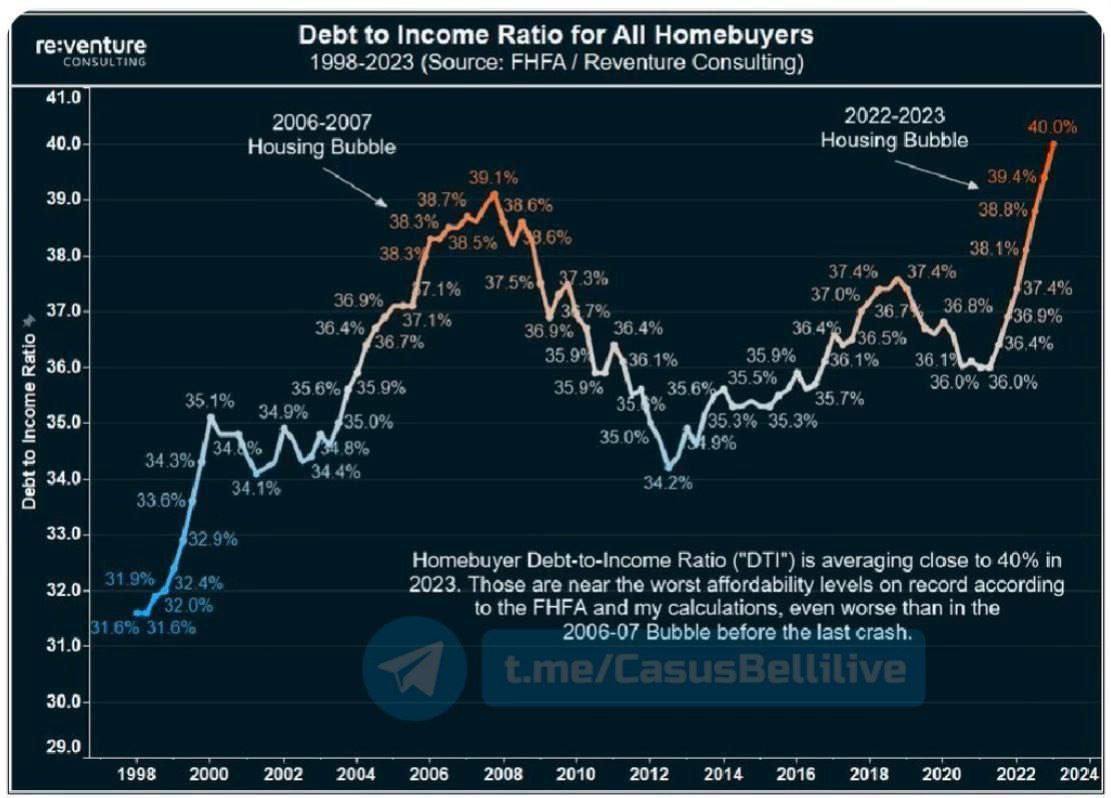
Americký trh s bydlením je na pokraji nové katastrofy - poměr hypotečních dluhů k platům se vyšplhal na 40 %.
Situace naznačuje rostoucí rizika a možný kolaps
Situace naznačuje rostoucí rizika a možný kolaps
👍 3
Bugsy
02.10.2023 15:44
Rollbit Coin (RLB) tři z hlavních produktů společnosti Rollbit se zaměřují na hraní:
Online kasino. Kasino je platforma založená na blockchainu, která nabízí výherní automaty a karetní hry jako poker.
Sportovní sázení. Tato platforma umožňuje sázet na téměř všechny sporty po celém světě, včetně fotbalu, amerického fotbalu, tenisu, golfu a boxu.
Obchodování s futures. Tato platforma umožňuje uživatelům sázet na cenu kryptoaktiv, jako je bitcoin, ethereum a mnoho dalších, s využitím až 1 000násobné páky.
Online kasino. Kasino je platforma založená na blockchainu, která nabízí výherní automaty a karetní hry jako poker.
Sportovní sázení. Tato platforma umožňuje sázet na téměř všechny sporty po celém světě, včetně fotbalu, amerického fotbalu, tenisu, golfu a boxu.
Obchodování s futures. Tato platforma umožňuje uživatelům sázet na cenu kryptoaktiv, jako je bitcoin, ethereum a mnoho dalších, s využitím až 1 000násobné páky.

Gali
07.10.2023 07:07

Swordfish
07.10.2023 08:34
spise do <#945723748210843658>
👍 1
Bugsy
07.10.2023 10:06
BREAKING – 200,000 reserve soldiers in Israel, called to military service, immediately. JoJo začala tam válka, Initial reports: At least 22 Israelis killed, hundreds injured in Hamas raid at southern Israeli towns. Unknown number of abducted Israelis.xxxxxx The rockets attack on Israel continues without a break! Over 3500 rockets fired since this morning. xxxxx “Hamas opened the gates of hell on the Gaza Strip, Hamas made the decision and Hamas will bear the responsibility and pay the price,” says Maj. Gen. Ghassan Alian, the Coordinator of Government Activities in the Territories.
Bold words, and Israelis are furious this morning.
But it remains to be seen how the world will respond once the Israeli response begins to result in Palestinian casualties.
And how Israel will react to international pressure...
Hamas needs to be eliminated as a military threat, but to do that Israel would need to ignore and withstand massive worldwide pressure.
Israel Today
Bold words, and Israelis are furious this morning.
But it remains to be seen how the world will respond once the Israeli response begins to result in Palestinian casualties.
And how Israel will react to international pressure...
Hamas needs to be eliminated as a military threat, but to do that Israel would need to ignore and withstand massive worldwide pressure.
Israel Today