
Bugsy
18.10.2022 19:10
💯 👉 Here are the key components of Evmos:
Cosmos SDK
The Cosmos software developer kit enables developers to build other blockchains on Cosmos.They can use pre-built and custom-built modules and test them before launch. Further, developers can connect horizontally with other Cosmos-based blockchains right out of the gate with the inter-blockchain communication (IBC) protocol.
Any blockchain built with the Cosmos SDK, including those deployed on Evmos, are horizontally scalable with the Cosmos ecosystem.
Application Blockchain Interface (ABCI)
ABCI is the interface between the Cosmos consensus protocol, called Tendermint, and applications on the network. It ensures all transactions are recorded on the blockchain. For Evmos, ABCI enables Ethereum’s consensus to be replaced by Cosmos consensus.
For a blockchain, finality is the assurance or guarantee that cryptocurrency transactions cannot be altered or reversed.
In Ethereum 2.0 the time to finality is six minutes, but could go to a maximum of 12. Designed differently, Cosmos has fast finality. That means the transaction is final when the block processes.
The average block time on Cosmos is eight seconds but can get as low as one second on other Cosmos blockchains. So its finality is much quicker than Ethereum’s.
Further, Cosmos can process up to 10,000 transactions per second, versus 15-20 for Ethereum.
And it’s cheaper too, with an average transaction cost of $0.02. Ethereum’s average transaction cost is around $3 but has gotten over 10 times higher in the past during periods of high traffic.
Overall, Cosmos provides faster transaction confirmations, higher throughput, and lower costs.
Inter‐Blockchain Communication Protocol (IBC)
An open‐source protocol for relaying messages between independent blockchains to one another. IBC allows these chains to trustlessly communicate with each other and exchange value, making them interoperable. That means all IBC-enabled blockchains on Cosmos are interoperable.
Cosmos SDK
The Cosmos software developer kit enables developers to build other blockchains on Cosmos.They can use pre-built and custom-built modules and test them before launch. Further, developers can connect horizontally with other Cosmos-based blockchains right out of the gate with the inter-blockchain communication (IBC) protocol.
Any blockchain built with the Cosmos SDK, including those deployed on Evmos, are horizontally scalable with the Cosmos ecosystem.
Application Blockchain Interface (ABCI)
ABCI is the interface between the Cosmos consensus protocol, called Tendermint, and applications on the network. It ensures all transactions are recorded on the blockchain. For Evmos, ABCI enables Ethereum’s consensus to be replaced by Cosmos consensus.
For a blockchain, finality is the assurance or guarantee that cryptocurrency transactions cannot be altered or reversed.
In Ethereum 2.0 the time to finality is six minutes, but could go to a maximum of 12. Designed differently, Cosmos has fast finality. That means the transaction is final when the block processes.
The average block time on Cosmos is eight seconds but can get as low as one second on other Cosmos blockchains. So its finality is much quicker than Ethereum’s.
Further, Cosmos can process up to 10,000 transactions per second, versus 15-20 for Ethereum.
And it’s cheaper too, with an average transaction cost of $0.02. Ethereum’s average transaction cost is around $3 but has gotten over 10 times higher in the past during periods of high traffic.
Overall, Cosmos provides faster transaction confirmations, higher throughput, and lower costs.
Inter‐Blockchain Communication Protocol (IBC)
An open‐source protocol for relaying messages between independent blockchains to one another. IBC allows these chains to trustlessly communicate with each other and exchange value, making them interoperable. That means all IBC-enabled blockchains on Cosmos are interoperable.
That includes Evmos. So any chain deployed on Evmos can horizontally scale to the rest of the Cosmos ecosystem, immediately expanding its user base.
Web 3.0 and EVM compatibility
Evmos utilizes the Go Ethereum (Geth) library, a decentralized command-line interface for running Ethereum applications. It uses the Go programming language, which the Cosmos SDK is written in as well. And it’s the official client for building on Ethereum, so it’s very familiar to Ethereum developers.
Further, Evmos enables a fully compatible JSON-RPC layer. That’s jargony, I know. It just means Evmos interacts with existing Ethereum clients and tooling. That includes tools such as MetaMask and Truffle, providing Web 3.0 compatibility.
Overall, Ethereum developers can launch applications on Evmos using the same programming language and tooling they already know and use.
ERC-20 Module
The ERC-20 module enables users to convert their ERC-20 tokens on Ethereum into assets on Cosmos, and vice versa. It also enables developers to write smart contracts that use EVM assets and function on Evmos and applications within the Cosmos ecosystem.
With the ERC-20 module, ETH and ERC-20 assets can be used in the Cosmos ecosystem. Plus, Cosmos assets such as ATOM or EVMOS can be used on EVM-based chains. And new applications based on ERC-20 smart contracts will have access to the Cosmos ecosystem.
Web 3.0 and EVM compatibility
Evmos utilizes the Go Ethereum (Geth) library, a decentralized command-line interface for running Ethereum applications. It uses the Go programming language, which the Cosmos SDK is written in as well. And it’s the official client for building on Ethereum, so it’s very familiar to Ethereum developers.
Further, Evmos enables a fully compatible JSON-RPC layer. That’s jargony, I know. It just means Evmos interacts with existing Ethereum clients and tooling. That includes tools such as MetaMask and Truffle, providing Web 3.0 compatibility.
Overall, Ethereum developers can launch applications on Evmos using the same programming language and tooling they already know and use.
ERC-20 Module
The ERC-20 module enables users to convert their ERC-20 tokens on Ethereum into assets on Cosmos, and vice versa. It also enables developers to write smart contracts that use EVM assets and function on Evmos and applications within the Cosmos ecosystem.
With the ERC-20 module, ETH and ERC-20 assets can be used in the Cosmos ecosystem. Plus, Cosmos assets such as ATOM or EVMOS can be used on EVM-based chains. And new applications based on ERC-20 smart contracts will have access to the Cosmos ecosystem.
👉 The EVM Hub of Cosmos
Evmos’ goal is to become the hub of EVM appchains on Cosmos.
That hub will see dApps launched in one place that tap into the liquidity of multiple blockchain ecosystems.
As we learned above, there’s a lot of benefits to building on Evmos. You get compatibility with EVM and Ethereum software and tooling.
Plus, you get the benefits of Cosmos as well:
The flexibility of the Cosmos SDK.
The user base of the Cosmos ecosystem through IBC.
Fast and cheap transactions.
Evmos’ goal is to become the hub of EVM appchains on Cosmos.
That hub will see dApps launched in one place that tap into the liquidity of multiple blockchain ecosystems.
As we learned above, there’s a lot of benefits to building on Evmos. You get compatibility with EVM and Ethereum software and tooling.
Plus, you get the benefits of Cosmos as well:
The flexibility of the Cosmos SDK.
The user base of the Cosmos ecosystem through IBC.
Fast and cheap transactions.
So we’ll likely see more projects move to Cosmos, such as dYdX. And we think they’ll use Evmos for its built-in EVM compatibility and the familiar developer experience.
Further, developers are incentivized to build on Evmos.
You see, Evmos implements an innovative feesplit module that shares fees between validators and smart contract deployers (i.e., developers).
This contrasts with most blockchains, where fees largely go to the block producers. So developers are highly incentivized to build on Evmos.
The center of this is the Evmos dApp store. It enables the on-chain revenue share model and is powered by the EVMOS token.
Developers register their applications, then fees are accumulated as smart contracts are deployed. And the fees generated are split 50/50.
Further, 25% of block emissions go to an incentive pool. Those incentives are used to help developers run their applications or launch their own appchains on Evmos.
And Evmos provides critical infrastructure for new appchains such as wallets, explorers, oracles, analytics, and other tooling.
With this in place, the Evmos dApp store is well positioned to become the center of an EVM appchain network.
Since launching in late April, there’s already rapid adoption on Evmos.
To date it has 14 dApps in the Evmos dApp store. And 93 projects are building on the Evmos platform.
Further, developers are incentivized to build on Evmos.
You see, Evmos implements an innovative feesplit module that shares fees between validators and smart contract deployers (i.e., developers).
This contrasts with most blockchains, where fees largely go to the block producers. So developers are highly incentivized to build on Evmos.
The center of this is the Evmos dApp store. It enables the on-chain revenue share model and is powered by the EVMOS token.
Developers register their applications, then fees are accumulated as smart contracts are deployed. And the fees generated are split 50/50.
Further, 25% of block emissions go to an incentive pool. Those incentives are used to help developers run their applications or launch their own appchains on Evmos.
And Evmos provides critical infrastructure for new appchains such as wallets, explorers, oracles, analytics, and other tooling.
With this in place, the Evmos dApp store is well positioned to become the center of an EVM appchain network.
Since launching in late April, there’s already rapid adoption on Evmos.
To date it has 14 dApps in the Evmos dApp store. And 93 projects are building on the Evmos platform.
Aave, Diffusion (a Uniswap fork), NovaDAO (an Ohm fork), Frax (an algorithmic stablecoin), Metalancer (a Balancer fork), and Gamyfi (an NFT marketplace) will all be launching on Evmos.
And more are being announced every day, such as:
CypherD Wallet, an Evmos-, EVM-, and IBC-compatible wallet.
xyz, a one-click cross-chain bridge application.
Pyxis Safe (part of the Aura Network), a decentralized multisig wallet application for Cosmos.
Lit Protocol, a decentralized access control protocol for digital content.
That momentum will continue with Evmos hackathons. Recall that hackathons are developer events where large groups work around a single product and win prizes. The goal is to create functioning software or applications by the end.
Evmos recently held the Momentum Hackathon, which attracted over 700 developers and had to be extended a month due to its popularity. Winners and additional funding are expected to be announced in the near future.
And there’s also the Covalent #OneMillionWallets Evmos Hackathon.
Covalent is a decentralized data infrastructure that enables users to seamlessly access blockchain data. Covalent has integrated Evmos into its API. Its hackathon will focus on dApp tooling, DeFi, and NFTs.
On top of that, the Evmos DAO recently approved the Evmos DeFi Liquidity Incentives Program.
Evmos will be using part of its community treasury to bootstrap liquidity for DeFi projects launching on its platform.
It will start with Diffusion, a Uniswap-like exchange with added features. And more protocols and applications will follow.
Overall, Evmos is bringing the world of Ethereum, and the power of the EVM, into the Cosmos ecosystem. And it’s set to become the EVM hub on Cosmos.
And more are being announced every day, such as:
CypherD Wallet, an Evmos-, EVM-, and IBC-compatible wallet.
xyz, a one-click cross-chain bridge application.
Pyxis Safe (part of the Aura Network), a decentralized multisig wallet application for Cosmos.
Lit Protocol, a decentralized access control protocol for digital content.
That momentum will continue with Evmos hackathons. Recall that hackathons are developer events where large groups work around a single product and win prizes. The goal is to create functioning software or applications by the end.
Evmos recently held the Momentum Hackathon, which attracted over 700 developers and had to be extended a month due to its popularity. Winners and additional funding are expected to be announced in the near future.
And there’s also the Covalent #OneMillionWallets Evmos Hackathon.
Covalent is a decentralized data infrastructure that enables users to seamlessly access blockchain data. Covalent has integrated Evmos into its API. Its hackathon will focus on dApp tooling, DeFi, and NFTs.
On top of that, the Evmos DAO recently approved the Evmos DeFi Liquidity Incentives Program.
Evmos will be using part of its community treasury to bootstrap liquidity for DeFi projects launching on its platform.
It will start with Diffusion, a Uniswap-like exchange with added features. And more protocols and applications will follow.
Overall, Evmos is bringing the world of Ethereum, and the power of the EVM, into the Cosmos ecosystem. And it’s set to become the EVM hub on Cosmos.
👉 👉 The Opportunity
Evmos secures its blockchain through a set of validators that are responsible for committing new blocks in the blockchain.
EVMOS is Evmos’ native token. And at its onset, Evmos will launch with 150 validators.
Validators can bond their own staking tokens as well as have the tokens "delegated," or staked, to them by token holders. That’s our income opportunity.
Validators and their delegators will earn EVMOS as block rewards and transaction fees in proportion to their stake.
Please be aware that the block reward inflation rate of EVMOS is currently high as it bootstraps its network. That rate will steadily decrease over time. We’ll be compensating with a staking rate that’s currently over 100% (but will also steadily decrease over time).
If validators double sign, are frequently offline, or don’t participate in governance, their staked EVMOS (including EVMOS of users that delegated to them) can be slashed. The penalty depends on the severity of the violation.
Evmos secures its blockchain through a set of validators that are responsible for committing new blocks in the blockchain.
EVMOS is Evmos’ native token. And at its onset, Evmos will launch with 150 validators.
Validators can bond their own staking tokens as well as have the tokens "delegated," or staked, to them by token holders. That’s our income opportunity.
Validators and their delegators will earn EVMOS as block rewards and transaction fees in proportion to their stake.
Please be aware that the block reward inflation rate of EVMOS is currently high as it bootstraps its network. That rate will steadily decrease over time. We’ll be compensating with a staking rate that’s currently over 100% (but will also steadily decrease over time).
If validators double sign, are frequently offline, or don’t participate in governance, their staked EVMOS (including EVMOS of users that delegated to them) can be slashed. The penalty depends on the severity of the violation.
💯 Crypto Income FIRE System
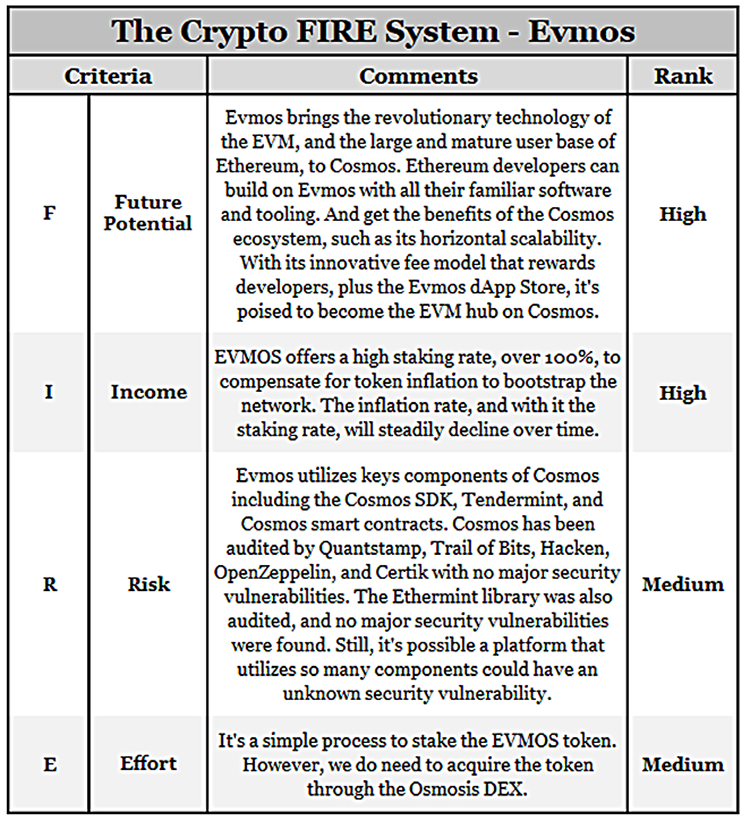
👉 👉 What It’s Worth
The virtual machine is a useful technology in Web 2.0.
It’s how Android emulators helped Android grow into the most widely used smartphone software in the world.
Even developers who don’t use Android devices can test and launch apps on an emulator.
In Web 3.0 it’s revolutionary.
That’s because of the EVM, or Ethereum Virtual Machine.
Whether you’re a user or developer, the playing field is the same.
And it runs around the world on the Ethereum blockchain, making it unstoppable.
Evmos is bringing that revolutionary technology to the Cosmos ecosystem.
That means any developer on Evmos can enjoy the benefits of Ethereum: the large and familiar user base… robust security and composability… and the familiar software and tooling.
But they also get the benefits of Cosmos: the customizable building framework… fast and cheap transactions… high throughput… and the horizontal scalability to the entire Cosmos ecosystem.
We’re already seeing rapid growth on Evmos. And we expect it to continue with its innovative token model, liquidity incentive programs, and the Evmos dApp store.
We think over the next two to three years, as the Evmos dApp store grows into an EVM hub, it can grow to 2% of Ethereum’s market value.That would give it a valuation of $3 billion.
Accounting for token inflation, EVMOS would be worth $3.75, a 100% gain over today’s price. Plus, we can collect a yield of over 100%. (Remember, though, that rate will steadily decline over time.)
While the price appreciation is nice, the best part is the crypto income yield on your EVMOS stake, which enables us to build our position and effectively lower our cost basis.
With EVMOS we’ll more than double our stake over the next year.And as the Evmos dApp store grows, we’re set up for super-charged returns.
The virtual machine is a useful technology in Web 2.0.
It’s how Android emulators helped Android grow into the most widely used smartphone software in the world.
Even developers who don’t use Android devices can test and launch apps on an emulator.
In Web 3.0 it’s revolutionary.
That’s because of the EVM, or Ethereum Virtual Machine.
Whether you’re a user or developer, the playing field is the same.
And it runs around the world on the Ethereum blockchain, making it unstoppable.
Evmos is bringing that revolutionary technology to the Cosmos ecosystem.
That means any developer on Evmos can enjoy the benefits of Ethereum: the large and familiar user base… robust security and composability… and the familiar software and tooling.
But they also get the benefits of Cosmos: the customizable building framework… fast and cheap transactions… high throughput… and the horizontal scalability to the entire Cosmos ecosystem.
We’re already seeing rapid growth on Evmos. And we expect it to continue with its innovative token model, liquidity incentive programs, and the Evmos dApp store.
We think over the next two to three years, as the Evmos dApp store grows into an EVM hub, it can grow to 2% of Ethereum’s market value.That would give it a valuation of $3 billion.
Accounting for token inflation, EVMOS would be worth $3.75, a 100% gain over today’s price. Plus, we can collect a yield of over 100%. (Remember, though, that rate will steadily decline over time.)
While the price appreciation is nice, the best part is the crypto income yield on your EVMOS stake, which enables us to build our position and effectively lower our cost basis.
With EVMOS we’ll more than double our stake over the next year.And as the Evmos dApp store grows, we’re set up for super-charged returns.
👍 1
Bugsy
18.10.2022 19:24
🕵️♂️ 🕵️♂️ 🕵️♂️ 😂
Why It’s Important: While macro concerns dominate financial headlines, and crypto marches through winter, institutions continue to prepare for a blockchain future.
Most recently, Bank of New York Mellon (BK) has added cryptocurrencies to its custody service.
It’s one of the oldest banks in the U.S. It was the first to be listed on the New York Stock Exchange. And is the world’s largest custodian bank, with $43 trillion in assets under administration.
Clients include endowments and foundations, financial institutions, financial consultants, corporations, public funds, and more.
And it’s a systemically important bank in the U.S. economy.
Now the financial professionals that use BNY Mellon for custody can offer cryptocurrencies to their customers as well.
Before, fund managers typically would have to find a firm specializing in cryptocurrency for custody services. So it just got easier to add crypto to investment portfolios.
According to Caroline Butler, CEO of custody services at BNY Mellon, even in the current environment “we continue to see significant demand from institutional investors and are excited about future opportunities from blockchain and tokenization technology for assets and cash.”
Why It’s Important: While macro concerns dominate financial headlines, and crypto marches through winter, institutions continue to prepare for a blockchain future.
Most recently, Bank of New York Mellon (BK) has added cryptocurrencies to its custody service.
It’s one of the oldest banks in the U.S. It was the first to be listed on the New York Stock Exchange. And is the world’s largest custodian bank, with $43 trillion in assets under administration.
Clients include endowments and foundations, financial institutions, financial consultants, corporations, public funds, and more.
And it’s a systemically important bank in the U.S. economy.
Now the financial professionals that use BNY Mellon for custody can offer cryptocurrencies to their customers as well.
Before, fund managers typically would have to find a firm specializing in cryptocurrency for custody services. So it just got easier to add crypto to investment portfolios.
According to Caroline Butler, CEO of custody services at BNY Mellon, even in the current environment “we continue to see significant demand from institutional investors and are excited about future opportunities from blockchain and tokenization technology for assets and cash.”
👍 1
What this means is BNY Mellon is ready if a fund or fund manager wants to access crypto. It has the tools necessary to store crypto securely.
This is great news. BNY Mellon is a bank that a lot of financial institutions, such as public pension funds and corporations, are used to working with. There’s already an established comfort level.
So the move could boost institutional adoption for digital assets.
And BNY Mellon isn’t the only financial institution expanding its cryptocurrency offerings.
In August Blackrock partnered with Coinbase to allow some clients the ability to trade, finance, and hold crypto assets in custody.
Plus, derivatives market giant CME Group is set to launch three new crypto reference rates.
CME is the world’s largest financial derivatives exchange. It trades in asset classes that include agricultural products, currencies, metals, stock indexes, and cryptocurrency futures.
And it wants its institutional clients and other users to have access to a much broader range of cryptocurrencies.
Reference rates for the native tokens of the Avalanche (AVAX), Tezos (XTZ), and Filecoin (FIL) blockchains will go live on the CME on October 31.
CME also has reference rates for ALGO, BTC, BCH, ADA, LINK, ATOM, ETH, LTC, DOT, MATIC, SOL, XLM, and UNI.
Not all of the reference rates are tradeable products. But the CME could certainly launch futures products around any of them.
It already has futures for BTC and ETH. And this year it added micro-sized options and Euro-denominated futures for both BTC and ETH.
On top of that, CME hired a new global head for its cryptocurrency businesses with the goal of driving product innovation and supporting long-term growth.
CME is clearly preparing for a crypto future despite the current crypto winter.
This is great news. BNY Mellon is a bank that a lot of financial institutions, such as public pension funds and corporations, are used to working with. There’s already an established comfort level.
So the move could boost institutional adoption for digital assets.
And BNY Mellon isn’t the only financial institution expanding its cryptocurrency offerings.
In August Blackrock partnered with Coinbase to allow some clients the ability to trade, finance, and hold crypto assets in custody.
Plus, derivatives market giant CME Group is set to launch three new crypto reference rates.
CME is the world’s largest financial derivatives exchange. It trades in asset classes that include agricultural products, currencies, metals, stock indexes, and cryptocurrency futures.
And it wants its institutional clients and other users to have access to a much broader range of cryptocurrencies.
Reference rates for the native tokens of the Avalanche (AVAX), Tezos (XTZ), and Filecoin (FIL) blockchains will go live on the CME on October 31.
CME also has reference rates for ALGO, BTC, BCH, ADA, LINK, ATOM, ETH, LTC, DOT, MATIC, SOL, XLM, and UNI.
Not all of the reference rates are tradeable products. But the CME could certainly launch futures products around any of them.
It already has futures for BTC and ETH. And this year it added micro-sized options and Euro-denominated futures for both BTC and ETH.
On top of that, CME hired a new global head for its cryptocurrency businesses with the goal of driving product innovation and supporting long-term growth.
CME is clearly preparing for a crypto future despite the current crypto winter.
This is happening elsewhere, too.
A recent Morgan Stanley report noted crypto exchange-traded funds (ETF) and exchange-traded products (ETP) and trusts continue to grow.
There are now over 180 crypto ETFs or ETPs… And half have launched in the current bear market.
These products give fund managers an easy way to invest in cryptocurrencies for their clients. They can easily be bought and sold on exchanges. And they can avoid pain points such as setting up wallets and storage.
The growth in these products demonstrates a continued interest in getting cryptocurrencies into portfolios.
Another interesting piece of news for institutional adoption of crypto came from Envestnet.
It’s a publicly traded financial technology company that does nearly $1 billion in annual revenue, has a $2.5 billion market cap, and boasts thousands of clients in the wealth management space.
Its flagship product is an advisory platform that integrates the services and software used by financial advisers in wealth management.
In other words, it specializes in helping wealth professionals get access to certain assets for their clients.
And it just partnered with Inflection Points, an employment and training company for bitcoin and crypto.
Inflection Points will be the main education partner for Envestnet’s thousands of RIAs (registered investment advisers) and brokerage houses.
Now these thousands of advisers will be better prepared to get their clients into crypto.
Yes, crypto winter marches on. But underneath the surface, institutions continue to prepare for a crypto future.
A recent Morgan Stanley report noted crypto exchange-traded funds (ETF) and exchange-traded products (ETP) and trusts continue to grow.
There are now over 180 crypto ETFs or ETPs… And half have launched in the current bear market.
These products give fund managers an easy way to invest in cryptocurrencies for their clients. They can easily be bought and sold on exchanges. And they can avoid pain points such as setting up wallets and storage.
The growth in these products demonstrates a continued interest in getting cryptocurrencies into portfolios.
Another interesting piece of news for institutional adoption of crypto came from Envestnet.
It’s a publicly traded financial technology company that does nearly $1 billion in annual revenue, has a $2.5 billion market cap, and boasts thousands of clients in the wealth management space.
Its flagship product is an advisory platform that integrates the services and software used by financial advisers in wealth management.
In other words, it specializes in helping wealth professionals get access to certain assets for their clients.
And it just partnered with Inflection Points, an employment and training company for bitcoin and crypto.
Inflection Points will be the main education partner for Envestnet’s thousands of RIAs (registered investment advisers) and brokerage houses.
Now these thousands of advisers will be better prepared to get their clients into crypto.
Yes, crypto winter marches on. But underneath the surface, institutions continue to prepare for a crypto future.
Bugsy
18.10.2022 19:36
Bugsy
20.10.2022 08:26
Former Celsius exec joins JPMorgan as director of crypto regulatory policy | Reuters
https://www.reuters.com/markets/us/former-celsius-exec-joins-jpmorgan-director-crypto-regulatory-policy-2022-10-19/
https://www.reuters.com/markets/us/former-celsius-exec-joins-jpmorgan-director-crypto-regulatory-policy-2022-10-19/
Bugsy
20.10.2022 21:05
Bugsy
28.10.2022 20:01
Dnes opouštíme naši pozici v MakerDAO (MKR) se ziskem 36 %.
MakerDAO jsme koupili v březnu 2019. Tehdy jsme věřili, že se MakerDAO a jeho stablecoin DAI stanou jedním z největších DeFi protokolů. A ukázalo se, že jsme měli pravdu.
Od té doby zaznamenala tato nová technologie v blockchainovém prostoru velký úspěch, protože celková hodnota DAI v oběhu se nafoukla ze zhruba 100 milionů dolarů v době, kdy jsme pozici doporučili, na 10 miliard dolarů na svém vrcholu v únoru.
Když jsme MakerDAO doporučovali, líbily se nám výhody, které DAI přináší.
DAI je decentralizovaná. To znamená, že ji nelze zabavit ani zablokovat.
Kromě toho se kolaterál, který je zálohou stablecoinu, nacházel v blockchainu. Svým uživatelům tak poskytoval větší transparentnost a důvěru, protože věděli, že se mohou kdykoli ujistit, že jejich aktiva jsou zcela kryta.
Protokol však změnil způsob svého fungování.
V uplynulém roce MakerDAO rozšířil své působení i do oblasti tradičních financí.
Zatímco velikost těchto půjček a vystavení riziku mimo blockchain začínala malá, v posledních několika týdnech se značně zvětšila.
Začátkem tohoto měsíce schválili držitelé tokenu MKR alokaci 500 milionů dolarů ze své rozvahy do amerických státních dluhopisů a korporátních dluhopisů.
A v pondělí MakerDAO schválila návrh, který by umístil 1,6 miliardy dolarů jejích aktiv do Coinbase Prime, aby generoval příjem.
MakerDAO tyto kroky učinila s cílem dále diverzifikovat svou rozvahu a generovat příjem pro držitele svých tokenů.
Její kroky však s sebou nesou další rizika. A snižují výhody za držení jejího stablecoinu DAI.
Tím, že zvyšuje svou expozici vůči centralizovaným subjektům a vládní cenzuře, se stablecoin DAI stává podobným jiným významným stablecoinům, jako jsou USDT a USDC.
MakerDAO opouští hlavní důvod, proč se nám líbil, kterým byla jeho decentralizovaná povaha. Proto jej z našeho portfolia odstraňujeme, abychom uvolnili místo novým příležitostem.
.
MakerDAO jsme koupili v březnu 2019. Tehdy jsme věřili, že se MakerDAO a jeho stablecoin DAI stanou jedním z největších DeFi protokolů. A ukázalo se, že jsme měli pravdu.
Od té doby zaznamenala tato nová technologie v blockchainovém prostoru velký úspěch, protože celková hodnota DAI v oběhu se nafoukla ze zhruba 100 milionů dolarů v době, kdy jsme pozici doporučili, na 10 miliard dolarů na svém vrcholu v únoru.
Když jsme MakerDAO doporučovali, líbily se nám výhody, které DAI přináší.
DAI je decentralizovaná. To znamená, že ji nelze zabavit ani zablokovat.
Kromě toho se kolaterál, který je zálohou stablecoinu, nacházel v blockchainu. Svým uživatelům tak poskytoval větší transparentnost a důvěru, protože věděli, že se mohou kdykoli ujistit, že jejich aktiva jsou zcela kryta.
Protokol však změnil způsob svého fungování.
V uplynulém roce MakerDAO rozšířil své působení i do oblasti tradičních financí.
Zatímco velikost těchto půjček a vystavení riziku mimo blockchain začínala malá, v posledních několika týdnech se značně zvětšila.
Začátkem tohoto měsíce schválili držitelé tokenu MKR alokaci 500 milionů dolarů ze své rozvahy do amerických státních dluhopisů a korporátních dluhopisů.
A v pondělí MakerDAO schválila návrh, který by umístil 1,6 miliardy dolarů jejích aktiv do Coinbase Prime, aby generoval příjem.
MakerDAO tyto kroky učinila s cílem dále diverzifikovat svou rozvahu a generovat příjem pro držitele svých tokenů.
Její kroky však s sebou nesou další rizika. A snižují výhody za držení jejího stablecoinu DAI.
Tím, že zvyšuje svou expozici vůči centralizovaným subjektům a vládní cenzuře, se stablecoin DAI stává podobným jiným významným stablecoinům, jako jsou USDT a USDC.
MakerDAO opouští hlavní důvod, proč se nám líbil, kterým byla jeho decentralizovaná povaha. Proto jej z našeho portfolia odstraňujeme, abychom uvolnili místo novým příležitostem.
.
👌 2
Bugsy
29.10.2022 17:19

Bugsy
01.11.2022 20:38
1.11.2022 Today, we’re removing BlockFi as one of our recommended platforms to borrow and lend against your crypto assets.
We first recommended BlockFi in 2020 as a way to earn income on your Ethereum (ETH). Since then, it has added yields on tokens like Uniswap, Chainlink, and stablecoins.
However, we believe the risk associated with using the platform has increased since we recommended it.
As we’ve learned over the past year, the accounting details on centralized lending platforms like BlockFi aren’t as transparent as those on decentralized finance (DeFi) lending platforms, which use blockchain technology.
Unlike DeFi lending platforms, we can’t peer into BlockFi’s private loan books and see everyone it has exposure to or the quality of its collateral.
So, in wake of the recent troubles we’re seeing from a few bitcoin mining companies, we re-examined BlockFi’s risk profile and decided to remove it from our list of recommended lending platforms.
Last week, one of the largest bitcoin mining companies, Core Scientific, warned it might seek relief through bankruptcy protection. And it won’t be making payments that are coming due from its lenders.
We first recommended BlockFi in 2020 as a way to earn income on your Ethereum (ETH). Since then, it has added yields on tokens like Uniswap, Chainlink, and stablecoins.
However, we believe the risk associated with using the platform has increased since we recommended it.
As we’ve learned over the past year, the accounting details on centralized lending platforms like BlockFi aren’t as transparent as those on decentralized finance (DeFi) lending platforms, which use blockchain technology.
Unlike DeFi lending platforms, we can’t peer into BlockFi’s private loan books and see everyone it has exposure to or the quality of its collateral.
So, in wake of the recent troubles we’re seeing from a few bitcoin mining companies, we re-examined BlockFi’s risk profile and decided to remove it from our list of recommended lending platforms.
Last week, one of the largest bitcoin mining companies, Core Scientific, warned it might seek relief through bankruptcy protection. And it won’t be making payments that are coming due from its lenders.
BlockFi is among the company’s largest creditors and could potentially face roughly $61 million in losses.
While a loss this size likely isn’t enough to cause severe damage to BlockFi’s operations, there’s simply no way to know what other toxic assets the company is exposed to.
But we do know that BlockFi is a major lender in the bitcoin mining industry…
Over the summer, a report detailed that bitcoin miners had roughly $4 billion in debt. And among the creditors to publicly listed bitcoin miners, BlockFi was the second-largest, according to The Block.
On top of this, Bloomberg reports bitcoin miners used their mining rigs as collateral to back a growing number of these $4 billion in loans. And as the price of bitcoin crashed, so did the mining equipment used as collateral.
On Monday, BlockFi notified its users that its crypto mining loans were only a small portion of its larger lending portfolio. But the company didn’t disclose how much exposure qualifies as “small.”
We see this as a red flag.
Over the summer, BlockFi experienced financial troubles. It entered a deal with FTX in exchange for a revolving credit facility that it could draw from if needed.
We’re unsure whether the revolving credit line will be enough to cover any potential problems BlockFi might face if more bitcoin miners go under.
Due to these recent events, we’re less confident in BlockFi as a safe place to park even a small portion of your assets to generate income.
And while the yields are market-beating, the uncertainty the company faces doesn’t warrant the risk.
Action to take: If you have funds in a BlockFi account, we recommend you withdraw them immediately. And if you used the platform to borrow against your crypto assets, we also recommend closing out these loans and withdrawing your collateral.
While a loss this size likely isn’t enough to cause severe damage to BlockFi’s operations, there’s simply no way to know what other toxic assets the company is exposed to.
But we do know that BlockFi is a major lender in the bitcoin mining industry…
Over the summer, a report detailed that bitcoin miners had roughly $4 billion in debt. And among the creditors to publicly listed bitcoin miners, BlockFi was the second-largest, according to The Block.
On top of this, Bloomberg reports bitcoin miners used their mining rigs as collateral to back a growing number of these $4 billion in loans. And as the price of bitcoin crashed, so did the mining equipment used as collateral.
On Monday, BlockFi notified its users that its crypto mining loans were only a small portion of its larger lending portfolio. But the company didn’t disclose how much exposure qualifies as “small.”
We see this as a red flag.
Over the summer, BlockFi experienced financial troubles. It entered a deal with FTX in exchange for a revolving credit facility that it could draw from if needed.
We’re unsure whether the revolving credit line will be enough to cover any potential problems BlockFi might face if more bitcoin miners go under.
Due to these recent events, we’re less confident in BlockFi as a safe place to park even a small portion of your assets to generate income.
And while the yields are market-beating, the uncertainty the company faces doesn’t warrant the risk.
Action to take: If you have funds in a BlockFi account, we recommend you withdraw them immediately. And if you used the platform to borrow against your crypto assets, we also recommend closing out these loans and withdrawing your collateral.
Bugsy
03.11.2022 21:31
3.11.2022
The Next Phase of the Digital Revolution Is Unfolding
In the future, I believe every asset will be tokenized.
That means stocks, bonds, titles of ownership, music rights – everything of value – will have their ownership rights secured by a blockchain.
And that future is already unfolding.
The Wall Street Journal says we’ve entered:
A world where you could buy stocks, bonds, derivatives, cryptocurrencies, or even pieces of art, all on one exchange, 24 hours a day, seven days a week, from anywhere in the world.
And BNY Mellon, which manages $2.4 trillion in assets, says this shift:
Open[s] the market to a whole new set of investors, now able to diversify their investment portfolios into asset classes previously well out of reach.
This shift to tokenization is all due to a revolutionary concept called Web 3.0. If you’re not familiar with this trend, here’s a brief primer.
In the future, decentralized technology will evolve into the third generation of the internet called Web 3.0.
This version of the internet will combine the power of blockchains (like bitcoin)… artificial intelligence… and cutting-edge computer technology.
Web 1.0 was the early internet until about 2000. You could use it to read websites… search for information… and buy items on websites like Amazon and eBay.
Web 2.0 is the version we’re using now. It allows mobile computing… social networks like Facebook and Twitter… and multiplayer games. It birthed the Big Data industry… machine learning… and search algorithms like you see on Google or Netflix.
With Web 3.0, you won’t just be able to send data to other people… but you can send anything of value, too. All with the click of a mouse. And without the need of a third party.
Anyone using Web 3.0 can make a loan or borrow money… transfer real estate… or even auction fractions of the value of famous paintings.
This revolution is going to involve every asset in the real world. That’s $844 trillion in value.
In the future, I believe every asset will be tokenized.
That means stocks, bonds, titles of ownership, music rights – everything of value – will have their ownership rights secured by a blockchain.
And that future is already unfolding.
The Wall Street Journal says we’ve entered:
A world where you could buy stocks, bonds, derivatives, cryptocurrencies, or even pieces of art, all on one exchange, 24 hours a day, seven days a week, from anywhere in the world.
And BNY Mellon, which manages $2.4 trillion in assets, says this shift:
Open[s] the market to a whole new set of investors, now able to diversify their investment portfolios into asset classes previously well out of reach.
This shift to tokenization is all due to a revolutionary concept called Web 3.0. If you’re not familiar with this trend, here’s a brief primer.
In the future, decentralized technology will evolve into the third generation of the internet called Web 3.0.
This version of the internet will combine the power of blockchains (like bitcoin)… artificial intelligence… and cutting-edge computer technology.
Web 1.0 was the early internet until about 2000. You could use it to read websites… search for information… and buy items on websites like Amazon and eBay.
Web 2.0 is the version we’re using now. It allows mobile computing… social networks like Facebook and Twitter… and multiplayer games. It birthed the Big Data industry… machine learning… and search algorithms like you see on Google or Netflix.
With Web 3.0, you won’t just be able to send data to other people… but you can send anything of value, too. All with the click of a mouse. And without the need of a third party.
Anyone using Web 3.0 can make a loan or borrow money… transfer real estate… or even auction fractions of the value of famous paintings.
This revolution is going to involve every asset in the real world. That’s $844 trillion in value.
And the Infinity Exchange will be the “tollbooth” of Web 3.0.
Almost every transaction that flows on Web 3.0 will go through this exchange. That means it gets a fee every time a token exchanges hands.
So just by owning this tollbooth, you can collect profits. And the more traffic flows, the more your wealth grows.
At the time of writing, its valuation is just $193 billion. But as trillions of dollars in value shift to the Infinity Exchange, we believe it’ll eventually have a market cap of $1.9 trillion.
That’s a 10x increase from today’s prices.
Almost every transaction that flows on Web 3.0 will go through this exchange. That means it gets a fee every time a token exchanges hands.
So just by owning this tollbooth, you can collect profits. And the more traffic flows, the more your wealth grows.
At the time of writing, its valuation is just $193 billion. But as trillions of dollars in value shift to the Infinity Exchange, we believe it’ll eventually have a market cap of $1.9 trillion.
That’s a 10x increase from today’s prices.
👉 The “Tollbooth” of Web 3.0
The digital tollbooth sitting at the center of Web 3.0 is Ethereum (ETH). And it will allow the tokenization of up to $844 trillion worth of assets (more on that below).
Even if you’re new to crypto, hearing the name Ethereum is like hearing Walmart or Home Depot. Along with bitcoin, it’s the boring blue-chip of the crypto world.
It’s no longer the sexy altcoin I recommended at $9 in 2016.
But as I’ll show you below, it’s poised for at least 10x growth from current prices as it evolves into the Infinity Exchange over the coming years.
I don’t know of any blue-chip stock that offers that type of upside.
Already, Ethereum is the world’s most widely used blockchain development platform…
The way Microsoft was the world’s most popular development platform in the 1990s… And the way the Android and iOS operating systems are the most popular development platforms today for mobile apps.
The next boom in application development will take place on Web 3.0 – not the traditional internet – and the network that will dominate that future is Ethereum.
Currently, Ethereum hosts over 37,000 applications – the most of any blockchain. That’s a tenfold rise in applications since early 2020.
The digital tollbooth sitting at the center of Web 3.0 is Ethereum (ETH). And it will allow the tokenization of up to $844 trillion worth of assets (more on that below).
Even if you’re new to crypto, hearing the name Ethereum is like hearing Walmart or Home Depot. Along with bitcoin, it’s the boring blue-chip of the crypto world.
It’s no longer the sexy altcoin I recommended at $9 in 2016.
But as I’ll show you below, it’s poised for at least 10x growth from current prices as it evolves into the Infinity Exchange over the coming years.
I don’t know of any blue-chip stock that offers that type of upside.
Already, Ethereum is the world’s most widely used blockchain development platform…
The way Microsoft was the world’s most popular development platform in the 1990s… And the way the Android and iOS operating systems are the most popular development platforms today for mobile apps.
The next boom in application development will take place on Web 3.0 – not the traditional internet – and the network that will dominate that future is Ethereum.
Currently, Ethereum hosts over 37,000 applications – the most of any blockchain. That’s a tenfold rise in applications since early 2020.
And nearly 4,000 active developers are currently working on the Ethereum network… That’s a 74% jump in two years.
Meanwhile, developers are creating decentralized applications (called dApps) that run on the Ethereum blockchain. These dApps are the crypto equivalent of apps you’ll find on Apple’s App Store or Google’s Play Store, and anyone can create them.
Just like regular apps, dApps include everything from banking to gaming apps. Today, Ethereum is responsible for over 80% of dApps.
This abundance of developers and apps on Ethereum has created a network effect that attracts more projects to Ethereum.
It’s similar to how Apple created a multibillion-dollar ecosystem with its Apple Store.
And how did Apple’s App Store get to be so successful?
It created an ecosystem that gave developers a one-stop shop for distribution, search, and validation services. It also provided them with a set of tools to build and monetize apps.
Now, imagine if you could’ve owned Apple before it launched the App Store…
On a split-adjusted basis, Apple shares traded at $0.58 in January 2000 as the tech bubble was peaking. As of this writing, shares trade around $148. So investors who got in before the launch of the App Store saw 255x returns.
Meanwhile, developers are creating decentralized applications (called dApps) that run on the Ethereum blockchain. These dApps are the crypto equivalent of apps you’ll find on Apple’s App Store or Google’s Play Store, and anyone can create them.
Just like regular apps, dApps include everything from banking to gaming apps. Today, Ethereum is responsible for over 80% of dApps.
This abundance of developers and apps on Ethereum has created a network effect that attracts more projects to Ethereum.
It’s similar to how Apple created a multibillion-dollar ecosystem with its Apple Store.
And how did Apple’s App Store get to be so successful?
It created an ecosystem that gave developers a one-stop shop for distribution, search, and validation services. It also provided them with a set of tools to build and monetize apps.
Now, imagine if you could’ve owned Apple before it launched the App Store…
On a split-adjusted basis, Apple shares traded at $0.58 in January 2000 as the tech bubble was peaking. As of this writing, shares trade around $148. So investors who got in before the launch of the App Store saw 255x returns.
The profit potential of getting in early would’ve been enormous. That’s because as usage and adoption grow, prices can skyrocket as a result.
Ethereum has become the App Store of the Web 3.0 ecosystem, just as I predicted in 2021.
But Ethereum isn’t just an ecosystem for dApps. It’s also at the heart of another disruptive trend: decentralized finance (DeFi).
Web 3.0 will eventually transition us from what I call the “centralized” middleman economy to the “decentralized” service economy.
It’s a brand-new way of conducting commerce that will remake entire segments of traditional markets.
Nowhere is this disruption poised to hit with more shattering force than in the financial sector.
You see, finance companies are the ultimate middlemen.
They borrow money cheaply from one set of investors and lend it to another at a fat profit. They buy stock from one group of investors, then immediately sell it to another.
Ethereum has become the App Store of the Web 3.0 ecosystem, just as I predicted in 2021.
But Ethereum isn’t just an ecosystem for dApps. It’s also at the heart of another disruptive trend: decentralized finance (DeFi).
Web 3.0 will eventually transition us from what I call the “centralized” middleman economy to the “decentralized” service economy.
It’s a brand-new way of conducting commerce that will remake entire segments of traditional markets.
Nowhere is this disruption poised to hit with more shattering force than in the financial sector.
You see, finance companies are the ultimate middlemen.
They borrow money cheaply from one set of investors and lend it to another at a fat profit. They buy stock from one group of investors, then immediately sell it to another.
All the while, they catch a middleman spread (the difference between the buy and sell prices).
It’s estimated the finance sector extracts over $9.28 trillion annually from the global economy. That’s more money than the utilities sector, communication services sector, and real estate sectors combined.
DeFi will do for finance what the internet has done for so many other businesses: replace a high-cost middleman with a low-cost one.
It uses cutting-edge blockchain technology to prevent manipulation without relying on trusted third parties.
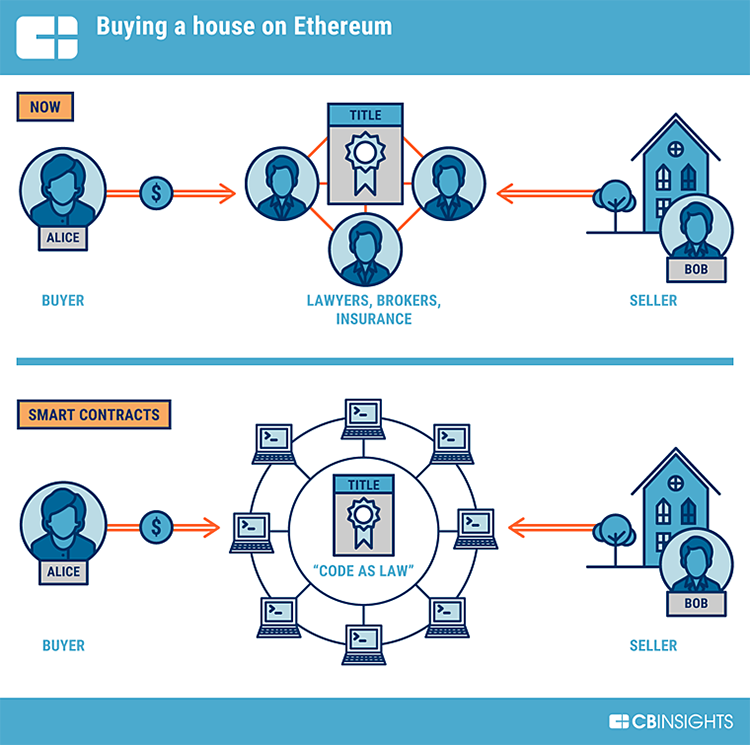
Take the real estate sector, for example…
A typical real estate transaction involves agents, brokers, lawyers, and insurers. But Ethereum replaces each of those middlemen with smart contracts.
A smart contract will automatically execute the deal if it meets all conditions for the sale – at a fraction of the costs of a traditional real estate transaction.
And if the smart contract executes on Ethereum, the parties will pay a fee in its native token, ether.
It’s estimated the finance sector extracts over $9.28 trillion annually from the global economy. That’s more money than the utilities sector, communication services sector, and real estate sectors combined.
DeFi will do for finance what the internet has done for so many other businesses: replace a high-cost middleman with a low-cost one.
It uses cutting-edge blockchain technology to prevent manipulation without relying on trusted third parties.
Take the real estate sector, for example…
A typical real estate transaction involves agents, brokers, lawyers, and insurers. But Ethereum replaces each of those middlemen with smart contracts.
A smart contract will automatically execute the deal if it meets all conditions for the sale – at a fraction of the costs of a traditional real estate transaction.
And if the smart contract executes on Ethereum, the parties will pay a fee in its native token, ether.
Eventually, Ethereum will make banking, borrowing, lending, and investing cheaper and more accessible for billions of people.
The good news is we still have a chance to get in on this trend early…
According to Grand View Research, DeFi will have an annualized growth rate of 42.5% over the rest of the decade, topping $230 billion in transactions from $12 billion in 2021.
Eventually, I believe Ethereum will do to the traditional financial services sector what Netflix did to Blockbuster and what Amazon did to Sears… It will wipe them off the map.
Hear me when I tell you this: Ethereum is the most important piece of software created for the deployment of other software programs.
That’s how powerful Ethereum is… And right now, the whole world is sleeping on just how valuable Ethereum will become.
The good news is we still have a chance to get in on this trend early…
According to Grand View Research, DeFi will have an annualized growth rate of 42.5% over the rest of the decade, topping $230 billion in transactions from $12 billion in 2021.
Eventually, I believe Ethereum will do to the traditional financial services sector what Netflix did to Blockbuster and what Amazon did to Sears… It will wipe them off the map.
Hear me when I tell you this: Ethereum is the most important piece of software created for the deployment of other software programs.
That’s how powerful Ethereum is… And right now, the whole world is sleeping on just how valuable Ethereum will become.
👉 The Gateway to $844 Trillion in Tokenized Assets
Based on my research, it’s clear to me Ethereum will eventually be the world’s most important software.
That will make it the tollbooth of Web 3.0. It will allow you to tokenize any asset (like real estate) and exchange it on the blockchain.
That’s why I call it the Infinity Exchange.
We’ve seen the first real use case for tokenization in the collectibles space.
For example, you can take a collectible asset like a painting and divide it into fractions. And a crypto token would represent each fraction of the asset – just like a share of stock represents an equity stake in a company.
Let’s say a seller owned a painting valued at $100,000. The owner could divide the painting into 10,000 fractions. That means each token would be worth $10.
If the painting later sells for $1 million at auction, each token would be worth $100.
Based on my research, it’s clear to me Ethereum will eventually be the world’s most important software.
That will make it the tollbooth of Web 3.0. It will allow you to tokenize any asset (like real estate) and exchange it on the blockchain.
That’s why I call it the Infinity Exchange.
We’ve seen the first real use case for tokenization in the collectibles space.
For example, you can take a collectible asset like a painting and divide it into fractions. And a crypto token would represent each fraction of the asset – just like a share of stock represents an equity stake in a company.
Let’s say a seller owned a painting valued at $100,000. The owner could divide the painting into 10,000 fractions. That means each token would be worth $10.
If the painting later sells for $1 million at auction, each token would be worth $100.
By tokenizing the painting, the seller can create a record for ownership… And multiple people could buy a stake in the painting.
That means vastly more people can get exposure to the collectibles space.
Up until tokenization began, only the ultra-rich could get into the space. Now, anyone could then buy, sell, or exchange their tokenized paintings on Ethereum – just like you can buy, sell, and exchange shares on a brokerage platform.
The key to tokenizing these assets will be non-fungible token (NFT) technology.
I get it if you think NFTs are a fad.
In 2021, we saw a buying frenzy as collectors paid millions of dollars for NFTs. One piece of digital artwork even sold at an auction for $69 million.
Then NFTs crashed along with the overall crypto market, and now many investors believe they’re worthless.
But pictures of punks and apes are just one application of NFT technology.
Using NFT technology to secure ownership rights to digital art and collectibles like Bored Apes and CryptoPunks was only the first use case to gain widespread traction – similar to how the first widespread use case for the internet was email.
Of course, today, we use the internet for much more than sending emails. The same will hold true for NFT technology in the future.
That’s because you can potentially tokenize any asset class on Ethereum – using NFT technology – and transact them with smart contracts.
As you can see in the chart below, we estimate the combined value of all global assets to be about $844 trillion.
That means vastly more people can get exposure to the collectibles space.
Up until tokenization began, only the ultra-rich could get into the space. Now, anyone could then buy, sell, or exchange their tokenized paintings on Ethereum – just like you can buy, sell, and exchange shares on a brokerage platform.
The key to tokenizing these assets will be non-fungible token (NFT) technology.
I get it if you think NFTs are a fad.
In 2021, we saw a buying frenzy as collectors paid millions of dollars for NFTs. One piece of digital artwork even sold at an auction for $69 million.
Then NFTs crashed along with the overall crypto market, and now many investors believe they’re worthless.
But pictures of punks and apes are just one application of NFT technology.
Using NFT technology to secure ownership rights to digital art and collectibles like Bored Apes and CryptoPunks was only the first use case to gain widespread traction – similar to how the first widespread use case for the internet was email.
Of course, today, we use the internet for much more than sending emails. The same will hold true for NFT technology in the future.
That’s because you can potentially tokenize any asset class on Ethereum – using NFT technology – and transact them with smart contracts.
As you can see in the chart below, we estimate the combined value of all global assets to be about $844 trillion.
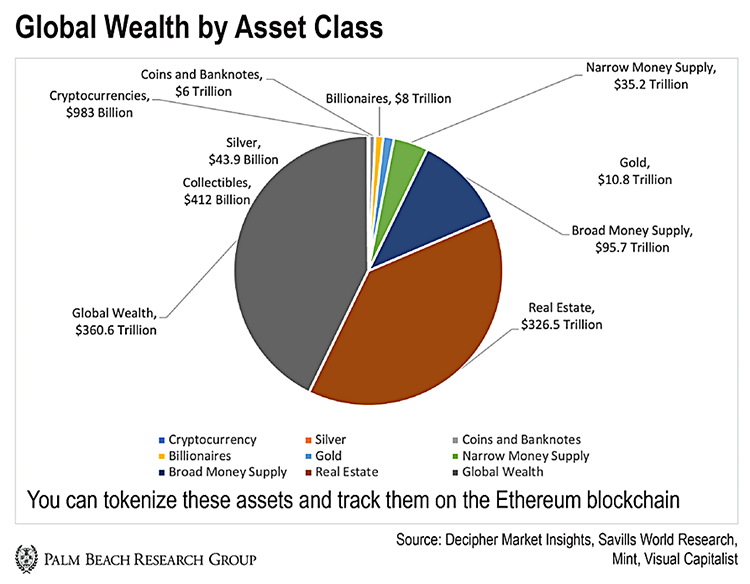
And you can tokenize nearly every one of those assets as an NFT and track them on the Ethereum blockchain.
Already, we’ve seen some institutions move to tokenizing financial assets:
Switzerland is adding tokenization to its banking infrastructure.
The Australian Securities Exchange expects to adopt digital tokens in 2023.
Japan is racing to tokenize its two main stock exchanges.
In time, I expect the Infinity Exchange to swallow up these assets whole. And we’ll see the price of ether skyrocket along with it
Already, we’ve seen some institutions move to tokenizing financial assets:
Switzerland is adding tokenization to its banking infrastructure.
The Australian Securities Exchange expects to adopt digital tokens in 2023.
Japan is racing to tokenize its two main stock exchanges.
In time, I expect the Infinity Exchange to swallow up these assets whole. And we’ll see the price of ether skyrocket along with it
👉
Bugsy
03.11.2022 21:45
What It’s Worth
Even if you’re not familiar with crypto, you know we’re mired in another Crypto Winter. Since hitting its all-time high of $4,892 in November 2021, ether is down 70%.
But as I’ll show you below, this pullback is a gift. It means you can invest in Ethereum at a huge discount before the next Crypto Spring blossoms.
You see, I first recommended ETH in April 2016 at just $9. Today, it’s up about 17,000%.
So if you bought $1,000 worth of ETH back then – and simply held on through the wild ride of the past six years – you’d have nearly $150,000 today.
That’s despite two brutal bear markets.
Right now, we can get in at fire sale prices. Here’s what I mean…
If ETH simply regains its all-time high of $4,892, that’s a 210% gain from current prices (at the time of writing)… But I think it has much more room to run.
That’s because the future is even brighter for Ethereum as the Infinity Exchange.
In September, Ethereum successfully completed its long-awaited Merge.
Even if you’re not familiar with crypto, you know we’re mired in another Crypto Winter. Since hitting its all-time high of $4,892 in November 2021, ether is down 70%.
But as I’ll show you below, this pullback is a gift. It means you can invest in Ethereum at a huge discount before the next Crypto Spring blossoms.
You see, I first recommended ETH in April 2016 at just $9. Today, it’s up about 17,000%.
So if you bought $1,000 worth of ETH back then – and simply held on through the wild ride of the past six years – you’d have nearly $150,000 today.
That’s despite two brutal bear markets.
Right now, we can get in at fire sale prices. Here’s what I mean…
If ETH simply regains its all-time high of $4,892, that’s a 210% gain from current prices (at the time of writing)… But I think it has much more room to run.
That’s because the future is even brighter for Ethereum as the Infinity Exchange.
In September, Ethereum successfully completed its long-awaited Merge.
The Merge transitioned Ethereum from proof-of-work to proof-of-stake.
Without getting into the weeds, the Merge will decrease the electricity required to power the Ethereum network by an estimated 99%.
That’s incredibly bullish, especially for investors who want to buy crypto assets that meet Environmental, Social, and Governance (ESG) standards.
The Merge will also reduce the issuance of new ETH by 90%.
When you combine that with the EIP-1559 upgrade, which burns the majority of fees on the Ethereum network, we could potentially have a deflationary asset.
As the supply decreases, Ethereum’s price should rise substantially.
In the past, I predicted Ethereum would hit a $1 trillion market cap. I may have been off on my timing, but I still believe it will get there in the coming years.
If it hits $1 trillion – as bitcoin did last year – that would make each ETH worth $8,757… That’s nearly a 6x gain from today’s prices.
But what really has me excited is Ethereum becoming the world’s Infinity Exchange.
Without getting into the weeds, the Merge will decrease the electricity required to power the Ethereum network by an estimated 99%.
That’s incredibly bullish, especially for investors who want to buy crypto assets that meet Environmental, Social, and Governance (ESG) standards.
The Merge will also reduce the issuance of new ETH by 90%.
When you combine that with the EIP-1559 upgrade, which burns the majority of fees on the Ethereum network, we could potentially have a deflationary asset.
As the supply decreases, Ethereum’s price should rise substantially.
In the past, I predicted Ethereum would hit a $1 trillion market cap. I may have been off on my timing, but I still believe it will get there in the coming years.
If it hits $1 trillion – as bitcoin did last year – that would make each ETH worth $8,757… That’s nearly a 6x gain from today’s prices.
But what really has me excited is Ethereum becoming the world’s Infinity Exchange.
As mentioned above, the estimated combined value of all the global assets is $844 trillion.
If Ethereum tokenizes just 1% of those assets, we’d see $8.4 trillion held on the Ethereum network.
As you can imagine, this would bring significantly more activity to the network. To get a sense of that usage, we can look at the impact DeFi had on the Ethereum network.
As some of you know, DeFi activity started to pick up in 2020 and peaked near the end of 2021 alongside the rest of the crypto market.
During this time, we saw the total value of assets held in DeFi protocols climb from roughly $600 million to $180 billion as decentralized exchanges and lending and trading platforms were built on the network.
These new use cases brought more assets to the ecosystem. And with it came a surge of demand to use the network.
From the start of 2020 to the end of 2021, the average price to use the network went from $0.10 per transaction to over $50. And the number of daily transactions jumped from roughly 550,000 to 1.25 million.
That means Ethereum was generating roughly $62.5 million each day in transaction fees toward the end of 2021.
If Ethereum tokenizes just 1% of those assets, we’d see $8.4 trillion held on the Ethereum network.
As you can imagine, this would bring significantly more activity to the network. To get a sense of that usage, we can look at the impact DeFi had on the Ethereum network.
As some of you know, DeFi activity started to pick up in 2020 and peaked near the end of 2021 alongside the rest of the crypto market.
During this time, we saw the total value of assets held in DeFi protocols climb from roughly $600 million to $180 billion as decentralized exchanges and lending and trading platforms were built on the network.
These new use cases brought more assets to the ecosystem. And with it came a surge of demand to use the network.
From the start of 2020 to the end of 2021, the average price to use the network went from $0.10 per transaction to over $50. And the number of daily transactions jumped from roughly 550,000 to 1.25 million.
That means Ethereum was generating roughly $62.5 million each day in transaction fees toward the end of 2021.
Now, with the emergence of scaling solutions, we’ve seen transaction fees come down substantially since then.
But if 1% of the world’s assets become tokenized on the Ethereum blockchain, I believe we could see layer-1 network demand return to – and exceed – prior highs.
If so, Ethereum would generate roughly $22.8 billion each year in network fees.
To get a sense of what this means for the price of Ethereum, we can attach a price-to-earnings (P/E) multiple similar to that of a high-growth tech company like Amazon, T-Mobile, or Digi International.
[The P/E ratio represents what an investor is willing to pay for $1 of a company’s earnings. For example, at a P/E ratio of 20, an investor is saying they’re willing to pay $20 for $1 of its earnings. It’s calculated by taking a company’s share price and dividing it by its earnings per share.]
If we use a 100 P/E multiple, Ethereum would be valued at $2.24 trillion. Or roughly $20,505 per token when taking into account today’s circulating supply.
That’s a 1,200% increase from today’s price (at the time of writing).
If Ethereum becomes the Infinity Exchange for 10% of global assets, this best-case scenario could prove conservative.
But that will take longer to play out than a 10x return in the next bull run.
But if 1% of the world’s assets become tokenized on the Ethereum blockchain, I believe we could see layer-1 network demand return to – and exceed – prior highs.
If so, Ethereum would generate roughly $22.8 billion each year in network fees.
To get a sense of what this means for the price of Ethereum, we can attach a price-to-earnings (P/E) multiple similar to that of a high-growth tech company like Amazon, T-Mobile, or Digi International.
[The P/E ratio represents what an investor is willing to pay for $1 of a company’s earnings. For example, at a P/E ratio of 20, an investor is saying they’re willing to pay $20 for $1 of its earnings. It’s calculated by taking a company’s share price and dividing it by its earnings per share.]
If we use a 100 P/E multiple, Ethereum would be valued at $2.24 trillion. Or roughly $20,505 per token when taking into account today’s circulating supply.
That’s a 1,200% increase from today’s price (at the time of writing).
If Ethereum becomes the Infinity Exchange for 10% of global assets, this best-case scenario could prove conservative.
But that will take longer to play out than a 10x return in the next bull run.
Bugsy
07.11.2022 20:48
7.11.2022
Ethereum (ETH)… There’s some exciting news here. It's actually gone deflationary for the first time, starting around mid-October.
As you know, after the Merge, the issuance rate of ETH dropped by about 90%. So as long as there's enough activity on the network, a portion of the fees gets burned, and that causes ETH to be deflationary. So the ETH supply since about a month ago has actually dropped by 10,000 ETH.
As ETH gets burned, the remaining ETH becomes more valuable. That's going to be good for us. And as we've seen, Ethereum’s done quite well since the middle of the year.
As you know, after the Merge, the issuance rate of ETH dropped by about 90%. So as long as there's enough activity on the network, a portion of the fees gets burned, and that causes ETH to be deflationary. So the ETH supply since about a month ago has actually dropped by 10,000 ETH.
As ETH gets burned, the remaining ETH becomes more valuable. That's going to be good for us. And as we've seen, Ethereum’s done quite well since the middle of the year.
👉 The next one is MATIC. That's the token for Polygon.
Polygon’s a layer-2 ecosystem on top of Ethereum. It’s one of the key projects named by Meta, formerly known as Facebook, as a partner for NFTs on Instagram. And it was also part of that institutional trade with the government of Singapore. So we have a lot of good news coming out with MATIC.
Polygon’s a layer-2 ecosystem on top of Ethereum. It’s one of the key projects named by Meta, formerly known as Facebook, as a partner for NFTs on Instagram. And it was also part of that institutional trade with the government of Singapore. So we have a lot of good news coming out with MATIC.
👉 Another one is Evmos. This is our most recent pick. As you recall, it’s a Cosmos chain that supports the EVM, or the Ethereum Virtual Machine. And we know that EVM has become a key piece of software for smart contracts in the crypto universe. So it's a very exciting project.
Tharsis Labs, which is the development company behind Evmos, just announced that it raised $27 million. This funding was led by Polychain Capital, and Galaxy Digital, Coinbase Ventures, Circle Ventures, and a few others were also involved.
Tharsis is going to use the funds to hire more engineers, develop partnerships, and build out the ecosystem. So that's some great news.
Tharsis Labs, which is the development company behind Evmos, just announced that it raised $27 million. This funding was led by Polychain Capital, and Galaxy Digital, Coinbase Ventures, Circle Ventures, and a few others were also involved.
Tharsis is going to use the funds to hire more engineers, develop partnerships, and build out the ecosystem. So that's some great news.
👉 The next one is Crypto.com and its Cronos blockchain (CRO). It announced it just surpassed 70 million users, which puts it in the same ballpark as Coinbase and Binance in terms of number of users. It also announced it'll exceed $1 billion in revenues for 2022.
This is a play where when we get to the next rally, Crypto.com is just so well positioned to leverage this massive user base that it’s grown. In the meantime, people are probably going to keep talking about the commercial with Matt Damon that came out last year around the top of the market. But that's not real news. The real news is Crypto.com is expanding its user base, and it’s well positioned for the next crypto rally.
This is a play where when we get to the next rally, Crypto.com is just so well positioned to leverage this massive user base that it’s grown. In the meantime, people are probably going to keep talking about the commercial with Matt Damon that came out last year around the top of the market. But that's not real news. The real news is Crypto.com is expanding its user base, and it’s well positioned for the next crypto rally.
👉 So ATOM… That's the token for Cosmos. We've been writing about Cosmos 2.0, and it’s basically making a bunch of upgrades to the network. It introduced interchange security. Essentially, other chains can use the Cosmos validator to secure their blockchains. So that will increase demand for the ATOM token as well as increase the fees that are generated for ATOM stakers, which is us. So that's great news.
Cosmos also introduced liquid staking. So what that enables you to do is use your staked ATOM in other DeFi protocols. That's an important development because people no longer have to make the decision, “Do I stake, or do I participate in DeFi?” This way you can do both, and it improves the capital efficiency of the ecosystem.
And then coming up for Cosmos is what it calls its interchange scheduler and interchange allocator. This is just a fancy way of saying it’s going to be allocating a portion of the fees to a treasury and then use that treasury for on-chain investments into Cosmos ecosystem projects. So that's something on tap for 2023 that will help facilitate the ecosystem.
There’s one final piece of news for ATOM, and it’s pretty big. Circle announced its USDC stablecoin will be coming to Cosmos in early 2023. And what it’s going to do is spin up its own application-specific blockchain just for USDC. It’s going to use interchange security. It'll use the Cosmos hub to secure its network, and we'll have USDC on the Cosmos ecosystem.
And that's big because Cosmos doesn’t really have a stablecoin right now. So to have a stablecoin in its ecosystem will help facilitate growth along with the other changes it’s making.
Cosmos also introduced liquid staking. So what that enables you to do is use your staked ATOM in other DeFi protocols. That's an important development because people no longer have to make the decision, “Do I stake, or do I participate in DeFi?” This way you can do both, and it improves the capital efficiency of the ecosystem.
And then coming up for Cosmos is what it calls its interchange scheduler and interchange allocator. This is just a fancy way of saying it’s going to be allocating a portion of the fees to a treasury and then use that treasury for on-chain investments into Cosmos ecosystem projects. So that's something on tap for 2023 that will help facilitate the ecosystem.
There’s one final piece of news for ATOM, and it’s pretty big. Circle announced its USDC stablecoin will be coming to Cosmos in early 2023. And what it’s going to do is spin up its own application-specific blockchain just for USDC. It’s going to use interchange security. It'll use the Cosmos hub to secure its network, and we'll have USDC on the Cosmos ecosystem.
And that's big because Cosmos doesn’t really have a stablecoin right now. So to have a stablecoin in its ecosystem will help facilitate growth along with the other changes it’s making.
👉 Then there’s one final crypto for today: Livepeer.
Livepeer is the open video infrastructure launched on Ethereum, and it’s now on layer-2 Arbitrum. Basically, developers can use Livepeer’s network to build decentralized video streaming applications. This is a good example of a project that continues to just chug along during the crypto winter, and it continues to see increased usage.
Livepeer measures its usage in minutes, and the minutes measure how much video has been transcoded. It actually set a record in the third quarter of 37 million minutes, and that was up about 12% from the quarter before. So that's pretty impressive to see the project continue to get increased usage even though we're in the middle of a crypto winter.
Livepeer is the open video infrastructure launched on Ethereum, and it’s now on layer-2 Arbitrum. Basically, developers can use Livepeer’s network to build decentralized video streaming applications. This is a good example of a project that continues to just chug along during the crypto winter, and it continues to see increased usage.
Livepeer measures its usage in minutes, and the minutes measure how much video has been transcoded. It actually set a record in the third quarter of 37 million minutes, and that was up about 12% from the quarter before. So that's pretty impressive to see the project continue to get increased usage even though we're in the middle of a crypto winter.
Bugsy
08.11.2022 17:19
The Company With a Solution to the Opioid Crisis
The settlement news from CVS, Walmart, and Walgreens reinforces our belief Big Pharma and pharmaceutical retailers not only need a solution… but realize the solution could be worth billions.
The first to market with a practical alternative will be a game-changer. And Isosceles just took a giant leap forward to potentially get to market with its delivery system much faster than we initially anticipated.
Recall, Isosceles already has two product candidates in development. Both use novel delivering systems to deliver synthetic cannabidiol (CBD).
Multiple studies have also shown that synthetic CBD is an effective, non-addictive alternative to opioids, specifically when it comes to pain relief.
While CBD is non-addictive, it comes with some side effects like liver damage. Plus, because many users take CBD orally, it’s highly inefficient. (We covered these drawbacks in our original writeup.)
To solve the inefficiency and side effects problems, Isosceles has developed two novel delivery mechanisms.
The settlement news from CVS, Walmart, and Walgreens reinforces our belief Big Pharma and pharmaceutical retailers not only need a solution… but realize the solution could be worth billions.
The first to market with a practical alternative will be a game-changer. And Isosceles just took a giant leap forward to potentially get to market with its delivery system much faster than we initially anticipated.
Recall, Isosceles already has two product candidates in development. Both use novel delivering systems to deliver synthetic cannabidiol (CBD).
Multiple studies have also shown that synthetic CBD is an effective, non-addictive alternative to opioids, specifically when it comes to pain relief.
While CBD is non-addictive, it comes with some side effects like liver damage. Plus, because many users take CBD orally, it’s highly inefficient. (We covered these drawbacks in our original writeup.)
To solve the inefficiency and side effects problems, Isosceles has developed two novel delivery mechanisms.
IPI-201. This delivery system uses an intravenous (IV) formulation. It will target postoperative pain.
IPI-301. This delivery system uses a microneedle intradermal delivery system. It will manage chronic pain.
Isosceles holds patents for the delivery system of both products. But let’s focus on IPI-201, the IV delivery system. It seeks to replace opioid and other addictive painkillers.
Two key Isosceles team members developed an IV delivery system for acetaminophen (the active ingredient in Tylenol). So the company will benefit from the existing research on that product.
The IV route is potentially groundbreaking. Patients who use IPI-201 will receive greater pain relief from a lower dosage… while decreasing the risk of side effects.
Isosceles has already moved to protect IPI-201 with a U.S. and international patent.
In the October issue, we laid out the entire case on why we’re bullish on Isosceles and IPI-201. But since then, it has announced a major partnership that’s made us even more optimistic…
On October 31, the company signed a non-binding letter of intent with a strategic partner for Phase I development of IPI-201.
IPI-301. This delivery system uses a microneedle intradermal delivery system. It will manage chronic pain.
Isosceles holds patents for the delivery system of both products. But let’s focus on IPI-201, the IV delivery system. It seeks to replace opioid and other addictive painkillers.
Two key Isosceles team members developed an IV delivery system for acetaminophen (the active ingredient in Tylenol). So the company will benefit from the existing research on that product.
The IV route is potentially groundbreaking. Patients who use IPI-201 will receive greater pain relief from a lower dosage… while decreasing the risk of side effects.
Isosceles has already moved to protect IPI-201 with a U.S. and international patent.
In the October issue, we laid out the entire case on why we’re bullish on Isosceles and IPI-201. But since then, it has announced a major partnership that’s made us even more optimistic…
On October 31, the company signed a non-binding letter of intent with a strategic partner for Phase I development of IPI-201.
This partnership is significant for a number of reasons. While we don’t know who the partner is, we know it’ll provide Isosceles with a proven contract research organization (CRO) partner.
This CRO gives Isosceles the potential to begin human trials in 2023. This is a big step forward in its push to validate IPI-201 as a treatment for pain.
One of the biggest benefits of investing in private biotechs, medical device, and delivery companies is they march to the beat of their own drum. Market sentiment can impact these types of companies… But data and results matter more than anything.
Good data for a biotech company will trump even the most bearish of markets almost every time. We have a unique opportunity with Isosceles because the weakness in the broad economy has priced many private offerings much more competitively than what we’d see in a bullish environment.
As we wrote last month, Isosceles’s goal is to raise up to $5 million through its Reg. CF offering. It’s selling shares for $2.05 apiece. The minimum buy-in for this deal is $500. That means the minimum purchase is 244 shares.
This CRO gives Isosceles the potential to begin human trials in 2023. This is a big step forward in its push to validate IPI-201 as a treatment for pain.
One of the biggest benefits of investing in private biotechs, medical device, and delivery companies is they march to the beat of their own drum. Market sentiment can impact these types of companies… But data and results matter more than anything.
Good data for a biotech company will trump even the most bearish of markets almost every time. We have a unique opportunity with Isosceles because the weakness in the broad economy has priced many private offerings much more competitively than what we’d see in a bullish environment.
As we wrote last month, Isosceles’s goal is to raise up to $5 million through its Reg. CF offering. It’s selling shares for $2.05 apiece. The minimum buy-in for this deal is $500. That means the minimum purchase is 244 shares.
Right now, Isosceles is valued at $30 million. As we wrote in our original writeup, we believe it’s eventually on track for a $500 million valuation. That would imply a 16.7x return – enough to turn every $500 into $8,350.
And based on our research, it has blue-sky potential of 100x over the next five years – assuming Isosceles passes Phase III clinical trials.
However, we believe a company will purchase Isosceles long before that.
Surprisingly, this deal remains open – even though we believe it’s one of the best private opportunities we’ve even seen
And based on our research, it has blue-sky potential of 100x over the next five years – assuming Isosceles passes Phase III clinical trials.
However, we believe a company will purchase Isosceles long before that.
Surprisingly, this deal remains open – even though we believe it’s one of the best private opportunities we’ve even seen
Given the strong management team… a clear path to revenue for IPI-301… and now a strategic partnership that will potentially get IPI-201 to market faster than anticipated, we’re recommending this deal once again.
We believe it has the best risk-reward profile of anything available currently in the private equity space.
If you missed our initial recommendation, we encourage you to revisit our analysis and views on the upside potential of Isosceles.
The recent lawsuits against pharmacy giants show just how relevant Isosceles’ technology is right now… Plus, we’re more excited than ever now that it’s signed this letter of intent with a strategic partner.
Soon, we believe the market will wake up to this opportunity and the deal will fill quickly once it does.
We believe it has the best risk-reward profile of anything available currently in the private equity space.
If you missed our initial recommendation, we encourage you to revisit our analysis and views on the upside potential of Isosceles.
The recent lawsuits against pharmacy giants show just how relevant Isosceles’ technology is right now… Plus, we’re more excited than ever now that it’s signed this letter of intent with a strategic partner.
Soon, we believe the market will wake up to this opportunity and the deal will fill quickly once it does.
Bugsy
09.11.2022 20:25
9.11.2022
Why Everybody Started Pulling Their Money off FTX
FTX is one of the largest crypto exchanges in the world. It’s in the top five in volume of crypto exchanges. You’ve probably seen its name all over the place. It’s been sponsoring a bunch of sponsorships. It’s been doing a bunch of high-profile lobbying on behalf of the crypto industry.
Anyway, long story short, FTX is owned by Sam Bankman-Fried. He’s the majority owner, and he also owns a quantitative trading firm called Alameda. Alameda supposedly has about $15 billion in assets on its books. Anyway, it came out a little bit ago that its asset book was leaked, and it came out that many of its assets were backed by FTX’s own token.
So why is that a problem? Well, when you’re backing 30%, 40% of your asset book with tokens that you essentially printed out of nowhere, it makes the rest of your counterparties a little bit concerned about the value of your collateral. On top of that it came out that Alameda had been taking out lines of credit and leveraging against these assets
FTX is one of the largest crypto exchanges in the world. It’s in the top five in volume of crypto exchanges. You’ve probably seen its name all over the place. It’s been sponsoring a bunch of sponsorships. It’s been doing a bunch of high-profile lobbying on behalf of the crypto industry.
Anyway, long story short, FTX is owned by Sam Bankman-Fried. He’s the majority owner, and he also owns a quantitative trading firm called Alameda. Alameda supposedly has about $15 billion in assets on its books. Anyway, it came out a little bit ago that its asset book was leaked, and it came out that many of its assets were backed by FTX’s own token.
So why is that a problem? Well, when you’re backing 30%, 40% of your asset book with tokens that you essentially printed out of nowhere, it makes the rest of your counterparties a little bit concerned about the value of your collateral. On top of that it came out that Alameda had been taking out lines of credit and leveraging against these assets
So what that did was it really opened up FTX and Alameda to attack. Once the rest of the industry saw just how dependent Alameda and FTX was on the value of the FTT token, which is the token that’s issued by the FTX Exchange, all bets were off.
In fact, Changpeng Zhao, who runs Binance, which is the biggest offshore crypto exchange in the world, came out and said, “Look, we’re going to dump half a billion dollars of your tokens.” He compared FTX and the FTT token to LUNA, which collapsed and basically went into a death spiral. And then everybody started pulling their money off FTX.
Now, FTX isn’t a bank… It’s a brokerage firm. In a traditional brokerage firm, if everybody were to try to pull their money off their brokerage account, theoretically they should be able to do so. Obviously, brokers lend out your stock, and they have stock loan departments, but they also have the ability to call those stocks in at any time that they want to. So every dollar in should be matched with a dollar out.
In fact, Changpeng Zhao, who runs Binance, which is the biggest offshore crypto exchange in the world, came out and said, “Look, we’re going to dump half a billion dollars of your tokens.” He compared FTX and the FTT token to LUNA, which collapsed and basically went into a death spiral. And then everybody started pulling their money off FTX.
Now, FTX isn’t a bank… It’s a brokerage firm. In a traditional brokerage firm, if everybody were to try to pull their money off their brokerage account, theoretically they should be able to do so. Obviously, brokers lend out your stock, and they have stock loan departments, but they also have the ability to call those stocks in at any time that they want to. So every dollar in should be matched with a dollar out.
The only time that’s not true is in banking because banking uses fractional reserves. So they’re never in a position where if everybody comes and asks for their money, they can give you your money. But brokerage firms are different. Brokerage firms are supposed to have the capital segregated. They’re not supposed to (except in certain instances) hypothecate that capital .
Even FTX said that it doesn’t hypothecate the capital, that it doesn’t trade with customers’ capital. Well, that’s clearly not true because it received something like 6 billion requests to pull money off the exchange… And if it truly had segregated accounts, if it truly wasn’t trading on those assets or hypothecating those assets, which means to borrow against your customers’ assets… Well, it should have been no problem to give everybody their money back.
Sure, it would’ve hurt FTX from a liquidity standpoint. But it should have had ample liquidity to do that. The fact it didn’t suggests that FTX was engaging in… Look, I don’t want to get sued, but let’s call it behavior that wasn’t in the best interest of its underlying clients.
So what’s the fallout of this? Well, the fallout of this is Sam Bankman-Fried has had to sell FTX, his crown jewel responsible for 95% of the revenue of his business, to Changpeng Zhao, who runs Binance.
Even FTX said that it doesn’t hypothecate the capital, that it doesn’t trade with customers’ capital. Well, that’s clearly not true because it received something like 6 billion requests to pull money off the exchange… And if it truly had segregated accounts, if it truly wasn’t trading on those assets or hypothecating those assets, which means to borrow against your customers’ assets… Well, it should have been no problem to give everybody their money back.
Sure, it would’ve hurt FTX from a liquidity standpoint. But it should have had ample liquidity to do that. The fact it didn’t suggests that FTX was engaging in… Look, I don’t want to get sued, but let’s call it behavior that wasn’t in the best interest of its underlying clients.
So what’s the fallout of this? Well, the fallout of this is Sam Bankman-Fried has had to sell FTX, his crown jewel responsible for 95% of the revenue of his business, to Changpeng Zhao, who runs Binance.
Now, Zhao’s firm, Binance, came out and said that it signed a nonbinding LOI, which basically means nothing. It means, “We’re going to take a look at this deal. If we like it, we’ll buy it. If we don’t like it, we’re going to pull out.”
So again, the problem here, and the problems that we’ve seen over the last year in crypto, haven’t been crypto problems. They’ve been centralized finance, greed-based lying problems, very human problems that we have in the traditional financial industry.
And the beauty of crypto is that there’s no one there to rescue you. There’s no Federal Reserve. There’s no SEC to come in and adjudicate. There’s nothing like that. If you don’t run a good business, crypto will destroy you. If you’re stupid enough to use massive leverage on assets that can drop 80% overnight, which is what happened to the FTT token, then you’re a dumbass, and you deserve to lose everything.
So again, the problem here, and the problems that we’ve seen over the last year in crypto, haven’t been crypto problems. They’ve been centralized finance, greed-based lying problems, very human problems that we have in the traditional financial industry.
And the beauty of crypto is that there’s no one there to rescue you. There’s no Federal Reserve. There’s no SEC to come in and adjudicate. There’s nothing like that. If you don’t run a good business, crypto will destroy you. If you’re stupid enough to use massive leverage on assets that can drop 80% overnight, which is what happened to the FTT token, then you’re a dumbass, and you deserve to lose everything.
That’s the unforgiving nature of crypto that people will try to vilify crypto for. And that’s a mistake. It’s the beauty of crypto. It’s unparalleled capitalism. It’s the type of capitalism that America was built on, the type of capitalism where you can’t run to your mama to go bail you out if you’ve been an idiot.
And Sam Bankman-Fried was an idiot. You can’t build a trading firm on a token that you issue that has no direct value and isn’t backed by anything. We all found that out with LUNA. So for Sam Bankman-Fried to do that and then stand there trying to bail everybody else out and spending all this money, putting the FTX name on it seems like every stadium on the planet, it’s a hundred layers of dumb. I mean, you’ve got to be really, really smart to be that stupid.
And Sam Bankman-Fried was an idiot. You can’t build a trading firm on a token that you issue that has no direct value and isn’t backed by anything. We all found that out with LUNA. So for Sam Bankman-Fried to do that and then stand there trying to bail everybody else out and spending all this money, putting the FTX name on it seems like every stadium on the planet, it’s a hundred layers of dumb. I mean, you’ve got to be really, really smart to be that stupid.
👉
Bitcoin and Ethereum Are Going Lower
So what’s going to be the fallout of this? Everything’s going down. Alameda Capital was… We don’t know how leveraged it was. FTX, we have no idea how leveraged it was. It probably borrowed tons of money from a bunch of different players. Those players’ books are a black book. We don’t know who owes who what.
It’s very similar to what we saw back in 2008 and 2009 with these credit default swaps where nobody really knew who had liability because it was all so opaque, which is the exact opposite of what crypto was built on. So over the next few days, weeks, and months, you’re going to see a lot of firms just blow up. You’re going to see a lot of people having to unwind positions and be forced to sell.
Yesterday we saw bitcoin make a new low, go down to $17,300, and pump back up to $20,000. Then $19,000… $18,000… Overnight, it went back down to $17,000 before trading at $18,000 again.
And now I’ll tell you unequivocally we’re going lower. Bitcoin’s going lower. Ethereum’s going lower. Why? For the same reason that we saw earlier in the year: We’re going to see forced selling. If you’re using leverage, you’re out of your mind. Just don’t leverage these assets.
So what’s going to be the fallout of this? Everything’s going down. Alameda Capital was… We don’t know how leveraged it was. FTX, we have no idea how leveraged it was. It probably borrowed tons of money from a bunch of different players. Those players’ books are a black book. We don’t know who owes who what.
It’s very similar to what we saw back in 2008 and 2009 with these credit default swaps where nobody really knew who had liability because it was all so opaque, which is the exact opposite of what crypto was built on. So over the next few days, weeks, and months, you’re going to see a lot of firms just blow up. You’re going to see a lot of people having to unwind positions and be forced to sell.
Yesterday we saw bitcoin make a new low, go down to $17,300, and pump back up to $20,000. Then $19,000… $18,000… Overnight, it went back down to $17,000 before trading at $18,000 again.
And now I’ll tell you unequivocally we’re going lower. Bitcoin’s going lower. Ethereum’s going lower. Why? For the same reason that we saw earlier in the year: We’re going to see forced selling. If you’re using leverage, you’re out of your mind. Just don’t leverage these assets.
Again and again, as I’ve said from the very beginning, we don’t need to use leverage. We don’t even need to use massive position sizing. We’re so early in the adoption of this asset class, in the development of this asset class, it’s just not necessary. Over time, this asset class will be worth $10 trillion, $20 trillion, $30 trillion… I mean, multiple tens of trillions of dollars. And all that’s required is a bit of common sense and small, uniform position sizes over a well-chosen array of investments.
Yes, some of them will go to zero. Yes, some of them will go down 90% before going up 50,000%. It’s the nature of this asset class, and if you can be rational and not too greedy, it’ll change your life.
Right now, what we’re dealing with are the after-effects of massive greed. So we’re going to see a lot of negative articles in the news. We’re going to see the regulators start getting crazy. I’ll tell you this right now, for centralized players in crypto, we should have regulation – period. I’ll tell you that right now. If you’re going to be custodying my money, client funds, you better be regulated. So that that’s going to change.
Yes, some of them will go to zero. Yes, some of them will go down 90% before going up 50,000%. It’s the nature of this asset class, and if you can be rational and not too greedy, it’ll change your life.
Right now, what we’re dealing with are the after-effects of massive greed. So we’re going to see a lot of negative articles in the news. We’re going to see the regulators start getting crazy. I’ll tell you this right now, for centralized players in crypto, we should have regulation – period. I’ll tell you that right now. If you’re going to be custodying my money, client funds, you better be regulated. So that that’s going to change.
Now, if we look at the actual, true decentralized protocols, true decentralized finance… That area of the market, which is the market that I care about – true decentralization, not centralized financial players –that market’s thriving. That market’s growing.
Yes, there have been problems there. But the way those protocols are designed, the problems don’t get out of control. You can’t borrow more than whatever the smart contract says. You can borrow, and the smart contract makes sure that everything is sufficiently collateralized. So you don’t have these death spirals that end up with these huge debts and us, the customers, paying the price.
Yes, you have market risk in DeFi. That’s fine. I’ll deal with market risk. But centralized holders of my capital? I got into crypto to escape that risk. I lived through 2008, 2009 – many of us did – and we saw how these centralized players in Wall Street that had begged us for our trust, absolutely abused our trust. I don’t want to rely on human trust anymore. To me, that’s the reason why I have so much of my money in bitcoin, because I don’t have to rely on trust.
Yes, there have been problems there. But the way those protocols are designed, the problems don’t get out of control. You can’t borrow more than whatever the smart contract says. You can borrow, and the smart contract makes sure that everything is sufficiently collateralized. So you don’t have these death spirals that end up with these huge debts and us, the customers, paying the price.
Yes, you have market risk in DeFi. That’s fine. I’ll deal with market risk. But centralized holders of my capital? I got into crypto to escape that risk. I lived through 2008, 2009 – many of us did – and we saw how these centralized players in Wall Street that had begged us for our trust, absolutely abused our trust. I don’t want to rely on human trust anymore. To me, that’s the reason why I have so much of my money in bitcoin, because I don’t have to rely on trust.
I rely on the algorithm, on the rules of the algorithm, which have continued to shepherd bitcoin’s holders to safety over the long term. Certainly over the shorter term and intermediate term, yes, we’ve had many times when bitcoin dropped 70%, 80%, 90%. But bitcoin has always come back. And why? Because of the sanctity of that code. It doesn’t matter how much power, wealth, or influence you have, you can’t change the code of bitcoin. And that’s inherently valuable to bitcoin.
So again, why is bitcoin down? Why is Ethereum down? It’s because of all these leveraged borrowers. We don’t know how much money they used to speculate on bitcoin, how much money they leveraged. We don’t know how much money they borrowed against their Ethereum positions. We have no idea. It’s a true black box in the DeFi protocols. We can see it because everything is on chain… But for these private trading firms and these centralized financial providers, we have no clue.
It has to change. And if it doesn’t change, I wouldn’t be surprised to see the U.S. regulators just say, “No, you can’t even touch the American market.” And I don’t want to see that because it affects the growth of this asset class. So somewhere between “No one is allowed to use any of these centralized foreign exchanges” to “OK, there are absolutely no rules, and you can do whatever you want”… There has to be a middle ground. I think, ultimately, we’ll find the middle ground.
So again, why is bitcoin down? Why is Ethereum down? It’s because of all these leveraged borrowers. We don’t know how much money they used to speculate on bitcoin, how much money they leveraged. We don’t know how much money they borrowed against their Ethereum positions. We have no idea. It’s a true black box in the DeFi protocols. We can see it because everything is on chain… But for these private trading firms and these centralized financial providers, we have no clue.
It has to change. And if it doesn’t change, I wouldn’t be surprised to see the U.S. regulators just say, “No, you can’t even touch the American market.” And I don’t want to see that because it affects the growth of this asset class. So somewhere between “No one is allowed to use any of these centralized foreign exchanges” to “OK, there are absolutely no rules, and you can do whatever you want”… There has to be a middle ground. I think, ultimately, we’ll find the middle ground.
But what I’ve learned from regulation is it looks like a pendulum. It’ll be swinging in one direction, then it’ll swing back in the other and it’ll finally find an equilibrium.
The closest parallel to what’s going on right now that I can see to traditional finance is really the early years of the American stock market, which were just as degenerate as some of these players that we’re seeing now. There was no SEC until the ‘30s. There were no insider trading rules. There were no rules on capital, on having adequate capital or safeguarding customer assets. And you would see brokerage firms just rise up and go out of business… rise up and go out of business… rise up and go out of business.
In the early part of the 1900s that was true, and you would see crazy panics. You would see bank runs that were just brutal until proper rules were enacted that would safeguard customer funds. So if you’re going to take customers’ funds, there have to be rules because history has proven again and again that humans are just greedy, and humans are fundamentally flawed and make awful decisions and terrible mistakes.
Again, the whole point of decentralized finance, of crypto, is to remove trust from the equation, to provide a marketplace or provide an asset that I can trade, borrow against, do all these different things with but not have to rely on a centralized third party.
The closest parallel to what’s going on right now that I can see to traditional finance is really the early years of the American stock market, which were just as degenerate as some of these players that we’re seeing now. There was no SEC until the ‘30s. There were no insider trading rules. There were no rules on capital, on having adequate capital or safeguarding customer assets. And you would see brokerage firms just rise up and go out of business… rise up and go out of business… rise up and go out of business.
In the early part of the 1900s that was true, and you would see crazy panics. You would see bank runs that were just brutal until proper rules were enacted that would safeguard customer funds. So if you’re going to take customers’ funds, there have to be rules because history has proven again and again that humans are just greedy, and humans are fundamentally flawed and make awful decisions and terrible mistakes.
Again, the whole point of decentralized finance, of crypto, is to remove trust from the equation, to provide a marketplace or provide an asset that I can trade, borrow against, do all these different things with but not have to rely on a centralized third party.
Now, I know that decentralized trading isn’t really where it needs to be in terms of speed, cost, and ease of use versus using a centralized type of broker. And so we’re still going to have to use centralized brokers until the decentralized exchanges improve their technology and improve their user interfaces.
But as I’ve always said from the beginning, if it’s not your keys, it’s not your crypto. And I understand that not everybody can take custody of their own crypto. I’m not ignorant to the fact that some people just shouldn’t take custody of their own crypto because they’re forgetful or they just have trouble navigating the wallets.
But if you can, I strongly urge you to take possession of your own crypto. And if you do that, you have to be very careful. You can’t store your seed phrase or your access keys on your computer. If you write them down, you’ve got to have several copies, because this is your money. If you lose your password or you lose your seed phrase, that’s it. The money’s gone.
But as I’ve always said from the beginning, if it’s not your keys, it’s not your crypto. And I understand that not everybody can take custody of their own crypto. I’m not ignorant to the fact that some people just shouldn’t take custody of their own crypto because they’re forgetful or they just have trouble navigating the wallets.
But if you can, I strongly urge you to take possession of your own crypto. And if you do that, you have to be very careful. You can’t store your seed phrase or your access keys on your computer. If you write them down, you’ve got to have several copies, because this is your money. If you lose your password or you lose your seed phrase, that’s it. The money’s gone.
It’s an incredible responsibility. But I’m grateful that we have that responsibility because when I first started on Wall Street, we could take possession of our own stocks. We could take possession of our own bonds. We had things like bearer bonds that were ours, and we didn’t have to show ID for our own capital.
Those days are long gone. That was more than 30 years ago. So crypto is the last place where you can actually own and custody your own assets. To me, that’s incredibly valuable. So if you’re trading on centralized exchanges, just be aware of that. Do your trades and take your money out, because what we’ve learned is that we can’t trust these centralized exchanges, and certainly not the offshore exchanges.
Now, if you do have to keep your money on an exchange… You say, “Look, T, I lose my phone all the time, or I lose my wallet all the time, or I’m just a forgetful person”… Then in that instance, I think you have to stick to the American exchanges. You have look at Coinbase, you have look at Kraken. You have to look at Gemini.
(upraveno)
Those days are long gone. That was more than 30 years ago. So crypto is the last place where you can actually own and custody your own assets. To me, that’s incredibly valuable. So if you’re trading on centralized exchanges, just be aware of that. Do your trades and take your money out, because what we’ve learned is that we can’t trust these centralized exchanges, and certainly not the offshore exchanges.
Now, if you do have to keep your money on an exchange… You say, “Look, T, I lose my phone all the time, or I lose my wallet all the time, or I’m just a forgetful person”… Then in that instance, I think you have to stick to the American exchanges. You have look at Coinbase, you have look at Kraken. You have to look at Gemini.
Now, they aren’t immune to these problems, but they’re based in the United States. They operate under U.S. rules. Many of them have insurance. If you look at something like Coinbase in terms of a good housekeeping seal of approval, if you will, the fact that BlackRock is going to work with it, the fact that so many large blue-chip companies and pension funds have trusted it to hold their crypto, that’s a big deal. You can’t ignore that. So I would say try and keep your trading on U.S. exchanges.
I understand a lot of the time we have to use Binance. Binance so far certainly has proven itself to be a credible player in the space. But even with Binance, you’ve got no recourse. If it goes out of business, you’ve got no recourse if it pulls up stakes. And I’m not suggesting that it would in any way, shape, or form… But again, it’s incumbent on you to protect yourself, even if it’s simply running a trade on Binance and then transferring it to a U.S. entity… or for tokens that aren’t traded here in the States, putting them on a wallet.
I understand a lot of the time we have to use Binance. Binance so far certainly has proven itself to be a credible player in the space. But even with Binance, you’ve got no recourse. If it goes out of business, you’ve got no recourse if it pulls up stakes. And I’m not suggesting that it would in any way, shape, or form… But again, it’s incumbent on you to protect yourself, even if it’s simply running a trade on Binance and then transferring it to a U.S. entity… or for tokens that aren’t traded here in the States, putting them on a wallet.
👉
Rest Assured That the Sun Will Shine Again
This is such an important time where we’re going to see more contagion unwind now within the space. How low do things like bitcoin and Ethereum go? It’s really hard to predict. If the amount of hidden debt is big enough, you could see a $12,000 price on bitcoin. I need you to be emotionally prepared for that. Will that definitively happen? I don’t know, but it certainly could. You could see Ethereum trade below $800. It could go to $600.
Again, it really depends on the amount of forced selling that there is in the market. And right now, that’s just impossible for me to predict because we don’t know the different layers of borrowing that have taken place among these private firms. We have no idea. When I say it’s a black box, it’s a black box.
So what do you do? I don’t know that you need to do anything. This has to work its way out. Whether it takes a month, three months, or six months, these forced liquidations have to take place in terms of bitcoin. I still just buy bitcoin whenever it’s weak. So again, I have multiple points where I go in, I buy a certain amount of bitcoin every single week, and then I have a certain amount of money for opportunistic buys.
This is such an important time where we’re going to see more contagion unwind now within the space. How low do things like bitcoin and Ethereum go? It’s really hard to predict. If the amount of hidden debt is big enough, you could see a $12,000 price on bitcoin. I need you to be emotionally prepared for that. Will that definitively happen? I don’t know, but it certainly could. You could see Ethereum trade below $800. It could go to $600.
Again, it really depends on the amount of forced selling that there is in the market. And right now, that’s just impossible for me to predict because we don’t know the different layers of borrowing that have taken place among these private firms. We have no idea. When I say it’s a black box, it’s a black box.
So what do you do? I don’t know that you need to do anything. This has to work its way out. Whether it takes a month, three months, or six months, these forced liquidations have to take place in terms of bitcoin. I still just buy bitcoin whenever it’s weak. So again, I have multiple points where I go in, I buy a certain amount of bitcoin every single week, and then I have a certain amount of money for opportunistic buys.
When bitcoin gets knocked down like we saw yesterday and like we saw today, right now I’m going to wait because clearly there are going to be more forced sellers. And if there are going to be forced sellers, then there’s no rush. I’ll just be patient. Let those forced sellers come in, and let’s see how much damage they do.
But a lot of people are going to confuse the ills and the stupid decisions of the centralized financial players with the validity of true decentralized protocols. And it’s important as investors in this space that we separate the two. It’s very, very important that we separate the two because back in the early 1900s, stocks were considered out of control, crazy risky, and you were a degenerate gambler if you were in them.
But that industry was so new, at least in America. It had to mature before it became the massive capital creation pool that it is currently. And I see crypto going through a very accelerated version of what the American stock market went through between, let’s call it 1900 and 1933, 1934, right? Except this is, of course, happening much, much quicker.
But a lot of people are going to confuse the ills and the stupid decisions of the centralized financial players with the validity of true decentralized protocols. And it’s important as investors in this space that we separate the two. It’s very, very important that we separate the two because back in the early 1900s, stocks were considered out of control, crazy risky, and you were a degenerate gambler if you were in them.
But that industry was so new, at least in America. It had to mature before it became the massive capital creation pool that it is currently. And I see crypto going through a very accelerated version of what the American stock market went through between, let’s call it 1900 and 1933, 1934, right? Except this is, of course, happening much, much quicker.
So long story short is just carry on with your lives. There’s nothing you and I can do to intervene in what’s going on between these leveraged players. Our job is just to take advantage of it. Our job isn’t to get caught up in it. Our job isn’t to make long-term negative decisions about the value of these assets based on the actions of a bunch of greedy dumbasses. And I hate to be that crude, but that’s what they are – just greedy dumbasses.
You look at FTX… It was in such a phenomenal position to just dominate this space. And I don’t know if it was greed or hubris, but to go out there and borrow even more money and leverage against its positions, I mean, it’s dumb. How much money did Sam Bankman-Fried have to make? The guy was worth, at one point I think last year, $35 billion, $40 billion, $50 billion, some insane number. Earlier this week, he was worth over $15 billion. I don’t think he’s even a billionaire now.
You look at FTX… It was in such a phenomenal position to just dominate this space. And I don’t know if it was greed or hubris, but to go out there and borrow even more money and leverage against its positions, I mean, it’s dumb. How much money did Sam Bankman-Fried have to make? The guy was worth, at one point I think last year, $35 billion, $40 billion, $50 billion, some insane number. Earlier this week, he was worth over $15 billion. I don’t think he’s even a billionaire now.
So greed affects everyone, but some people it affects even more. And especially the brightest people tend to be the greediest because they think they’re smarter than everybody else. But nobody can outsmart leveraging against an asset that can drop 80% overnight. I mean, you’ve got to be dumber than two rocks in a sock to leverage an asset to such a degree that you can’t get out, like on an asset that can drop 80% overnight. I mean, it’s another level of stupid. Like I said, it’s the kind of stupid where you’ve got to be really, really brilliant to be that dumb.
Anyway, I’m sure we’re going to get a lot of questions, comments, concerns. Please send them in. Obviously, I can’t give you personalized investment advice, but I’m happy to answer whatever I can.
In the interim, what’s our job to do? Absolutely nothing at all, right? If you’ve got money earmarked for bitcoin weakness, well, go ahead, and you can use that. I think bitcoin prices are going to come in. I think Ethereum prices are going to come in. I personally would love to see Ethereum below $800. I would start buying quite a bit more. And if I do get the opportunity to buy bitcoin between $12,000 and $15,000, I’m going to be all over it.
Anyway, I’m sure we’re going to get a lot of questions, comments, concerns. Please send them in. Obviously, I can’t give you personalized investment advice, but I’m happy to answer whatever I can.
In the interim, what’s our job to do? Absolutely nothing at all, right? If you’ve got money earmarked for bitcoin weakness, well, go ahead, and you can use that. I think bitcoin prices are going to come in. I think Ethereum prices are going to come in. I personally would love to see Ethereum below $800. I would start buying quite a bit more. And if I do get the opportunity to buy bitcoin between $12,000 and $15,000, I’m going to be all over it.
So again, be rational. Be rational. If you’ve got extra capital, and it makes sense for you to put it to work in some of these names as they come in, go ahead and do so. If you don’t, don’t sweat it.
Yes, it would be awful to watch bitcoin drop to $12,000, if that happens. It would be awful to watch Ethereum drop below $800, if that happens. But we’ve seen it before. We saw Ethereum go from $1,450 to $80 in the last crash. We saw bitcoin go from $20,000 to something like $2,900 in the last crash. And we survived it… And all we had to do was just wait.
So I know it’s easy to get completely consumed by this stuff. I would urge you not to. There’s nothing that you or I can do to change these short-term outcomes. So it’s incumbent on us to keep a level head. Just keep on with your life. Enjoy your life.
Yes, it would be awful to watch bitcoin drop to $12,000, if that happens. It would be awful to watch Ethereum drop below $800, if that happens. But we’ve seen it before. We saw Ethereum go from $1,450 to $80 in the last crash. We saw bitcoin go from $20,000 to something like $2,900 in the last crash. And we survived it… And all we had to do was just wait.
So I know it’s easy to get completely consumed by this stuff. I would urge you not to. There’s nothing that you or I can do to change these short-term outcomes. So it’s incumbent on us to keep a level head. Just keep on with your life. Enjoy your life.
Crypto is going to do whatever it does. It’s like a wild, bucking bronco. There’s nothing we can do while it’s bucking like crazy. And eventually it’ll buck all the idiots out of this space. It’ll form a bottom, and it’ll pave the way for the next bull market, which should occur sometime going into later next year as we start prepping for the next halving, which is going to be in 2024.
All right, friends, that’s enough out of me. Again, I want you to just be calm. I know it’s not easy to be calm when we see our equity just getting hammered. But we’ve been through this before. This won’t be the last time that we have to deal with these types of crisis events.
But so long as you’re rational through this, so long as you’ve been rationally position sized, you can rest assured that the sun will shine again even though it’ll feel like we’re going to be in darkness here for a long, hot minute. But the sun will shine again.
All right, friends, that’s enough out of me. Again, I want you to just be calm. I know it’s not easy to be calm when we see our equity just getting hammered. But we’ve been through this before. This won’t be the last time that we have to deal with these types of crisis events.
But so long as you’re rational through this, so long as you’ve been rationally position sized, you can rest assured that the sun will shine again even though it’ll feel like we’re going to be in darkness here for a long, hot minute. But the sun will shine again.
Bugsy
10.11.2022 08:21
Binance backs out of FTX rescue, leaving the crypto exchange on the brink of collapse
💩 1
😂 1
Bugsy
11.11.2022 14:25
Sam Bankman-Fried's cryptocurrency exchange FTX files for bankruptcy
https://www.cnbc.com/2022/11/11/sam-bankman-frieds-cryptocurrency-exchange-ftx-files-for-bankruptcy.html?source=iosappshare%7Ccom.hammerandchisel.discord.Share
https://www.cnbc.com/2022/11/11/sam-bankman-frieds-cryptocurrency-exchange-ftx-files-for-bankruptcy.html?source=iosappshare%7Ccom.hammerandchisel.discord.Share
Bugsy
11.11.2022 14:32
Další na radě bude BlockFi ale to už jsem sem dával 1.11.
Bugsy
11.11.2022 21:37
Today, we’re exiting our remaining position in Silvergate Capital (SI) for a 240% gain.
We entered the position in April 2020 to capitalize on the need for institutional banking for companies involved with crypto.
Since then, it has grown to become one of the largest institutional banks involved in the crypto space.
Silvergate has partnered with some of the biggest players in the space, including Kraken, Gemini, Crypto.com, Coinbase, and Circle.
But due to the recent collapse of FTX – which filed for bankruptcy Friday – and the contagion spreading in its wake, we’re exiting this position as a precaution.
While it’s unclear as to the significance this event will have on Silvergate Capital, we’re making this move to protect our capital.
If we combine our 240% gain from selling our remaining position today with the 1,389% gain we booked from selling 30% of the position back in February 2021, our combined return on the position is 584%.
Action to take: Sell the remaining position of Silvergate Capital (SI) for a 240% gain.
We entered the position in April 2020 to capitalize on the need for institutional banking for companies involved with crypto.
Since then, it has grown to become one of the largest institutional banks involved in the crypto space.
Silvergate has partnered with some of the biggest players in the space, including Kraken, Gemini, Crypto.com, Coinbase, and Circle.
But due to the recent collapse of FTX – which filed for bankruptcy Friday – and the contagion spreading in its wake, we’re exiting this position as a precaution.
While it’s unclear as to the significance this event will have on Silvergate Capital, we’re making this move to protect our capital.
If we combine our 240% gain from selling our remaining position today with the 1,389% gain we booked from selling 30% of the position back in February 2021, our combined return on the position is 584%.
Action to take: Sell the remaining position of Silvergate Capital (SI) for a 240% gain.
Bugsy
14.11.2022 08:45
Bankman vystudoval M.I.T. a seznámil se tam s Caroline Ellison, ze které udělal šéfku firmy Alameda Research. Caroline je dcerou Glenna Ellisona, profesora ekonomie na M.I.T. a je to bývalý nadřízený Garryho Genslera, který v minulosti přednášel jako profesor na M.I.T. pod Ellisonem, ale v současné době je šéfem federální Komise pro cenné papíry.
(upraveno)
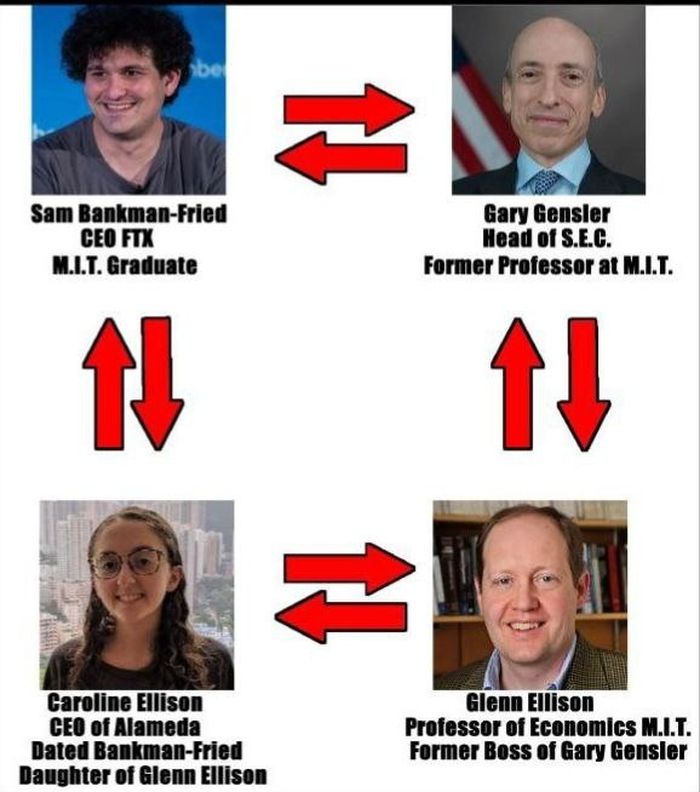
🤔 6

Willy
14.11.2022 18:10
Toho si všimli až teď ? 🤔 nebo jen lidi vidí spojitosti tam kde je chtějí vidět ?
Bugsy
14.11.2022 18:25
↩
@Willy
Toho si všimli až teď ? 🤔 nebo jen lidi vidí spojitosti tam kde je chtějí vidět ?
Je to jak se vším, 50% pravda 50% spekulace
💯 2
Bugsy
16.11.2022 06:04
Bugsy
16.11.2022 06:10
Bugsy
16.11.2022 06:40
↩
@Bugsy
Je to jak se vším, 50% pravda 50% spekulace

Bugsy
16.11.2022 15:29
další na řadě může být USDT,
But today, I can’t help but wonder who, or what, will fall next. And I just can’t help but wonder about Tether (USDT), the largest U.S. dollar stablecoin in the industry.
Bugsy
18.11.2022 07:23
17.11.
Today, we have an important alert on Gemini, one of our recommended crypto trading exchanges.
On Wednesday, the crypto lending platform Genesis announced it has suspended redemptions at its lending facility.
It’s one of the largest institutional crypto lenders, with $2.8 billion in total active loans as of the end of the third quarter.
Shortly after the announcement, Gemini Earn, the lending arm of the Gemini exchange, suspended its withdrawals. That’s because Genesis is the lending partner for Gemini Earn.
It’s important to note that if you hold your assets on the Gemini exchange, you still have access to your funds. Only those who held their assets on Gemini Earn are affected by the suspension.
That being said, we’re concerned about the risk surrounding the Gemini exchange in the wake of this announcement. And we recommend removing your assets from the Gemini exchange as soon as possible.
There are reports that Genesis is seeking to raise $1 billion. And considering the market environment surrounding crypto, we’re concerned that might not happen.
If Genesis can’t raise the funds it seeks, Gemini Earn could be the next lending platform to file for bankruptcy.
It’s possible there isn’t a clear separation between Gemini Earn and the Gemini exchange. If that’s the case, we could see assets from the exchange tied up in this mess.
(upraveno)
On Wednesday, the crypto lending platform Genesis announced it has suspended redemptions at its lending facility.
It’s one of the largest institutional crypto lenders, with $2.8 billion in total active loans as of the end of the third quarter.
Shortly after the announcement, Gemini Earn, the lending arm of the Gemini exchange, suspended its withdrawals. That’s because Genesis is the lending partner for Gemini Earn.
It’s important to note that if you hold your assets on the Gemini exchange, you still have access to your funds. Only those who held their assets on Gemini Earn are affected by the suspension.
That being said, we’re concerned about the risk surrounding the Gemini exchange in the wake of this announcement. And we recommend removing your assets from the Gemini exchange as soon as possible.
There are reports that Genesis is seeking to raise $1 billion. And considering the market environment surrounding crypto, we’re concerned that might not happen.
If Genesis can’t raise the funds it seeks, Gemini Earn could be the next lending platform to file for bankruptcy.
It’s possible there isn’t a clear separation between Gemini Earn and the Gemini exchange. If that’s the case, we could see assets from the exchange tied up in this mess.
For these reasons, we recommend you remove your assets from the Gemini exchange and take self-custody of them.
You can find more information on our recommended wallets for storing your crypto assets in our Crypto Corner.
If you feel taking self-custody of your assets isn't right for you, we recommend transferring them to either Coinbase or Kraken. Both are U.S.-based companies.
Coinbase is a highly regulated exchange that’s audited by Deloitte & Touche, one of the Big Four accounting firms.
And Kraken uses proof-of-reserves, which is an independent audit that ensures it holds the assets it claims to on your behalf.
There’s a high level of uncertainty in the market right now, and we encourage you to remove any counterparty risk if possible. The best way to do that is to self-custody your tokens when possible.
Action to take: Remove any tokens you hold on Gemini. Store them in your own wallet, or on Coinbase or Kraken.
You can find more information on our recommended wallets for storing your crypto assets in our Crypto Corner.
If you feel taking self-custody of your assets isn't right for you, we recommend transferring them to either Coinbase or Kraken. Both are U.S.-based companies.
Coinbase is a highly regulated exchange that’s audited by Deloitte & Touche, one of the Big Four accounting firms.
And Kraken uses proof-of-reserves, which is an independent audit that ensures it holds the assets it claims to on your behalf.
There’s a high level of uncertainty in the market right now, and we encourage you to remove any counterparty risk if possible. The best way to do that is to self-custody your tokens when possible.
Action to take: Remove any tokens you hold on Gemini. Store them in your own wallet, or on Coinbase or Kraken.
Bugsy
20.11.2022 18:11
FTX Was a Case of Downright Fraud
So, first, let's recap what happened. This all started on November 2. That's when a CoinDesk report came out about Alameda Research's balance sheet.
Now, Alameda Research was the trading firm associated with FTX, and the report showed that it had a large percentage of its assets in illiquid assets, with a lot of it in FTT, its own token.
Shortly after that, there was a tweet from Binance CEO Changpeng Zhao, also known as CZ, that the company was going to liquidate its FTT position. And it was a sizable position, $2.1 billion. So, of course, that ratcheted up the uncertainty.
The FTT token price started falling. Alameda offered to buy FTX – that never materialized. The day after, FTX had to pause withdrawals. Binance gave its intention to potentially buy the company, but that fell through. And by November 11, FTX declared bankruptcy.
So in a matter of nine days, the entire thing collapsed. And it's just left the industry in shock. Part of that is because of the person involved, Sam Bankman-Fried, who's been a very prominent figure in crypto. He's been up on the hill in Washington, D.C., in front of Congress, and things like that.
So, first, let's recap what happened. This all started on November 2. That's when a CoinDesk report came out about Alameda Research's balance sheet.
Now, Alameda Research was the trading firm associated with FTX, and the report showed that it had a large percentage of its assets in illiquid assets, with a lot of it in FTT, its own token.
Shortly after that, there was a tweet from Binance CEO Changpeng Zhao, also known as CZ, that the company was going to liquidate its FTT position. And it was a sizable position, $2.1 billion. So, of course, that ratcheted up the uncertainty.
The FTT token price started falling. Alameda offered to buy FTX – that never materialized. The day after, FTX had to pause withdrawals. Binance gave its intention to potentially buy the company, but that fell through. And by November 11, FTX declared bankruptcy.
So in a matter of nine days, the entire thing collapsed. And it's just left the industry in shock. Part of that is because of the person involved, Sam Bankman-Fried, who's been a very prominent figure in crypto. He's been up on the hill in Washington, D.C., in front of Congress, and things like that.
For what was considered a venerable firm to collapse in nine days has just left everyone in shock. So the question is, how did this happen?
One thing I want you to know is this was more than just poor risk management. It was more than just being overleveraged. This was a case of downright fraud.
Since the bankruptcy, a new CEO has come in. The guy's name is John Ray, and he has 40 years of restructuring experience. He worked on Enron and a number of other situations like that. And what he said is he's never seen “such a complete failure of corporate controls” like he's seen with FTX.
So that just shows you the severity of the situation. It's come to light FTX had no central cash management system. It had no audited financial statements for Alameda. Sam Bankman-Fried had a secret back door to move funds between FTX and Alameda. And the majority of employees were in the dark. No one even knew about this.
One thing I want you to know is this was more than just poor risk management. It was more than just being overleveraged. This was a case of downright fraud.
Since the bankruptcy, a new CEO has come in. The guy's name is John Ray, and he has 40 years of restructuring experience. He worked on Enron and a number of other situations like that. And what he said is he's never seen “such a complete failure of corporate controls” like he's seen with FTX.
So that just shows you the severity of the situation. It's come to light FTX had no central cash management system. It had no audited financial statements for Alameda. Sam Bankman-Fried had a secret back door to move funds between FTX and Alameda. And the majority of employees were in the dark. No one even knew about this.
And this has happened despite numerous investments into FTX. For example, the Ontario Teachers’ Pension Plan made… I think it was a $90 million investment into FTX. And anytime it does that, it brings in its own due-diligence people to examine the company, pour through financials, talk to people, things like that. And despite those efforts, it was caught up in the storm as well.
That's what happens in fraud. People are just downright lying. It's hard to know what the real situation is.
So, as I mentioned before, some of the severity of this is just due to the fact that it involves Sam- Bankman-Fried. This guy was Cointelegraph’s No. 1 most influential person in crypto in 2021. He had built FTX into a $32 billion empire at the beginning of the year. Alameda was also a $1 billion or $2 billion company that was doing $5 billion in volume a day or more.
That's what happens in fraud. People are just downright lying. It's hard to know what the real situation is.
So, as I mentioned before, some of the severity of this is just due to the fact that it involves Sam- Bankman-Fried. This guy was Cointelegraph’s No. 1 most influential person in crypto in 2021. He had built FTX into a $32 billion empire at the beginning of the year. Alameda was also a $1 billion or $2 billion company that was doing $5 billion in volume a day or more.
Bankman-Fried’s own fortune ballooned to $26 billion. And part of his popularity was his efforts toward achieving regulatory compliance. He took part in congressional hearings. He called on crypto exchanges to voluntarily report their transaction activity to avoid market manipulation. He was also the second-biggest donor in the midterm elections, donating close to $40 million, second only to George Soros.
So when you compare that to the fraud we're seeing today, it's just a shock. It's just a huge difference, a juxtaposition on what you expected Sam Bankman-Fried to be, and what he’s turned out to be. And that's a large reason why this is such a big event today.
So when you compare that to the fraud we're seeing today, it's just a shock. It's just a huge difference, a juxtaposition on what you expected Sam Bankman-Fried to be, and what he’s turned out to be. And that's a large reason why this is such a big event today.