
Bugsy
13.09.2022 20:32
Persistent Inflation
Because the prices of “sticky” goods remain high, our research tells us inflation will also remain high.
Remember, sticky goods and services are those whose prices change at a much slower pace than categories like food and gasoline.
Sticky goods include things like rent and health care services. When their prices rise, they take a long time to come back down.
The Atlanta Federal Reserve tracks these sticky categories. The prices for these items rose from a 5.8% annualized rate in July to 6.1% in August.
This suggests sticky prices have yet to peak… A key insight that Wall Street is only beginning to wake up to.
The most recent evidence of this came out this morning in the August Consumer Price Index (CPI) results. Consumer prices rose by 8.3% year-over-year in August – a slight jump from Wall Street’s estimated 8.1%.
However, we kept our focus on the Core Sticky CPI numbers. The prices of goods and services (excluding food and energy) grew by 0.6% from July – working out to a rate of 6.3% year-over-year – doubling Wall Street’s expectations.
We saw the biggest gains in things like rent prices and medical expenses, two of the stickiest categories in the CPI calculation.
This cements the likelihood that the Fed will raise rates by 75 basis points next week… and points to the Fed hiking rates by 75 basis points in November too.
All in all, this is as clear an example as any that stickier price categories are now in the driver’s seat when it comes to inflation… And that’s bad news for stocks.
Because the prices of “sticky” goods remain high, our research tells us inflation will also remain high.
Remember, sticky goods and services are those whose prices change at a much slower pace than categories like food and gasoline.
Sticky goods include things like rent and health care services. When their prices rise, they take a long time to come back down.
The Atlanta Federal Reserve tracks these sticky categories. The prices for these items rose from a 5.8% annualized rate in July to 6.1% in August.
This suggests sticky prices have yet to peak… A key insight that Wall Street is only beginning to wake up to.
The most recent evidence of this came out this morning in the August Consumer Price Index (CPI) results. Consumer prices rose by 8.3% year-over-year in August – a slight jump from Wall Street’s estimated 8.1%.
However, we kept our focus on the Core Sticky CPI numbers. The prices of goods and services (excluding food and energy) grew by 0.6% from July – working out to a rate of 6.3% year-over-year – doubling Wall Street’s expectations.
We saw the biggest gains in things like rent prices and medical expenses, two of the stickiest categories in the CPI calculation.
This cements the likelihood that the Fed will raise rates by 75 basis points next week… and points to the Fed hiking rates by 75 basis points in November too.
All in all, this is as clear an example as any that stickier price categories are now in the driver’s seat when it comes to inflation… And that’s bad news for stocks.
Aside from this morning’s reading, plenty of other factors point to persistent inflation as well.
The August jobs report came in much stronger than expected. The U.S. economy added 315,000 new jobs vs. the expected 298,000 consensus. The survey of employers shows broad-based gains across virtually all sectors of the jobs market.
Even with the surprise beat in job gains, the ratio of job vacancies to the number of unemployed Americans remains unchanged at two open positions for every one person currently unemployed… A sign that employees retain leverage to demand higher wages.
Inflation-adjusted incomes also rose by 0.3% in July, which has helped elevate consumer confidence.
The Conference Board’s Consumer Confidence Index rose by more than forecast in August, to its highest level since May. This suggests Americans are growing more optimistic about the economy and the state of their wallets.
The more confidence and cash Americans have, the more they’ll spend. And the more they spend, the more room companies have to raise prices.
Everything above affects consumer demand, but that’s only half of what drives inflation. On the supply side, other emerging issues appear troubling.
There’s a brewing fight between union railway workers and the nation’s largest freight companies. If they don’t reach a deal by Friday, the railway workers have promised to strike.
The Association of American Railroads has released a report projecting the economic impact of a nationwide strike to be more than $2 billion a day.
A strike would cause the 140,000-mile network of rails to idle. The shipments of goods across the U.S. would be crippled.
The pandemic has shown us the surge in prices that can result from a hampered supply chain. We expect a railway strike to lead to a similar conclusion if a deal is not reached.
Now, let’s take a look at how rising interest rates will continue to let volatility fester.
The August jobs report came in much stronger than expected. The U.S. economy added 315,000 new jobs vs. the expected 298,000 consensus. The survey of employers shows broad-based gains across virtually all sectors of the jobs market.
Even with the surprise beat in job gains, the ratio of job vacancies to the number of unemployed Americans remains unchanged at two open positions for every one person currently unemployed… A sign that employees retain leverage to demand higher wages.
Inflation-adjusted incomes also rose by 0.3% in July, which has helped elevate consumer confidence.
The Conference Board’s Consumer Confidence Index rose by more than forecast in August, to its highest level since May. This suggests Americans are growing more optimistic about the economy and the state of their wallets.
The more confidence and cash Americans have, the more they’ll spend. And the more they spend, the more room companies have to raise prices.
Everything above affects consumer demand, but that’s only half of what drives inflation. On the supply side, other emerging issues appear troubling.
There’s a brewing fight between union railway workers and the nation’s largest freight companies. If they don’t reach a deal by Friday, the railway workers have promised to strike.
The Association of American Railroads has released a report projecting the economic impact of a nationwide strike to be more than $2 billion a day.
A strike would cause the 140,000-mile network of rails to idle. The shipments of goods across the U.S. would be crippled.
The pandemic has shown us the surge in prices that can result from a hampered supply chain. We expect a railway strike to lead to a similar conclusion if a deal is not reached.
Now, let’s take a look at how rising interest rates will continue to let volatility fester.
👉 Rising Interest Rates
On August 26, Fed Chair Jerome Powell gave a speech at the annual Jackson Hole summit that all but confirmed our predictions.
Powell confirmed the Fed is determined to attack inflation forcefully. He added that the historical record cautions strongly against prematurely loosening policy.
This is a clear sign that not only will the Fed remain aggressive with rate hikes, it will also keep rates at elevated levels for quite a while.
Powell warned the Fed’s actions will bring pain to businesses and households – his clearest decree yet that the Fed will not back down if evidence of pain begins to emerge.
The bond market has reacted quickly to all of this news.
Since our last update, the yield on 10-year Treasury bonds rose from 3.03% to 3.43%.
Higher yields make it more expensive for companies to borrow money which can lower earnings… They also lower stock values as future cash flows are discounted more aggressively.
All of this suggests more volatility ahead. But remember, more volatility means more cash in your pocket.
On August 26, Fed Chair Jerome Powell gave a speech at the annual Jackson Hole summit that all but confirmed our predictions.
Powell confirmed the Fed is determined to attack inflation forcefully. He added that the historical record cautions strongly against prematurely loosening policy.
This is a clear sign that not only will the Fed remain aggressive with rate hikes, it will also keep rates at elevated levels for quite a while.
Powell warned the Fed’s actions will bring pain to businesses and households – his clearest decree yet that the Fed will not back down if evidence of pain begins to emerge.
The bond market has reacted quickly to all of this news.
Since our last update, the yield on 10-year Treasury bonds rose from 3.03% to 3.43%.
Higher yields make it more expensive for companies to borrow money which can lower earnings… They also lower stock values as future cash flows are discounted more aggressively.
All of this suggests more volatility ahead. But remember, more volatility means more cash in your pocket.
👉 Lower Company Earnings
In addition to persistent inflation and rising interest rates, the outlook for company earnings remains bearish in the near-term.
In fact, we saw a pickup in the number of companies lowering full-year earnings projections. Each bar represents the ratio between the number of companies downgrading their forecast and those upgrading it.
Following a short slowdown in the downgrades after a surge through June and July, we now see them picking back up in the last week of August.
This is a troubling sign, especially considering the month coming up. Third quarter earnings season begins in the middle of October. We’re likely to see companies trying to front-run potentially negative results by lowering their earnings forecast ahead of time.
As profits drop, share prices will follow.
In addition to persistent inflation and rising interest rates, the outlook for company earnings remains bearish in the near-term.
In fact, we saw a pickup in the number of companies lowering full-year earnings projections. Each bar represents the ratio between the number of companies downgrading their forecast and those upgrading it.
Following a short slowdown in the downgrades after a surge through June and July, we now see them picking back up in the last week of August.
This is a troubling sign, especially considering the month coming up. Third quarter earnings season begins in the middle of October. We’re likely to see companies trying to front-run potentially negative results by lowering their earnings forecast ahead of time.
As profits drop, share prices will follow.
👉 Bonus Headwind: Quantitative Tightening
In June, we discussed the new Federal Reserve plans called Quantitative Tightening (QT) and Qualitative Easing (QE).
QE is when the Fed builds its asset base by buying bonds in order to keep interest rates low. QT is when the Fed allows the bonds on its balance sheet to mature without buying new ones to take their place.
Instead of injecting money into the economy like QE does, QT removes money.
Over the past three months, the Fed has communicated that it wanted to see $47.5 billion of government bonds roll off its balance sheet per month.
And this month, the Fed’s plan is to kick up its quantitative tightening even more. Its stated goal is to allow $95 billion of government bonds per month to roll off its balance sheet, doubling its initial amount.
This action will, in all likelihood, cause volatility to surge higher. And that’s exactly what AE was designed to take advantage of. Because just like with our previous profitable plays, we’ll be ready to capture the higher premiums that will emerge from the volatility.
As a reminder: Higher premiums mean more income for you, and they reduce the capital you have at risk.
In June, we discussed the new Federal Reserve plans called Quantitative Tightening (QT) and Qualitative Easing (QE).
QE is when the Fed builds its asset base by buying bonds in order to keep interest rates low. QT is when the Fed allows the bonds on its balance sheet to mature without buying new ones to take their place.
Instead of injecting money into the economy like QE does, QT removes money.
Over the past three months, the Fed has communicated that it wanted to see $47.5 billion of government bonds roll off its balance sheet per month.
And this month, the Fed’s plan is to kick up its quantitative tightening even more. Its stated goal is to allow $95 billion of government bonds per month to roll off its balance sheet, doubling its initial amount.
This action will, in all likelihood, cause volatility to surge higher. And that’s exactly what AE was designed to take advantage of. Because just like with our previous profitable plays, we’ll be ready to capture the higher premiums that will emerge from the volatility.
As a reminder: Higher premiums mean more income for you, and they reduce the capital you have at risk.
👉 Our Targets Have Been Set
The next phase of this Anomaly Window is beginning… And we expect even more volatility ahead.
We couldn’t be more excited about the opportunities that will emerge over the rest of the year.
While others panic, we’ll be patient… knowing we have the right strategy to rip double-digit income from the market while everyone is losing their shirts.
We’re crushing the performance of hedge funds and the market because we aren’t swinging at every pitch. We’re being patient, waiting for the stocks we love to fall back to a level we see as a steal.
While past performance is no guarantee of future success, our record here at AE gives us confidence we can smash the market and deliver stunning returns for you again and again. To paraphrase Teeka: We’ll let the game come to us.
The next phase of this Anomaly Window is beginning… And we expect even more volatility ahead.
We couldn’t be more excited about the opportunities that will emerge over the rest of the year.
While others panic, we’ll be patient… knowing we have the right strategy to rip double-digit income from the market while everyone is losing their shirts.
We’re crushing the performance of hedge funds and the market because we aren’t swinging at every pitch. We’re being patient, waiting for the stocks we love to fall back to a level we see as a steal.
While past performance is no guarantee of future success, our record here at AE gives us confidence we can smash the market and deliver stunning returns for you again and again. To paraphrase Teeka: We’ll let the game come to us.
Bugsy
13.09.2022 20:45
👉 👉 👉 The Cancer-Fighting Superstar
The health care sector has remained a port in the storm this year.
The industry’s recession-proof demand – coupled with the return of health procedures as COVID-19 subsides – has helped shield investors from market downturns.
Health care stocks in the S&P 500 are down an average 7.7% – about half of the 14.5% the S&P 500 has lost.
One of the brightest spots in the health care sector this year has been Merck (MRK).
Merck is the largest oncological drug manufacturer in the world. It develops treatments and vaccines that primarily combat a variety of different cancers.
The company has had a stellar 2022 so far, with shares up 14%.
Over the past 12 months, Merck has grown its revenue to $57.2 billion – a 28% jump. It also posted $18.9 billion in operating income – an eye popping 561% higher than 12 months ago. That’s good enough for a 33% operating profit margin, better than all large-cap health care companies outside of Pfizer.
Merck has also managed to more than double its free cash flow from $7 billion to $14.4 billion over the past 12 months.
We believe this growth is set to continue, and it all starts with Keytruda.
Keytruda is Merck’s top selling drug. It’s also the second-highest selling drug in the United States – 34% of Merck’s revenue comes from Keytruda.
The drug detects and fights cancer cells in the body. It’s a foundational treatment for cancer patients around the world.
Keytruda works on a wide variety of different cancers. Since launching in 2014, it has been approved to treat more than 30 forms of cancer.
This has helped Keytruda consistently grow its revenue 10% per quarter over the past five years. At that rate, Keytruda will double in size every two years.
Currently, there are over 1,400 trials investigating Keytruda in a wide variety of cancers and treatment settings. CEO Robert Davis projects by 2026 Keytruda will be an approved treatment for an additional 60 forms of cancer.
The health care sector has remained a port in the storm this year.
The industry’s recession-proof demand – coupled with the return of health procedures as COVID-19 subsides – has helped shield investors from market downturns.
Health care stocks in the S&P 500 are down an average 7.7% – about half of the 14.5% the S&P 500 has lost.
One of the brightest spots in the health care sector this year has been Merck (MRK).
Merck is the largest oncological drug manufacturer in the world. It develops treatments and vaccines that primarily combat a variety of different cancers.
The company has had a stellar 2022 so far, with shares up 14%.
Over the past 12 months, Merck has grown its revenue to $57.2 billion – a 28% jump. It also posted $18.9 billion in operating income – an eye popping 561% higher than 12 months ago. That’s good enough for a 33% operating profit margin, better than all large-cap health care companies outside of Pfizer.
Merck has also managed to more than double its free cash flow from $7 billion to $14.4 billion over the past 12 months.
We believe this growth is set to continue, and it all starts with Keytruda.
Keytruda is Merck’s top selling drug. It’s also the second-highest selling drug in the United States – 34% of Merck’s revenue comes from Keytruda.
The drug detects and fights cancer cells in the body. It’s a foundational treatment for cancer patients around the world.
Keytruda works on a wide variety of different cancers. Since launching in 2014, it has been approved to treat more than 30 forms of cancer.
This has helped Keytruda consistently grow its revenue 10% per quarter over the past five years. At that rate, Keytruda will double in size every two years.
Currently, there are over 1,400 trials investigating Keytruda in a wide variety of cancers and treatment settings. CEO Robert Davis projects by 2026 Keytruda will be an approved treatment for an additional 60 forms of cancer.
Thus, Keytruda’s total addressable market could reach $200 billion by 2025. That’s 10x the $19 billion in revenue the drug has generated so far this year.
Merck also has the rights to Keytruda locked with its patent on this form of the drug which will last through 2028.
Outside of Keytruda, Merck has an entire fleet of high-performing drugs.
Merck’s second most popular drug, Gardasil, helps prevent HPV. Its revenue has grown by 40% over the past year as its demand has exploded worldwide.
Merck’s new drug pipeline is also strong. It currently has 30 drugs in the final stages of clinical trials, with three already in the final stage of review by regulators.
So even in the highly unlikely scenario that demand for Merck’s blockbuster drugs stagnates, it has a fleet of future drug releases to grow the company.
Even with the impressive financial and share growth Merck has experienced, the company is still heavily undervalued.
At a forward price-to-earnings (P/E) multiple of 11.9, Merck is trading at a 28% discount to its peers and a 32% discount to the market overall.
Despite how rapidly Merck has grown its earnings this year, it’s only trading nine percent above the lowest trading multiple it reached in the last 10 years.
That will help create a floor in Merck’s share price, especially if the company continues to grow at its current pace.
Finally, Merck currently pays a 3.2% dividend and has consistently raised its dividend every year for the past 42 years. That makes it one of the oldest dividend aristocrats currently trading.
Merck also has the rights to Keytruda locked with its patent on this form of the drug which will last through 2028.
Outside of Keytruda, Merck has an entire fleet of high-performing drugs.
Merck’s second most popular drug, Gardasil, helps prevent HPV. Its revenue has grown by 40% over the past year as its demand has exploded worldwide.
Merck’s new drug pipeline is also strong. It currently has 30 drugs in the final stages of clinical trials, with three already in the final stage of review by regulators.
So even in the highly unlikely scenario that demand for Merck’s blockbuster drugs stagnates, it has a fleet of future drug releases to grow the company.
Even with the impressive financial and share growth Merck has experienced, the company is still heavily undervalued.
At a forward price-to-earnings (P/E) multiple of 11.9, Merck is trading at a 28% discount to its peers and a 32% discount to the market overall.
Despite how rapidly Merck has grown its earnings this year, it’s only trading nine percent above the lowest trading multiple it reached in the last 10 years.
That will help create a floor in Merck’s share price, especially if the company continues to grow at its current pace.
Finally, Merck currently pays a 3.2% dividend and has consistently raised its dividend every year for the past 42 years. That makes it one of the oldest dividend aristocrats currently trading.
👌 2
Bugsy
16.09.2022 10:00
💯 The Long-Awaited Ethereum Merge Is Here
First, let's go over the [Ethereum] Merge.
The Merge is simply Ethereum moving from a proof-of-work (PoW) to a proof-of-stake (PoS) model. One of the biggest things that will have a very beneficial effect, at least on holders of the Ethereum token, is that the inflation rate is going to drop dramatically – by around 90%.
This means the amount of new tokens issued will drop about 90%, which is quite bullish for the price of Ethereum, assuming that usage continues to accelerate.
Now, the two areas that won't get immediately fixed are fees and speed. Fees are still going to stay high, and speed is still going to stay slow… But that will be fixed in future updates.
In terms of what's going to happen to the price of Ethereum after the Merge… You're going to have the benefit of knowing what actually happened when you watch this video… I don't.
Right now, it's Wednesday, September 14, and the Merge is supposed to happen tomorrow, September 15.
First, let's go over the [Ethereum] Merge.
The Merge is simply Ethereum moving from a proof-of-work (PoW) to a proof-of-stake (PoS) model. One of the biggest things that will have a very beneficial effect, at least on holders of the Ethereum token, is that the inflation rate is going to drop dramatically – by around 90%.
This means the amount of new tokens issued will drop about 90%, which is quite bullish for the price of Ethereum, assuming that usage continues to accelerate.
Now, the two areas that won't get immediately fixed are fees and speed. Fees are still going to stay high, and speed is still going to stay slow… But that will be fixed in future updates.
In terms of what's going to happen to the price of Ethereum after the Merge… You're going to have the benefit of knowing what actually happened when you watch this video… I don't.
Right now, it's Wednesday, September 14, and the Merge is supposed to happen tomorrow, September 15.
Often, when you see a big run up on something for a highly anticipated event, it's usually a “buy the rumor, sell the news” type of thing. So it wouldn't shock me if – when the Merge goes through, as long as it's successful – we see prices flatten or even come in a little bit. I’d be shocked if we saw a massive one-way move up.
A lot of the Merge has been priced in when you consider bitcoin is really just about 10–15% above its lows, and Ethereum is almost 100% above its lows.
A lot of that out-performance is the pricing in of the beneficial effect the Merge will have on the new token issuance for the Ethereum network.
Now, of course, outside possibility exists that the Merge could go horribly wrong. What they're attempting to do has been likened to trying to hot swap an engine out of a plane while it's in the air flying. It's very difficult, and fraught with risk.
However, even if it goes horribly wrong… the token will get absolutely macerated by the market… but it's not something that Ethereum can’t recover from.
I think we're far enough along down the road of adoption, and there are enough incentivized folks with lots of capital tied up in this asset to fix it.
That said, I don't anticipate any major horrible event.
[Editor’s Note: At the time of publishing, the Ethereum Merge was successful.]
There might be a few spinoff tokens – a few forks that refuse to follow along with the new PoS model and decide to just stick with PoW.
Will they become something meaningful? I don't think so. But they would certainly offer people what’s basically some free money after the merger takes place.
Assuming that there were some splits and some other forks: However many ether coins you owned, you’d receive [the same amount] of these new split coins. And we would recommend selling them if that's the case.
A lot of the Merge has been priced in when you consider bitcoin is really just about 10–15% above its lows, and Ethereum is almost 100% above its lows.
A lot of that out-performance is the pricing in of the beneficial effect the Merge will have on the new token issuance for the Ethereum network.
Now, of course, outside possibility exists that the Merge could go horribly wrong. What they're attempting to do has been likened to trying to hot swap an engine out of a plane while it's in the air flying. It's very difficult, and fraught with risk.
However, even if it goes horribly wrong… the token will get absolutely macerated by the market… but it's not something that Ethereum can’t recover from.
I think we're far enough along down the road of adoption, and there are enough incentivized folks with lots of capital tied up in this asset to fix it.
That said, I don't anticipate any major horrible event.
[Editor’s Note: At the time of publishing, the Ethereum Merge was successful.]
There might be a few spinoff tokens – a few forks that refuse to follow along with the new PoS model and decide to just stick with PoW.
Will they become something meaningful? I don't think so. But they would certainly offer people what’s basically some free money after the merger takes place.
Assuming that there were some splits and some other forks: However many ether coins you owned, you’d receive [the same amount] of these new split coins. And we would recommend selling them if that's the case.
Bugsy
16.09.2022 10:10
👉 Institutional Buyers View Bitcoin Immaturely
As I speak right now, bitcoin is at $20,000. It had been $24,000 recently, and then we saw some much hotter inflation numbers than Wall Street was expecting.
Frankly, I've been calling for higher inflation all year. I was shocked Wall Street was shocked that inflation was higher than they thought it was going to be. That, to me, was a given.
Inflation is sticky. It doesn't just end overnight. And we'll probably see these waves where inflation looks like it's coming in a little bit, and then it rears its ugly head, over and over.
So what does this mean? It means that the Federal Reserve will continue to raise rates.
First, everyone thought, "Oh, they're only going to do 50 basis points." Then they thought, "Oh, maybe they'll do 75 basis points, but that'll be it, and then they'll start to pivot." But now, people are starting to consider, "They might go 100 basis points next week. They might go one whole point, and they're definitively not pivoting. They might then go up again in November, and then up again in December."
There's a lot of fear right now. And that’s because interest rates are incredibly important for how you value the stock market.
When you look at the risk-free rate of return – depending upon what that number is – it impacts the calculations for a discounted cash flow, net present value, and it determines how much you should pay for a certain amount of cash flow.
So that number is incredibly important for how institutional capital allocators determine what price to pay for stocks.
What does that have to do with bitcoin?
Over the last year or two, bitcoin has become incredibly correlated to the Nasdaq. So if the Nasdaq does well, bitcoin does well. And that had never existed before. Bitcoin was always a non-correlated asset.
(upraveno)
As I speak right now, bitcoin is at $20,000. It had been $24,000 recently, and then we saw some much hotter inflation numbers than Wall Street was expecting.
Frankly, I've been calling for higher inflation all year. I was shocked Wall Street was shocked that inflation was higher than they thought it was going to be. That, to me, was a given.
Inflation is sticky. It doesn't just end overnight. And we'll probably see these waves where inflation looks like it's coming in a little bit, and then it rears its ugly head, over and over.
So what does this mean? It means that the Federal Reserve will continue to raise rates.
First, everyone thought, "Oh, they're only going to do 50 basis points." Then they thought, "Oh, maybe they'll do 75 basis points, but that'll be it, and then they'll start to pivot." But now, people are starting to consider, "They might go 100 basis points next week. They might go one whole point, and they're definitively not pivoting. They might then go up again in November, and then up again in December."
There's a lot of fear right now. And that’s because interest rates are incredibly important for how you value the stock market.
When you look at the risk-free rate of return – depending upon what that number is – it impacts the calculations for a discounted cash flow, net present value, and it determines how much you should pay for a certain amount of cash flow.
So that number is incredibly important for how institutional capital allocators determine what price to pay for stocks.
What does that have to do with bitcoin?
Over the last year or two, bitcoin has become incredibly correlated to the Nasdaq. So if the Nasdaq does well, bitcoin does well. And that had never existed before. Bitcoin was always a non-correlated asset.
But now, it’s correlated because we have a new type of buyer in the marketplace… An institutional buyer. And institutions look at things like bitcoin fundamentally differently.
Institutional buyers don’t look at bitcoin from an ideological standpoint. They look at it as a high risk, highly volatile trading asset.
Institutional buyers look at bitcoin akin to a high beta tech stock that has no earnings but goes through these incredible periods of volatility. So the way these investors allocate capital to that type of investment is predicated upon prevailing interest rates.
If the risk-free rate of return is higher, they’ll change their allocation and move it away from what they’d consider to be high risk investments – like bitcoin and high-growth tech stocks that don't have earnings yet. Then, they'll move it over into more predictable blue-chip names that have earnings, predictable cash flows, and a measure of inflation protection.
And that's what's happening right now. You're seeing capital get reallocated and re-shifted, and that's what's causing tech stocks and bitcoin to drop. Now, will that correlation stay there forever? I don't think so.
Institutional buyers don’t look at bitcoin from an ideological standpoint. They look at it as a high risk, highly volatile trading asset.
Institutional buyers look at bitcoin akin to a high beta tech stock that has no earnings but goes through these incredible periods of volatility. So the way these investors allocate capital to that type of investment is predicated upon prevailing interest rates.
If the risk-free rate of return is higher, they’ll change their allocation and move it away from what they’d consider to be high risk investments – like bitcoin and high-growth tech stocks that don't have earnings yet. Then, they'll move it over into more predictable blue-chip names that have earnings, predictable cash flows, and a measure of inflation protection.
And that's what's happening right now. You're seeing capital get reallocated and re-shifted, and that's what's causing tech stocks and bitcoin to drop. Now, will that correlation stay there forever? I don't think so.
We're dealing with the fact that institutions have only started to come into this space. So these institutions have a very immature view of bitcoin as an asset. And I don't mean that in a derogatory way. They just haven't been in the asset long enough to develop any nuance for what gives it value.
When they look at crypto, they see it purely as a trading asset. It’s highly speculative, has massive moves, and experiences enormous volatility. They don't care if that volatility is up or down. They’re just as easy to go short as they are to go long.
Institutional investors love the volatility, but they don't look at it the way that we do… The way this is essentially a central bank in cyberspace that nobody controls…
We know it’s a way to transmit value that nobody can stand in the way of… A monetary system run by a set of rules... And a long-term store of value that nobody can manipulate, control, or dilute.
But institutions don’t care about any of those reasons to own bitcoin.
For them, it's like a dollar, yen trading pair. It's like trading metals on the London Metal Exchange. It's like trading gasoline futures. They couldn’t care less.
All they care about is the volatility. So when they change their allocations, it has an impact not only on bitcoin, but also in the tech space.
We know that's true because last week, when the market started to price in a Fed pivot – or at least a Fed pause – on raising interest rates, what happened? The S&P went up 5%, the Nasdaq rose more than 5%, and bitcoin went up 20%.
There were major moves going higher because the allocation models changed. When we then saw core inflation come in much hotter than everybody expected, all the computers changed their allocation models and it's sell, sell, sell.
When they look at crypto, they see it purely as a trading asset. It’s highly speculative, has massive moves, and experiences enormous volatility. They don't care if that volatility is up or down. They’re just as easy to go short as they are to go long.
Institutional investors love the volatility, but they don't look at it the way that we do… The way this is essentially a central bank in cyberspace that nobody controls…
We know it’s a way to transmit value that nobody can stand in the way of… A monetary system run by a set of rules... And a long-term store of value that nobody can manipulate, control, or dilute.
But institutions don’t care about any of those reasons to own bitcoin.
For them, it's like a dollar, yen trading pair. It's like trading metals on the London Metal Exchange. It's like trading gasoline futures. They couldn’t care less.
All they care about is the volatility. So when they change their allocations, it has an impact not only on bitcoin, but also in the tech space.
We know that's true because last week, when the market started to price in a Fed pivot – or at least a Fed pause – on raising interest rates, what happened? The S&P went up 5%, the Nasdaq rose more than 5%, and bitcoin went up 20%.
There were major moves going higher because the allocation models changed. When we then saw core inflation come in much hotter than everybody expected, all the computers changed their allocation models and it's sell, sell, sell.
👉 This Isn’t the End of Bitcoin… Or the Cycle We’re In
How long are we going to be in that process? How long are we going to be beholden to interest rates?
It's probably going to be for the balance of this cycle until we get into the next halving.
So having an idea of what’s going to happen on interest rates – or at least having a theory – is important. I'm going to be talking a lot about it in the future because it matters right now. It really matters where interest rates go.
I hate the fact that bitcoin has become correlated to what the Federal Reserve does. But I recognize that's the cycle we're in.
The same thing happened in 2016. Bitcoin was highly correlated to what the People's Bank of China said about bitcoin mining. And there I was thinking, “Mining is highly mobile. Whether they shut down mining or not, it's not the end of bitcoin.” But the market didn't believe that.
How long are we going to be in that process? How long are we going to be beholden to interest rates?
It's probably going to be for the balance of this cycle until we get into the next halving.
So having an idea of what’s going to happen on interest rates – or at least having a theory – is important. I'm going to be talking a lot about it in the future because it matters right now. It really matters where interest rates go.
I hate the fact that bitcoin has become correlated to what the Federal Reserve does. But I recognize that's the cycle we're in.
The same thing happened in 2016. Bitcoin was highly correlated to what the People's Bank of China said about bitcoin mining. And there I was thinking, “Mining is highly mobile. Whether they shut down mining or not, it's not the end of bitcoin.” But the market didn't believe that.
Any time the People's Bank of China came out with anything that was remotely negative about bitcoin, prices would absolutely take it on the chin. Any time People’s Bank said anything remotely positive or neutral about bitcoin, it would soar. You had this correlation with statements that were coming out of the People's Bank of China.
Now, people don't care what the People's Bank of China says about bitcoin. In fact, it shut down bitcoin mining and bitcoin went higher. And everybody moved to the United States to mine their bitcoin.
So I see this current correlation between bitcoin and tech stocks – or bitcoin and Fed policy – as just another situation like that.
It’s a temporary correlation. And I believe as the market matures in its understanding of what bitcoin really is and how valuable it really is, it will change. But for now, we're stuck with it.
So it's incumbent upon us to have an opinion on where interest rates are going to go and what interest rates are going to look like. Because it's going to help insulate us mentally and emotionally if we see more volatility.
With that said, [Fed Chair] Jay Powell has been very clear. He wants to kill inflation. Now, thank goodness this is not like 1979 or 1980, where they can take interest rates to 20%. Back then, debt-to-GDP was somewhere around 35%. So you could go to 20% interest rates and not bankrupt the federal government.
Now, people don't care what the People's Bank of China says about bitcoin. In fact, it shut down bitcoin mining and bitcoin went higher. And everybody moved to the United States to mine their bitcoin.
So I see this current correlation between bitcoin and tech stocks – or bitcoin and Fed policy – as just another situation like that.
It’s a temporary correlation. And I believe as the market matures in its understanding of what bitcoin really is and how valuable it really is, it will change. But for now, we're stuck with it.
So it's incumbent upon us to have an opinion on where interest rates are going to go and what interest rates are going to look like. Because it's going to help insulate us mentally and emotionally if we see more volatility.
With that said, [Fed Chair] Jay Powell has been very clear. He wants to kill inflation. Now, thank goodness this is not like 1979 or 1980, where they can take interest rates to 20%. Back then, debt-to-GDP was somewhere around 35%. So you could go to 20% interest rates and not bankrupt the federal government.
Bugsy
16.09.2022 10:22
You can't do that now.
Debt-to-GDP is 140%, which means we have 140% of debt versus our actual GDP. So if you went to 20% interest rates, you’d literally bankrupt the federal government just on interest. I think interest would be something like $6 trillion. So you wouldn't even be able to pay the interest.
We don't have to worry about that. However, interest rates are going to go up. I think at least 4% is a done deal. And if you're not thinking that and modeling that, you're making a mistake. Will they stop at 4%? It remains to be seen.
All of this to say, we're going to see more volatility.
This type of volatility is different from somebody borrowing $12 billion in bitcoin, and they've only got $500 million worth of equity, and they get blown out… and then bitcoin just gets completely smashed and sold because there are no buyers. This is a different type of selling.
Debt-to-GDP is 140%, which means we have 140% of debt versus our actual GDP. So if you went to 20% interest rates, you’d literally bankrupt the federal government just on interest. I think interest would be something like $6 trillion. So you wouldn't even be able to pay the interest.
We don't have to worry about that. However, interest rates are going to go up. I think at least 4% is a done deal. And if you're not thinking that and modeling that, you're making a mistake. Will they stop at 4%? It remains to be seen.
All of this to say, we're going to see more volatility.
This type of volatility is different from somebody borrowing $12 billion in bitcoin, and they've only got $500 million worth of equity, and they get blown out… and then bitcoin just gets completely smashed and sold because there are no buyers. This is a different type of selling.
I don't see that type of catastrophic action coming into bitcoin because the Fed funds rate goes to 4%.
You'll definitely have some fear. You'll definitely have some sell offs. When you get a 4% print on Fed funds, all equities have to get re-priced.
So for us, I believe that continues to be a buying opportunity for bitcoin. Now, why do I say that? Am I just a Pollyanna who always thinks the pullbacks are a buying opportunity? No.
As you know, earlier this year, I was very cautious. We didn't know how bad the selloff was going to be because we didn't know how much borrowed money there was in the market. That centralized finance market was so opaque. We had no view into it.
What’s got me back onto using this weakness to accumulate more bitcoin? The news out of BlackRock. I know I've talked about it a lot, but I'll continue talking about it. The fact that BlackRock is coming into bitcoin is huge.
You'll definitely have some fear. You'll definitely have some sell offs. When you get a 4% print on Fed funds, all equities have to get re-priced.
So for us, I believe that continues to be a buying opportunity for bitcoin. Now, why do I say that? Am I just a Pollyanna who always thinks the pullbacks are a buying opportunity? No.
As you know, earlier this year, I was very cautious. We didn't know how bad the selloff was going to be because we didn't know how much borrowed money there was in the market. That centralized finance market was so opaque. We had no view into it.
What’s got me back onto using this weakness to accumulate more bitcoin? The news out of BlackRock. I know I've talked about it a lot, but I'll continue talking about it. The fact that BlackRock is coming into bitcoin is huge.
It's not reflected in the price yet, and it might not get reflected in the price for another six months or another year. But I think the next catalyst for bitcoin will be when the Federal Reserve signals it's done raising interest rates.
I think when that day happens, that's the bottom in equities… The bottom in growth stocks… And it’ll be the bottom in bitcoin.
To get an idea of when that will be, we have to look at the yield curve. The yield curve is simply a measure of interest rates over different maturity dates.
If we look at the yield curve, it’s suggesting that by the latter half of 2023, interest rates are actually going to be moving down.
So does that mean we have to wait until the end of 2023 for prices to move up? No.
Remember, the market is a discounting mechanism. It generally discounts events 6–12 months before they happen.
Let me be clear that this is me looking into my crystal ball: I see a scenario where the Fed continues to be very aggressive about raising rates this year. But I see it completing the massive rate raises this year. I wouldn't be surprised to see two back-to-back 75 basis point raises – or a 100 basis point increase and then 75 and 50, or 100 bits, and 75 and 75. The Fed really has to make a statement here.
I think they’ll want to get the big shocks out of the way this year. And if that's the case, it sets up 2023 as a recovery year.
Now, we have to see how that pans out. That’s truly me just staring into a crystal ball, attempting to use the experience of previous cycles that I've gone through like 1990 and 1994, and attempting to create a scenario around that.
Is that wishful thinking on my part? Maybe. But I've been through a cycle like this before
I think when that day happens, that's the bottom in equities… The bottom in growth stocks… And it’ll be the bottom in bitcoin.
To get an idea of when that will be, we have to look at the yield curve. The yield curve is simply a measure of interest rates over different maturity dates.
If we look at the yield curve, it’s suggesting that by the latter half of 2023, interest rates are actually going to be moving down.
So does that mean we have to wait until the end of 2023 for prices to move up? No.
Remember, the market is a discounting mechanism. It generally discounts events 6–12 months before they happen.
Let me be clear that this is me looking into my crystal ball: I see a scenario where the Fed continues to be very aggressive about raising rates this year. But I see it completing the massive rate raises this year. I wouldn't be surprised to see two back-to-back 75 basis point raises – or a 100 basis point increase and then 75 and 50, or 100 bits, and 75 and 75. The Fed really has to make a statement here.
I think they’ll want to get the big shocks out of the way this year. And if that's the case, it sets up 2023 as a recovery year.
Now, we have to see how that pans out. That’s truly me just staring into a crystal ball, attempting to use the experience of previous cycles that I've gone through like 1990 and 1994, and attempting to create a scenario around that.
Is that wishful thinking on my part? Maybe. But I've been through a cycle like this before

Bugsy
21.09.2022 06:58
Zverejnený výnos o čiastočnej mobilizácii v Rusku
V súlade s federálnymi zákonmi č. 61-FZ z 31. mája 1996 "O obrane", č. 31-FZ z 26. februára 1997 "O mobilizačnej príprave a mobilizácii v Ruskej federácii" a č. 53-FZ z 28. marca 1998 "O vojenskej povinnosti a vojenskej službe" týmto rozhodujem
1. Vyhlásiť čiastočnú mobilizáciu v Ruskej federácii od 21. septembra 2022.
2) Povolávať občanov Ruskej federácie na vojenskú službu mobilizáciou do Ozbrojených síl Ruskej federácie. Občania Ruskej federácie povolaní na vojenskú službu v rámci mobilizácie majú postavenie vojakov vykonávajúcich vojenskú službu v ozbrojených silách Ruskej federácie na základe zmluvy.
3. Stanoviť, že výška odmeny pre občanov Ruskej federácie povolaných na vojenskú službu v rámci mobilizácie v Ozbrojených silách Ruskej federácie zodpovedá výške odmeny pre vojakov vykonávajúcich vojenskú službu v Ozbrojených silách Ruskej federácie na základe zmluvy.
4. Zmluvy o výkone vojenskej služby, ktoré uzatvorili vojaci, zostávajú v platnosti až do skončenia obdobia čiastočnej mobilizácie, s výnimkou prípadov prepustenia vojaka z vojenskej služby z dôvodov ustanovených týmto dekrétom.
5. Stanoviť počas obdobia čiastočnej mobilizácie nasledujúce dôvody na prepustenie z vojenskej služby pre vojakov slúžiacich na základe zmluvy, ako aj občanov Ruskej federácie povolaných na vojenskú službu v rámci mobilizácie v ozbrojených silách Ruskej federácie
(a) Podľa veku: po dosiahnutí vekovej hranice pre vojenskú službu;
(b) zo zdravotných dôvodov - pretože boli vojenskou lekárskou komisiou vyhlásení za nespôsobilých na vojenskú službu, s výnimkou vojenského personálu, ktorý vyjadril želanie pokračovať vo vojenskej službe na vojenských funkciách, ktoré môžu byť obsadené takýmto personálom;
(c) v súvislosti s nadobudnutím právoplatnosti rozsudku súdu, ktorým bol uložený trest odňatia slobody.
V súlade s federálnymi zákonmi č. 61-FZ z 31. mája 1996 "O obrane", č. 31-FZ z 26. februára 1997 "O mobilizačnej príprave a mobilizácii v Ruskej federácii" a č. 53-FZ z 28. marca 1998 "O vojenskej povinnosti a vojenskej službe" týmto rozhodujem
1. Vyhlásiť čiastočnú mobilizáciu v Ruskej federácii od 21. septembra 2022.
2) Povolávať občanov Ruskej federácie na vojenskú službu mobilizáciou do Ozbrojených síl Ruskej federácie. Občania Ruskej federácie povolaní na vojenskú službu v rámci mobilizácie majú postavenie vojakov vykonávajúcich vojenskú službu v ozbrojených silách Ruskej federácie na základe zmluvy.
3. Stanoviť, že výška odmeny pre občanov Ruskej federácie povolaných na vojenskú službu v rámci mobilizácie v Ozbrojených silách Ruskej federácie zodpovedá výške odmeny pre vojakov vykonávajúcich vojenskú službu v Ozbrojených silách Ruskej federácie na základe zmluvy.
4. Zmluvy o výkone vojenskej služby, ktoré uzatvorili vojaci, zostávajú v platnosti až do skončenia obdobia čiastočnej mobilizácie, s výnimkou prípadov prepustenia vojaka z vojenskej služby z dôvodov ustanovených týmto dekrétom.
5. Stanoviť počas obdobia čiastočnej mobilizácie nasledujúce dôvody na prepustenie z vojenskej služby pre vojakov slúžiacich na základe zmluvy, ako aj občanov Ruskej federácie povolaných na vojenskú službu v rámci mobilizácie v ozbrojených silách Ruskej federácie
(a) Podľa veku: po dosiahnutí vekovej hranice pre vojenskú službu;
(b) zo zdravotných dôvodov - pretože boli vojenskou lekárskou komisiou vyhlásení za nespôsobilých na vojenskú službu, s výnimkou vojenského personálu, ktorý vyjadril želanie pokračovať vo vojenskej službe na vojenských funkciách, ktoré môžu byť obsadené takýmto personálom;
(c) v súvislosti s nadobudnutím právoplatnosti rozsudku súdu, ktorým bol uložený trest odňatia slobody.
6. Vláde Ruskej federácie:
(a) financovať opatrenia na čiastočnú mobilizáciu;
b) prijať potrebné opatrenia na zabezpečenie potrieb ozbrojených síl Ruskej federácie, iných vojsk, vojenských útvarov a orgánov počas obdobia čiastočnej mobilizácie.
8. Vyšší úradníci subjektov Ruskej federácie zabezpečia, aby občania boli povolaní na vojenskú službu v rámci mobilizácie do ozbrojených síl Ruskej federácie v počte a v lehotách stanovených Ministerstvom obrany Ruskej federácie pre každý subjekt Ruskej federácie.
9. Priznať občanom Ruskej federácie zamestnaným v organizáciách obranného priemyslu právo odkladu odvodu na vojenskú službu počas mobilizácie (po dobu zamestnania v týchto organizáciách). Kategórie občanov Ruskej federácie, ktorým sa priznáva právo na odklad, a postup pri jeho udeľovaní určuje vláda Ruskej federácie.
10. Tento dekrét nadobúda účinnosť dňom jeho úradného uverejnenia.
(a) financovať opatrenia na čiastočnú mobilizáciu;
b) prijať potrebné opatrenia na zabezpečenie potrieb ozbrojených síl Ruskej federácie, iných vojsk, vojenských útvarov a orgánov počas obdobia čiastočnej mobilizácie.
8. Vyšší úradníci subjektov Ruskej federácie zabezpečia, aby občania boli povolaní na vojenskú službu v rámci mobilizácie do ozbrojených síl Ruskej federácie v počte a v lehotách stanovených Ministerstvom obrany Ruskej federácie pre každý subjekt Ruskej federácie.
9. Priznať občanom Ruskej federácie zamestnaným v organizáciách obranného priemyslu právo odkladu odvodu na vojenskú službu počas mobilizácie (po dobu zamestnania v týchto organizáciách). Kategórie občanov Ruskej federácie, ktorým sa priznáva právo na odklad, a postup pri jeho udeľovaní určuje vláda Ruskej federácie.
10. Tento dekrét nadobúda účinnosť dňom jeho úradného uverejnenia.
🙁 1
🥶 2

AdamB
24.09.2022 19:11
jiggly:994687229270175744 1
🤦♂️ 2

Abaddeon
24.09.2022 20:23
Bugsy
29.09.2022 14:20
🕵️♂️ REPORT 28.9.2022
Boy, oh boy, what a strange world we find ourselves in. You know, so much of what’s going on right now really has nothing to do with the crypto market. And the crypto market right now is a bit of a side show compared to what’s really happening in the world right now that has people freaked out.
You have seen interest rates move up so quickly and so violently that it is creating some serious problems. If you look at the bonds in the UK, the British pound sterling, they are trading as if the United Kingdom is about to fall into the ocean and never ever come back.
You have seen the British pound just absolutely collapse. Just recently it was 1.27. It’s got down to as low as 1.03. It’s now 1.06.
You have seen interest rates explode. They went from something like 40 bits to 4%. The 30-year bond in England went to 5%. And you’ve had the British Central Bank, the Bank of England, come out and say, “You know, we’re taking a tightening stance.”
And then you had the British government come out and say, “Well, we’re going to do all these tax cuts to try and boost economic growth.” So, you can’t reign in one side by attempting to raise rates. And then, on the other side, say, “We’re just going to issue a ton of bonds and jam through a program that we know we can’t pay for.”
(upraveno)
Boy, oh boy, what a strange world we find ourselves in. You know, so much of what’s going on right now really has nothing to do with the crypto market. And the crypto market right now is a bit of a side show compared to what’s really happening in the world right now that has people freaked out.
You have seen interest rates move up so quickly and so violently that it is creating some serious problems. If you look at the bonds in the UK, the British pound sterling, they are trading as if the United Kingdom is about to fall into the ocean and never ever come back.
You have seen the British pound just absolutely collapse. Just recently it was 1.27. It’s got down to as low as 1.03. It’s now 1.06.
You have seen interest rates explode. They went from something like 40 bits to 4%. The 30-year bond in England went to 5%. And you’ve had the British Central Bank, the Bank of England, come out and say, “You know, we’re taking a tightening stance.”
And then you had the British government come out and say, “Well, we’re going to do all these tax cuts to try and boost economic growth.” So, you can’t reign in one side by attempting to raise rates. And then, on the other side, say, “We’re just going to issue a ton of bonds and jam through a program that we know we can’t pay for.”
🤮 The British Bond Market’s Reversal
So, something has to break. In this instance, it was the British bond market, and the British currency just completely collapsed. People have been selling the British pound as if Britain is going to fall into an economic ocean and never come out of it again.
It’s gotten so bad that the Bank of England had to step back and put on hold all of their rate raising rhetoric, where they said that, “We’re no longer going to buy bonds in the open market, we’re actually going to let our bonds, run off and mature,” and to completely step back from that, because their bond market was falling apart.
The long end of the curve, 30-year bonds, the rates were going insane. And you were seeing as rates go up, bond prices go down. So, they had bonds that they had issued with 1% coupons. So a hundred dollars a bond that is now trading 50% off where they were originally issued.
So, if you are a pension fund and you bought $10 billion worth of these bonds, you’ve got a mark-to-market loss of $5 billion on your balance sheet.
So, something has to break. In this instance, it was the British bond market, and the British currency just completely collapsed. People have been selling the British pound as if Britain is going to fall into an economic ocean and never come out of it again.
It’s gotten so bad that the Bank of England had to step back and put on hold all of their rate raising rhetoric, where they said that, “We’re no longer going to buy bonds in the open market, we’re actually going to let our bonds, run off and mature,” and to completely step back from that, because their bond market was falling apart.
The long end of the curve, 30-year bonds, the rates were going insane. And you were seeing as rates go up, bond prices go down. So, they had bonds that they had issued with 1% coupons. So a hundred dollars a bond that is now trading 50% off where they were originally issued.
So, if you are a pension fund and you bought $10 billion worth of these bonds, you’ve got a mark-to-market loss of $5 billion on your balance sheet.
That’s a problem.
I was reading an article this morning that one of the reasons why the Bank of England had to reverse course and basically say, “No, we’re going to go out and buy an unlimited amount of bonds in order to control the long end of the interest rate curve,” (which is called ‘yield curve control’), is because several of their pension funds were facing liquidation. They were going to be insolvent.
Now, I don’t know if that’s true. This is what I’ve read. But if it is true, I mean, how much leverage are in these pension funds? How can they not take a mark-to-market loss of 50%?
Because the way bonds work is, so long as you hold them to maturity, you don’t take a loss. It doesn’t matter how high interest rates go, or how low the price of your bond goes. So long as you hold it to maturity, you get par in return – par being a hundred cents on the dollar for what you put into it.
If there were institutions or pension funds that were on the verge of insolvency because their long-dated bonds had dropped so much in value, it suggests that they are 1) using leverage, which they shouldn’t be doing if you’re running pension money, and 2), they’re running an irresponsible amount of leverage.
I was reading an article this morning that one of the reasons why the Bank of England had to reverse course and basically say, “No, we’re going to go out and buy an unlimited amount of bonds in order to control the long end of the interest rate curve,” (which is called ‘yield curve control’), is because several of their pension funds were facing liquidation. They were going to be insolvent.
Now, I don’t know if that’s true. This is what I’ve read. But if it is true, I mean, how much leverage are in these pension funds? How can they not take a mark-to-market loss of 50%?
Because the way bonds work is, so long as you hold them to maturity, you don’t take a loss. It doesn’t matter how high interest rates go, or how low the price of your bond goes. So long as you hold it to maturity, you get par in return – par being a hundred cents on the dollar for what you put into it.
If there were institutions or pension funds that were on the verge of insolvency because their long-dated bonds had dropped so much in value, it suggests that they are 1) using leverage, which they shouldn’t be doing if you’re running pension money, and 2), they’re running an irresponsible amount of leverage.
👉 We’re in a Currency War That’s Affecting Crypto
So why am I talking about all this stuff, which has, on the surface of it, nothing to do with crypto?
I’m talking about this stuff because we are in the middle of what people will look back and see and call, I believe, a currency war. There is a currency war going on right now that is brutal, devastating, and will have ramifications not unlike a shooting war.
It will impact the lives of millions of people quite negatively. You’ve got the US Dollar showing strength that it hasn’t shown in 20, 30, 40 Years, which makes imports much more expensive for the rest of the world. Of course, it makes it a lot cheaper for us.
And this is being driven by the Federal Reserve raising rates. Think about it this way: For years, the Federal Reserve has been expanding the money supply. And as they expand the money supply, that money’s got to go somewhere. It goes all over the world looking for a return, right? These are American dollars and stock markets go up, and houses go up, and, yes, crypto goes up, and all these other types of risk assets go up.
Well, now, [Fed Chair] Jerome Powell is calling all those dollars home. So how do you call those dollars home? How do you bring them back out of the marketplace? Well, you up your risk-free rate of return to a point that is significantly higher than everybody else’s risk-free rate of return, and that just attracts money like a magnet.
So why am I talking about all this stuff, which has, on the surface of it, nothing to do with crypto?
I’m talking about this stuff because we are in the middle of what people will look back and see and call, I believe, a currency war. There is a currency war going on right now that is brutal, devastating, and will have ramifications not unlike a shooting war.
It will impact the lives of millions of people quite negatively. You’ve got the US Dollar showing strength that it hasn’t shown in 20, 30, 40 Years, which makes imports much more expensive for the rest of the world. Of course, it makes it a lot cheaper for us.
And this is being driven by the Federal Reserve raising rates. Think about it this way: For years, the Federal Reserve has been expanding the money supply. And as they expand the money supply, that money’s got to go somewhere. It goes all over the world looking for a return, right? These are American dollars and stock markets go up, and houses go up, and, yes, crypto goes up, and all these other types of risk assets go up.
Well, now, [Fed Chair] Jerome Powell is calling all those dollars home. So how do you call those dollars home? How do you bring them back out of the marketplace? Well, you up your risk-free rate of return to a point that is significantly higher than everybody else’s risk-free rate of return, and that just attracts money like a magnet.
That great sucking sound is Jerome Powell calling back all those dollars home that he has unleashed upon the world over the last several years.
So, what does that have to do with crypto? What it has to do with crypto is that we are in the process of a battle taking place amongst the world’s currencies. Everybody sees the interest rate going up in the United States. You can get 4% risk free even if inflation’s running at 8.5% right? (It’s actually quite higher than that.)
I could see a fund management that’s saying, “Okay, I can get 4% risk free. I can get almost 6% on investment grade corporate bonds. Maybe I do that and I take a guaranteed inflation haircut of between 4% and 2%, but I’m not losing 25% in the Nasdaq. I’m not losing 20% in the S&P 500. I’m not getting my face ripped off in all these other assets that are just getting killed right now.”
So there’s a lot of people doing that math, and that is sucking money out of everything.
So, what does that have to do with crypto? What it has to do with crypto is that we are in the process of a battle taking place amongst the world’s currencies. Everybody sees the interest rate going up in the United States. You can get 4% risk free even if inflation’s running at 8.5% right? (It’s actually quite higher than that.)
I could see a fund management that’s saying, “Okay, I can get 4% risk free. I can get almost 6% on investment grade corporate bonds. Maybe I do that and I take a guaranteed inflation haircut of between 4% and 2%, but I’m not losing 25% in the Nasdaq. I’m not losing 20% in the S&P 500. I’m not getting my face ripped off in all these other assets that are just getting killed right now.”
So there’s a lot of people doing that math, and that is sucking money out of everything.
👉 Bitcoin Is Immune to the Pitfalls of Fiat
What’s really interesting is, we see asset prices around the world start to contract as money starts running to some of the highest interest rates we’ve seen in the United States over the last 10 years. What’s interesting is that while every other currency is going down, bitcoin is actually holding its own. It’s been trading between $18,500 and $21,000. Right now, it’s trading at $19,500.
Anytime I see it go below $19,000, I’m in there and I’m buying. I’m not suggesting you do that. It’s up to you. But I buy Bitcoin every single week. And so, what I’ve been looking at recently here is anytime it dips into $18,000, I get in there and I do my weekly buy.
What’s really interesting is, we see asset prices around the world start to contract as money starts running to some of the highest interest rates we’ve seen in the United States over the last 10 years. What’s interesting is that while every other currency is going down, bitcoin is actually holding its own. It’s been trading between $18,500 and $21,000. Right now, it’s trading at $19,500.
Anytime I see it go below $19,000, I’m in there and I’m buying. I’m not suggesting you do that. It’s up to you. But I buy Bitcoin every single week. And so, what I’ve been looking at recently here is anytime it dips into $18,000, I get in there and I do my weekly buy.
So, what we are seeing is bitcoin actually hold its own as a currency, right? Now, bitcoin should not be viewed as a currency the way that we view the dollar. I don’t think it’s a good idea to use bitcoin to buy small things. It doesn’t make any sense from the tax standpoint, from the cost of transaction to giving up all that potential return. It doesn’t make sense. I view bitcoin more as this generation’s store of value, which would be characterized as gold maybe 30 or 40 years ago. And, you know, I wouldn’t take my gold and trade it for stuff.
I think fiat currency is very important. We need fiat currency. For day-to-day operations, we need fiat currency. If we had a currency that never went down in value, that consistently, over time, increased in value, economic activity would really slow down.
So, a little bit of inflation is actually a good thing for economic activity.
Now, I’m sure there are many economists out there that will shoot me for saying that, but I think fiat is not all good, and fiat is not all bad. It does serve a purpose. I think where we have a problem with fiat is where central banks and politicians lose sight of any type of restraint on the amount of fiat that they issue. You can’t issue fiat forever. Eventually, you’re going to have a problem.
I think fiat currency is very important. We need fiat currency. For day-to-day operations, we need fiat currency. If we had a currency that never went down in value, that consistently, over time, increased in value, economic activity would really slow down.
So, a little bit of inflation is actually a good thing for economic activity.
Now, I’m sure there are many economists out there that will shoot me for saying that, but I think fiat is not all good, and fiat is not all bad. It does serve a purpose. I think where we have a problem with fiat is where central banks and politicians lose sight of any type of restraint on the amount of fiat that they issue. You can’t issue fiat forever. Eventually, you’re going to have a problem.
👍 1
The UK is discovering that right now. If it had not been for the Bank of England stepping in and basically saying, “We’re going to print as much money as we need to in order to buy 30-year gilts, (which is what they call their treasury securities, their government bonds), you could have seen an 8% 30-year government bond in Britain, because the yields were just taken off.
The market was just saying, “We don’t want your paper. If you want us to buy your paper, you got to pay us, and you got to pay us more than 4% or 5%. And so, the BOE knows that. They’re coming in there as the buyer of last resort. So again, that’s called yield curve control.
Again, what does this have to do with bitcoin? What this has to do with bitcoin is that, unlike traditional fiat currency, bitcoin is immovable in the sense that we know there’s only going to be 21 million bitcoins, and no one can change the emission schedule of those new coins. It’s fixed, and it’s fixed by code and by a set of rules that everybody agrees to.
And so that has value when you’re in an environment where central banks can just change it on a whim.
The market was just saying, “We don’t want your paper. If you want us to buy your paper, you got to pay us, and you got to pay us more than 4% or 5%. And so, the BOE knows that. They’re coming in there as the buyer of last resort. So again, that’s called yield curve control.
Again, what does this have to do with bitcoin? What this has to do with bitcoin is that, unlike traditional fiat currency, bitcoin is immovable in the sense that we know there’s only going to be 21 million bitcoins, and no one can change the emission schedule of those new coins. It’s fixed, and it’s fixed by code and by a set of rules that everybody agrees to.
And so that has value when you’re in an environment where central banks can just change it on a whim.
Bugsy
29.09.2022 14:44
👉 Smart Money in the Bond Market Affects All Others
Now, if we look at American equities, they’re rallying today because people are thinking, “Oh, well, look, the Bank of England blinked. So, Jerome Powell will probably blink and pivot.” If you’re banking on that, I think that’s a mistake. I don’t think he will pivot. Jerome Powell has many more resources at his disposal than the Bank of England does. The American economy is much stronger than the British economy, period. So, he doesn’t have to engage in yield curve control yet. I think that’s another phase that will happen in the future, but not now.
I think he’s going to continue to ratchet up rates. I think he’s going to continue to talk tough until the end of this year, which is going to put pressure on all assets. I don’t care if they are the safest assets in the world or the craziest assets in the world.
Every asset is going to come under pressure while the Federal Reserve is raising interest rates. How high will they go? Well, they said before they weren’t going to go to 3%, where they’re 3.25% now, and now they say they’re going to 4.6%.
The reason why we have so much turmoil in the traditional financial markets right now is that capital allocators, the people that allocate capital on behalf of others and on themselves, they’ve got to redo all their models. They’ve got to think, “Okay, Jerome Powell is saying 4.6%, let’s pencil in 5%. If we pencil in a 5% risk-free rate of return, which is going to be in government bonds, that means you’re going to be able to get 6.5%, 6.75% in corporate bonds.
Now, if we look at American equities, they’re rallying today because people are thinking, “Oh, well, look, the Bank of England blinked. So, Jerome Powell will probably blink and pivot.” If you’re banking on that, I think that’s a mistake. I don’t think he will pivot. Jerome Powell has many more resources at his disposal than the Bank of England does. The American economy is much stronger than the British economy, period. So, he doesn’t have to engage in yield curve control yet. I think that’s another phase that will happen in the future, but not now.
I think he’s going to continue to ratchet up rates. I think he’s going to continue to talk tough until the end of this year, which is going to put pressure on all assets. I don’t care if they are the safest assets in the world or the craziest assets in the world.
Every asset is going to come under pressure while the Federal Reserve is raising interest rates. How high will they go? Well, they said before they weren’t going to go to 3%, where they’re 3.25% now, and now they say they’re going to 4.6%.
The reason why we have so much turmoil in the traditional financial markets right now is that capital allocators, the people that allocate capital on behalf of others and on themselves, they’ve got to redo all their models. They’ve got to think, “Okay, Jerome Powell is saying 4.6%, let’s pencil in 5%. If we pencil in a 5% risk-free rate of return, which is going to be in government bonds, that means you’re going to be able to get 6.5%, 6.75% in corporate bonds.
So that changes a lot of math for a lot of people. If they say, “Okay, I can get close to 7% investment grade debt, which has a very low chance of not paying. So, it’s very high quality. If I can get close to 7% on bonds, why do I need to be long equities? Why do I need to take on risk? Why do I need to do venture capital? Why do I need to speculate in homes? Why do I need to speculate in these other things?”
What happens is that you get this enormous amount of capital doing this math and saying, “Hmm, well, maybe I can make an extra two or three or four points, going a little bit further out on the risk curve, but why should I take that risk when there’s so much uncertainty?”
This plays into exactly what Jerome Powell is trying to do. He is trying to de-risk the entire capital system for the purpose of slowing down the economy. That’s what he’s trying to do. It’s not that he’s trying to de-risk it to prevent a crash later. What he’s trying to do is prevent out of control inflation.
So, when you raise interest rates, what happens is, the capital that would normally go into new business formation, venture capital, real estate, that capital starts doing the math and says, “Well, I’m not going to go there. I’m going to go here instead.
What happens is that you get this enormous amount of capital doing this math and saying, “Hmm, well, maybe I can make an extra two or three or four points, going a little bit further out on the risk curve, but why should I take that risk when there’s so much uncertainty?”
This plays into exactly what Jerome Powell is trying to do. He is trying to de-risk the entire capital system for the purpose of slowing down the economy. That’s what he’s trying to do. It’s not that he’s trying to de-risk it to prevent a crash later. What he’s trying to do is prevent out of control inflation.
So, when you raise interest rates, what happens is, the capital that would normally go into new business formation, venture capital, real estate, that capital starts doing the math and says, “Well, I’m not going to go there. I’m going to go here instead.
I’ll give you a small example just based on me. I have relationships with different sponsors for different types of real estate investments. One of the sponsors reached out to me and he said, “Look, we’re doing a fund. It pays a flat 8% and has a 3-year lock-up. It doesn’t give you any other upside, but it gives you an 8% payout.”
Normally that would’ve been something that I would have jumped on, because 8% in a market environment where the interest rates were so low and the collateral was good, I would say, “Okay, this, this makes sense.” But now you look at it and you say, “Well, I’m going to lock up my money for three years for only 8% when I can get close to 6% right now, in investment grade corporate bonds.” So, then you start doing the math, and then you start thinking about what kind of liquidity premium do you require?
So, if I’m getting 8%, but my money is tied up for three years, I’ve got no way to borrow against it. I can’t use it on my balance sheet in any way, shape or form. When you do a private placement, that money just pretty much disappears and has no ability to be used anywhere else in your portfolio, versus putting that money in a bunch of investment grade, corporate bonds that are yielding, let’s say close to 6%.
Normally that would’ve been something that I would have jumped on, because 8% in a market environment where the interest rates were so low and the collateral was good, I would say, “Okay, this, this makes sense.” But now you look at it and you say, “Well, I’m going to lock up my money for three years for only 8% when I can get close to 6% right now, in investment grade corporate bonds.” So, then you start doing the math, and then you start thinking about what kind of liquidity premium do you require?
So, if I’m getting 8%, but my money is tied up for three years, I’ve got no way to borrow against it. I can’t use it on my balance sheet in any way, shape or form. When you do a private placement, that money just pretty much disappears and has no ability to be used anywhere else in your portfolio, versus putting that money in a bunch of investment grade, corporate bonds that are yielding, let’s say close to 6%.
I give up two percentage points, but what do I gain? I gain liquidity, right? I gain liquidity and I gain a higher safety rating, right? I’ve got investment grade versus non-rated debt that’s part of a fund. And I’m just one person.
So that is happening across millions of different participants and thousands of different financial firms and family offices. They’re all looking at the amount of risk they have in their portfolio. They’re looking at their expected returns, they’re looking at the risk-free rate of return, and they’re making changes in their portfolio, and they’re de-risking their portfolio because they don’t have to take on as much risk as they did in the past to get the same or even more yield.
So that is happening across millions of different participants and thousands of different financial firms and family offices. They’re all looking at the amount of risk they have in their portfolio. They’re looking at their expected returns, they’re looking at the risk-free rate of return, and they’re making changes in their portfolio, and they’re de-risking their portfolio because they don’t have to take on as much risk as they did in the past to get the same or even more yield.
That matters.
It matters that you know that’s going on at work, because that’s what’s causing equity prices to come down. That’s what’s causing bond prices to come down. And to a certain extent, it’s what’s causing pressure on bitcoin.
It matters that you know that’s going on at work, because that’s what’s causing equity prices to come down. That’s what’s causing bond prices to come down. And to a certain extent, it’s what’s causing pressure on bitcoin.
👉 The Crossroads Between Bitcoin, the Fed, and Fiat
If you think about it, one of the great things about bitcoin is that it’s a place of refuge when governments engage in out-of-control money printing, because there is no CEO of bitcoin that you can implore to issue more bitcoins. It’s just implacable. It issues bitcoins according to its emission schedule.
But what happens when you pull money out of the system, instead of adding money to the system, which is what the Fed has been doing? Well, it has a negative effect on things like bitcoin. Remember, one of bitcoin’s really massive use cases is a place to go to when there’s out of control money printing.
And right now, we’re seeing the opposite. We’re seeing the Federal Reserve pull capital back. They want to pull over $2 trillion back over the next couple of years. So it would make sense that that would put bitcoin under pressure.
So, the next part of this process is we have to ask ourselves, “Okay, is the Federal Reserve going to completely change their interest rate policy now for years? This is a 10–15-year secular change to raising rates, or is this temporary, and they will start printing money again?
If you think about it, one of the great things about bitcoin is that it’s a place of refuge when governments engage in out-of-control money printing, because there is no CEO of bitcoin that you can implore to issue more bitcoins. It’s just implacable. It issues bitcoins according to its emission schedule.
But what happens when you pull money out of the system, instead of adding money to the system, which is what the Fed has been doing? Well, it has a negative effect on things like bitcoin. Remember, one of bitcoin’s really massive use cases is a place to go to when there’s out of control money printing.
And right now, we’re seeing the opposite. We’re seeing the Federal Reserve pull capital back. They want to pull over $2 trillion back over the next couple of years. So it would make sense that that would put bitcoin under pressure.
So, the next part of this process is we have to ask ourselves, “Okay, is the Federal Reserve going to completely change their interest rate policy now for years? This is a 10–15-year secular change to raising rates, or is this temporary, and they will start printing money again?
So, this is an important question that we need to answer, because this cuts right to the heart of one of bitcoin’s core value propositions. I would never have looked at something like bitcoin in the very beginning had not the Federal Reserve been engaged in reckless amounts of money printing, because I wouldn’t need to, right?
The US dollar does a very good job if you don’t abuse it. It does well. It slowly loses value, but the rate of rot is relatively slow. What I saw was a massive rate of rot. I saw politicians and central bankers just completely diluting the value of the American dollar. And I said, “Okay, I need a way to hedge against that.”
And bitcoin has been a wonderful hedge against that.
Even though we’re down as much as we are, on balance it’s been an incredible hedge against the amount of reckless money printing and spending that’s been going on, not just in the United States, but all over the world.
The US dollar does a very good job if you don’t abuse it. It does well. It slowly loses value, but the rate of rot is relatively slow. What I saw was a massive rate of rot. I saw politicians and central bankers just completely diluting the value of the American dollar. And I said, “Okay, I need a way to hedge against that.”
And bitcoin has been a wonderful hedge against that.
Even though we’re down as much as we are, on balance it’s been an incredible hedge against the amount of reckless money printing and spending that’s been going on, not just in the United States, but all over the world.
So, a long position in bitcoin is a bet on central banks, ultimately, specifically the American central bank [The Fed], going back on its word at some point and starting to loosen monetary policy again. I think that’s an easy bet to make, that they will do that.
The only reason why they are raising rates now is because inflation has so clearly gotten out of hand, and they can’t just stand by and watch inflation ravage the country. But again, unlike previous times such as the late seventies, early eighties when interest rates went close to 20%, the Federal Reserve cannot raise rates to the same degree that [Former Fed Chair] Paul Volcker did back in the eighties, because our debt is just too high.
If interest rates double, then the amount of money that the American government would have to spend just on interest would dwarf all other government spending. So, the government can do that for a short amount of time, but not a long amount of time.
The only reason why they are raising rates now is because inflation has so clearly gotten out of hand, and they can’t just stand by and watch inflation ravage the country. But again, unlike previous times such as the late seventies, early eighties when interest rates went close to 20%, the Federal Reserve cannot raise rates to the same degree that [Former Fed Chair] Paul Volcker did back in the eighties, because our debt is just too high.
If interest rates double, then the amount of money that the American government would have to spend just on interest would dwarf all other government spending. So, the government can do that for a short amount of time, but not a long amount of time.
Bugsy
29.09.2022 14:56
👉 🪩 For Now, the Fed Has Committed to Economic Contraction
So, I’m going to peer deeply into my crystal ball right now. If I’m peering into a crystal ball, what do I see? I see that the Federal Reserve talks tough between now and the end of the year and cranks up interest rates, probably to 4.6%, maybe 5%.
I think that Jerome Powell, and I’ve got no proof to this, will be done by the end of the year. And as we go into 2023, the market will start to price in a pivot by the Fed, or at least a pause.
And so, if we look at the American yield curve, we see that as we go further out the curve, meaning further out the different maturities, interest rates drop off. Now, normally interest rates start low, and then they come up and they go high. What we have now is interest rates are high, and then they drop off. That’s called an inverted yield curve. What that tells us is that the smartest money in finance (which is in the bond market, not the stock market), is betting that future rates are going to be lower because we’re going to have an economic slowdown.
So, I’m going to peer deeply into my crystal ball right now. If I’m peering into a crystal ball, what do I see? I see that the Federal Reserve talks tough between now and the end of the year and cranks up interest rates, probably to 4.6%, maybe 5%.
I think that Jerome Powell, and I’ve got no proof to this, will be done by the end of the year. And as we go into 2023, the market will start to price in a pivot by the Fed, or at least a pause.
And so, if we look at the American yield curve, we see that as we go further out the curve, meaning further out the different maturities, interest rates drop off. Now, normally interest rates start low, and then they come up and they go high. What we have now is interest rates are high, and then they drop off. That’s called an inverted yield curve. What that tells us is that the smartest money in finance (which is in the bond market, not the stock market), is betting that future rates are going to be lower because we’re going to have an economic slowdown.
If we have an economic slowdown, that means interest rates need to come in. And that’s ultimately very bullish for bitcoin, and for many other risk assets that we own, not just in crypto.
Also, equity valuation multiples on American equities will rise as rates come down. But between now and then, it’s going to be a bumpy ride.
Between now and the end of the year, I wouldn’t be surprised if equities really take it on the chin. One good punch in the mouth is what it looks like we’re going to see, but it would be a mistake to think that that’s the end of the world. It’s not. It’s just a readjustment that these assets have to go through and it’s temporary.
If I thought that the Federal Reserve was going to continue to raise rates and was making a secular change in policy, like a 10-year change in policy, I’d say, “Okay, we’ve pretty much got to hedge every asset that we own that includes bitcoin, equities, everything, because everything will be under pressure for 10 years.”
Also, equity valuation multiples on American equities will rise as rates come down. But between now and then, it’s going to be a bumpy ride.
Between now and the end of the year, I wouldn’t be surprised if equities really take it on the chin. One good punch in the mouth is what it looks like we’re going to see, but it would be a mistake to think that that’s the end of the world. It’s not. It’s just a readjustment that these assets have to go through and it’s temporary.
If I thought that the Federal Reserve was going to continue to raise rates and was making a secular change in policy, like a 10-year change in policy, I’d say, “Okay, we’ve pretty much got to hedge every asset that we own that includes bitcoin, equities, everything, because everything will be under pressure for 10 years.”
But I don’t think that’s going to happen. I don’t think Jerome Powell has the political capital to do that, nor does he have the desire to do that. You’re talking about putting millions of people out of work if he were to adopt that policy.
So instead, what I see is pretty much what I said from the beginning of the year: That 2022 is going to be a rough year, but it’s also going to be a year that you use to acquire assets on the cheap. You know, bitcoin sub $19,000 is cheap.
Will it stay there forever? No, it won’t. What will be the catalyst? There are a few catalysts. You’ve got the next halving that’s coming up in 2024. You’ve got the resumption of Quantitative Easing. Look, the Bank of England has been talking tough for eight weeks. All it took was a little bit of volatility in their bond market, and bang, they turned around, “Oh, no, we’re not tightening. We’re going to buy as many bonds as we have to…”
So instead, what I see is pretty much what I said from the beginning of the year: That 2022 is going to be a rough year, but it’s also going to be a year that you use to acquire assets on the cheap. You know, bitcoin sub $19,000 is cheap.
Will it stay there forever? No, it won’t. What will be the catalyst? There are a few catalysts. You’ve got the next halving that’s coming up in 2024. You’ve got the resumption of Quantitative Easing. Look, the Bank of England has been talking tough for eight weeks. All it took was a little bit of volatility in their bond market, and bang, they turned around, “Oh, no, we’re not tightening. We’re going to buy as many bonds as we have to…”
Think about that. Think about how humiliating that is for the Bank of England, that they had to turn around and do a complete 180 like that. They’ve canceled all their speeches where they were going to talk about how they had to raise rates. So, this is the economic reality of what central bankers are going to have to deal with.
Again, Jerome Powell’s in a bit of a different spot. The American economy is much stronger than every other economy. He still has a lot of leeway to work with, and he is, in his words, definitively attempting to slow down the American economy. So that has not been fully priced in yet.
Again, Jerome Powell’s in a bit of a different spot. The American economy is much stronger than every other economy. He still has a lot of leeway to work with, and he is, in his words, definitively attempting to slow down the American economy. So that has not been fully priced in yet.
👍 4
Bugsy
29.09.2022 15:04
👉 Today’s Turbulence Is Creating the Next Money-Making Opportunities
In terms of equities, we’re going to see more weakness. I think there’ll be tremendous value there. And I have been a buyer on weakness in American equities, in indexes and in some certain individual names that have got down to just crazy prices.
However, I think there’ll be even better deals between now and the end of October. So, this is not a time to view this market with fear and trepidation. If I think you need to view this market from the eyes of an opportunist.
You need to look at this market and say, “Okay, yeah, we’re getting cheaper, but where are the best assets in this market that I want to own? And at what price do I want to own them?”
In terms of equities, we’re going to see more weakness. I think there’ll be tremendous value there. And I have been a buyer on weakness in American equities, in indexes and in some certain individual names that have got down to just crazy prices.
However, I think there’ll be even better deals between now and the end of October. So, this is not a time to view this market with fear and trepidation. If I think you need to view this market from the eyes of an opportunist.
You need to look at this market and say, “Okay, yeah, we’re getting cheaper, but where are the best assets in this market that I want to own? And at what price do I want to own them?”
And then you have a three-to-five-year mindset as you do that, which is what I do when I’m buying opportunistically on weakness. And I say, “Okay, in three years, do I think this is significantly higher?” Yeah.
“In five years, do I think it’s significantly higher?” Yeah.
“If I look back five years from now at this chart, am I going to wish that I had bought down here?” And the answer is invariably yes, certainly with bitcoin and certain equity indexes and equities that are trading at prices that are insane.
You’ve got businesses (and I’m not telling you to go buy this), but you’ve got businesses like Meta that are trading at seven times enterprise value, right? Seven times EBITDA to enterprise value. That’s insanely cheap.
“In five years, do I think it’s significantly higher?” Yeah.
“If I look back five years from now at this chart, am I going to wish that I had bought down here?” And the answer is invariably yes, certainly with bitcoin and certain equity indexes and equities that are trading at prices that are insane.
You’ve got businesses (and I’m not telling you to go buy this), but you’ve got businesses like Meta that are trading at seven times enterprise value, right? Seven times EBITDA to enterprise value. That’s insanely cheap.
It doesn’t make sense. It’s not rational. And so during periods like we’re in now, things like that will happen. Completely irrational prices will emerge, and it’s incumbent upon you as an investor to take advantage of that and do it in a rational way, so you can deal with the ongoing volatility. Position sizing always matters, but certainly don’t shut your eyes to the opportunity that’s going on right now. Because these turbulent times that we are in right now, they’re creating the next wave of massive money-making opportunities.
I think that’s certainly true for bitcoin. I think that’s true for many stocks, and I think that’s true for certain indexes that three to five years from now will be ridiculously higher than where they are now. Of course, the downside is you’ve got to deal with volatility, and nobody likes dealing with volatility.
But I think if you’ve got the right temperament, and if you can think in timeframes that are long enough (a three-to-five-year timeframe is long enough for cycles to work themselves out), there’s a lot of money to be made right now in a lot of different areas.
But I think if you’ve got the right temperament, and if you can think in timeframes that are long enough (a three-to-five-year timeframe is long enough for cycles to work themselves out), there’s a lot of money to be made right now in a lot of different areas.
👌 1
🙏 2

RobotZ
30.09.2022 03:32
↩
@Bugsy
That’s a problem.
I was reading an article this morning that one of the reasons why the Bank of England had to reverse course and basically say, “No, we’re going to go out and buy an unlimited amount of bonds in order to control the long end of the interest rate curve,” (which is called ‘yield curve control’), is because several of their pension funds were facing liquidation. They were going to be insolvent.
Now, I don’t know if that’s true. This is what I’ve read. But if it is true, I mean, how much leverage are in these pension funds? How can they not take a mark-to-market loss of 50%?
Because the way bonds work is, so long as you hold them to maturity, you don’t take a loss. It doesn’t matter how high interest rates go, or how low the price of your bond goes. So long as you hold it to maturity, you get par in return – par being a hundred cents on the dollar for what you put into it.
If there were institutions or pension funds that were on the verge of insolvency because their long-dated bonds had dropped so much in value, it suggests that they are 1) using leverage, which they shouldn’t be doing if you’re running pension money, and 2), they’re running an irresponsible amount of leverage.
I was reading an article this morning that one of the reasons why the Bank of England had to reverse course and basically say, “No, we’re going to go out and buy an unlimited amount of bonds in order to control the long end of the interest rate curve,” (which is called ‘yield curve control’), is because several of their pension funds were facing liquidation. They were going to be insolvent.
Now, I don’t know if that’s true. This is what I’ve read. But if it is true, I mean, how much leverage are in these pension funds? How can they not take a mark-to-market loss of 50%?
Because the way bonds work is, so long as you hold them to maturity, you don’t take a loss. It doesn’t matter how high interest rates go, or how low the price of your bond goes. So long as you hold it to maturity, you get par in return – par being a hundred cents on the dollar for what you put into it.
If there were institutions or pension funds that were on the verge of insolvency because their long-dated bonds had dropped so much in value, it suggests that they are 1) using leverage, which they shouldn’t be doing if you’re running pension money, and 2), they’re running an irresponsible amount of leverage.
👍🏻 1
Důchody na páku
Bugsy
01.10.2022 13:34

👍 1
Bugsy
01.10.2022 19:41
Australská centrální banka (RBA) zkrachovala a ohlásila vymazání rezerv a obrovské ztráty z dluhopisů.
Centrální banka odhalila své vymazané vlastní zdroje díky nákupům dluhopisů, které byly způsobeny pandemií koronaviru Wuhan (COVID-19). Cílem těchto nákupů bylo podpořit hospodářskou aktivitu v období výluky.
Během projevu 21. září v Sydney viceguvernérka RBA Michelle Bullocková odhalila, že kroky centrální banky způsobily účetní ztrátu ve výši 36,7 miliardy australských dolarů (23,49 miliardy Kč). USD, což RBA se záporným vlastním kapitálem ve výši 12,94 mld. australských dolarů (7,94 mld. USD) znemožnilo na určitou dobu vyplácet vládní dividendy.
Přesto Bullock ujistil, že centrální banka může i nadále plnit své závazky, jakmile se stanou splatnými, protože RBA může tisknout peníze. "Záporná kapitálová pozice proto neovlivní schopnost rezervní banky plnit své úkoly," uvedla.
(upraveno)
Centrální banka odhalila své vymazané vlastní zdroje díky nákupům dluhopisů, které byly způsobeny pandemií koronaviru Wuhan (COVID-19). Cílem těchto nákupů bylo podpořit hospodářskou aktivitu v období výluky.
Během projevu 21. září v Sydney viceguvernérka RBA Michelle Bullocková odhalila, že kroky centrální banky způsobily účetní ztrátu ve výši 36,7 miliardy australských dolarů (23,49 miliardy Kč). USD, což RBA se záporným vlastním kapitálem ve výši 12,94 mld. australských dolarů (7,94 mld. USD) znemožnilo na určitou dobu vyplácet vládní dividendy.
Přesto Bullock ujistil, že centrální banka může i nadále plnit své závazky, jakmile se stanou splatnými, protože RBA může tisknout peníze. "Záporná kapitálová pozice proto neovlivní schopnost rezervní banky plnit své úkoly," uvedla.
👍 1
😮 3
🤡 2
🤣 2
Bugsy
02.10.2022 20:51
2.10.2022 / Právě teď generální ředitel Credit Suisse přiznal, že v příštích dnech zažije Credit Suisse nejkritičtější okamžik ve své historii.
🤔 1
Deutsche Bank and Credit Suisse are tanking more right now than the financial crisis of 2009. There are so many market indicators that we are heading towards a major financial crisis.
ZÍTRA ASI BUDE VESELO, MOŽNÁ OTEVŘU NĚJAKÝ SHORT NA AKCIE
Bugsy
02.10.2022 21:32
,
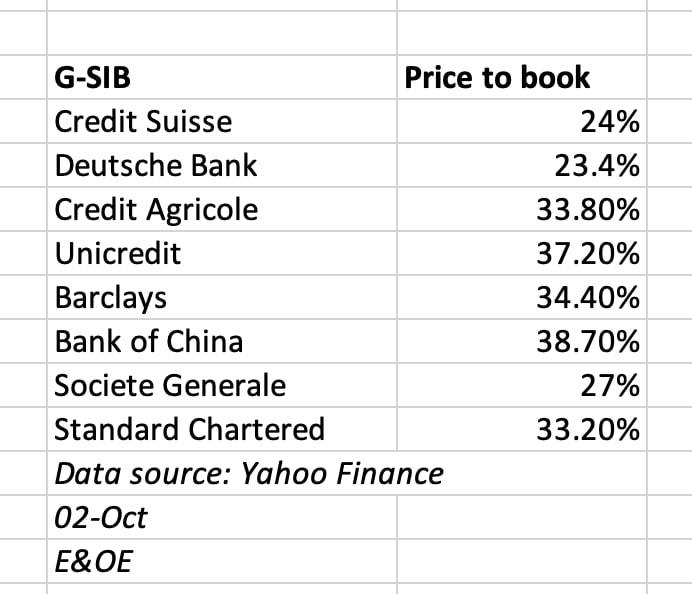
Bugsy
02.10.2022 21:40
is reporting that a major investment bank is on the brink, citing 'a credible source'.
Most are pointing towards Credit Suisse. It was caught out in the Archegos disaster and since then (Feb 2021) its share price has spiralled to $3.90 from $14.90. Moreover, the credit default swaps are at distressed levels.
A memo from the CEO to staff circulated late on Friday:
"I know it's not easy to remain focused amid the many stories you read in the media – in particular, given the many factually inaccurate statements being made. That said, I trust that you are not confusing our day-to-day stock price performance with the strong capital base and liquidity position of the bank," he wrote.
Today, Fox Business' Charlie Gasparino reported that:
"CEO Ulrich Koerner has been meeting w major institutional investors worried the firm is on shaky financial footing and assuring them the bank has strong capital, liquidity etc. One large investor tells me "the bank and wealth management platform are very valuable, but the investment bank is a disaster." The CDS's of the bank have been trading as if a Lehman Moment was about to hit."
This could lead to an ugly open tomorrow and something far worse if it proves to be true.
The bank will have to effective refute this in the strongest possible fashion, otherwise they'll have clients pulling money and couter-parties cutting credit lines. Rumours like these can be self-fulfilling.
We've already got an inflation crisis and an energy crisis. How about a banking crisis too?
Most are pointing towards Credit Suisse. It was caught out in the Archegos disaster and since then (Feb 2021) its share price has spiralled to $3.90 from $14.90. Moreover, the credit default swaps are at distressed levels.
A memo from the CEO to staff circulated late on Friday:
"I know it's not easy to remain focused amid the many stories you read in the media – in particular, given the many factually inaccurate statements being made. That said, I trust that you are not confusing our day-to-day stock price performance with the strong capital base and liquidity position of the bank," he wrote.
Today, Fox Business' Charlie Gasparino reported that:
"CEO Ulrich Koerner has been meeting w major institutional investors worried the firm is on shaky financial footing and assuring them the bank has strong capital, liquidity etc. One large investor tells me "the bank and wealth management platform are very valuable, but the investment bank is a disaster." The CDS's of the bank have been trading as if a Lehman Moment was about to hit."
This could lead to an ugly open tomorrow and something far worse if it proves to be true.
The bank will have to effective refute this in the strongest possible fashion, otherwise they'll have clients pulling money and couter-parties cutting credit lines. Rumours like these can be self-fulfilling.
We've already got an inflation crisis and an energy crisis. How about a banking crisis too?
Bugsy
02.10.2022 21:53
23.51 otevřel jsem short na CS i když budou hodně intervenovat tak to asi neudrží 🤷♂️ cena 3.92 🤷♂️

#KhubicKcz
02.10.2022 21:54
Počítáš s nějakým dalším dominovým efektem ???
Bugsy
03.10.2022 08:42
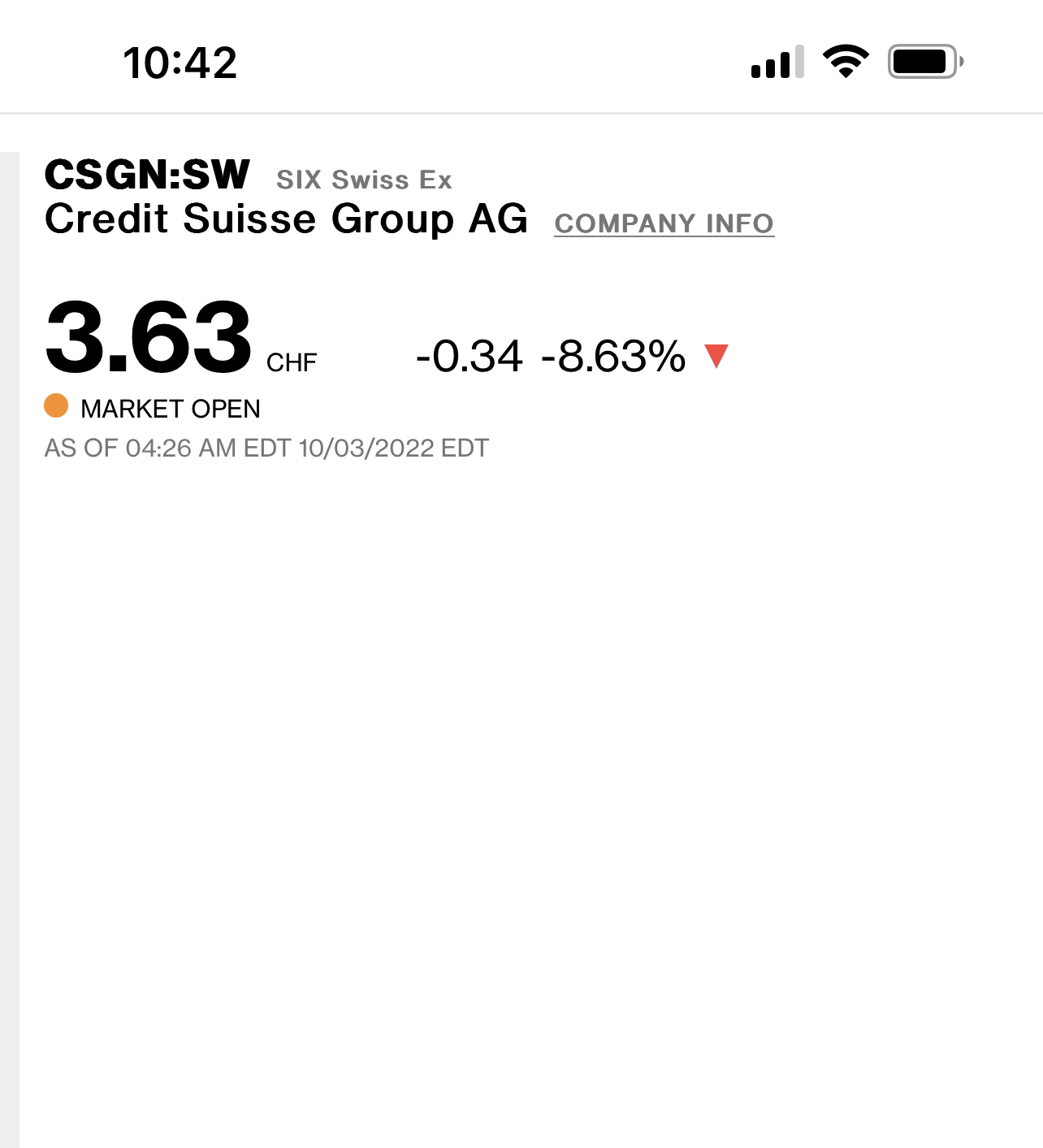
pog:825465951868813342 1
🧠 1
Bugsy
03.10.2022 21:11
Katar se stal největším akcionářem německé energetické společnosti RWE a zaplatil za tento podíl 2,43 miliardy eur.
AdamB
07.10.2022 19:36
https://twitter.com/LawrenceLepard/status/1578461227302678529 někdo, kdo mi blbuvzdorně vysvětli 30 year bond yield ve vztahu k nemovitostnimu trhu?
Bugsy
09.10.2022 07:41
3000 Restaurants und Hotels könnten hohen Energiepreisen zum Opfer fallen
https://www.blick.ch/wirtschaft/gastrosuisse-praesident-casimir-platzer-warnt-wegen-steigender-strompreise-3000-restaurants-und-hotels-droht-der-konkurs-id17944861.html
https://www.blick.ch/wirtschaft/gastrosuisse-praesident-casimir-platzer-warnt-wegen-steigender-strompreise-3000-restaurants-und-hotels-droht-der-konkurs-id17944861.html
Bugsy
10.10.2022 07:31
"the dow jones (30 largest industrial stocks on planet earth) if officially more volatile than bitcoin."
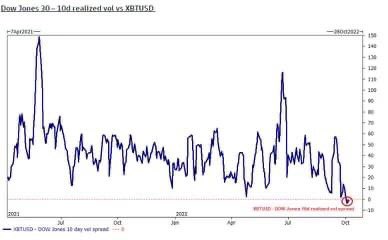
kek:872079105607233557 5
Bugsy
12.10.2022 21:37
12.10.2022 👉 Bitcoin Will Recover From This Tough Period
But if you look at the history of bitcoin and crypto in general, it repeatedly rallies and then blows up… Over and over again. When we crossed a $1 trillion market cap, I thought we had moved beyond bitcoin dropping 65–70%… Clearly we haven’t.
The same thing is true with Ethereum. There’s still an enormous amount of volatility around these assets. And so it’s easy to lose sight when there’s very little activity and prices are languishing.
And, you know, I look back on these videos, and I think, “Oh my goodness, you know, T, you sound like a broken record. You’re saying the same thing again and again and again.”
But that’s what you need to survive these drawdowns. The key through the process is just not doing something dumb, like selling at the bottom. If you have the financial wherewithal to continue dollar-cost averaging, do that with the coins that are important to you.
For me, that’s bitcoin.
But if you look at the history of bitcoin and crypto in general, it repeatedly rallies and then blows up… Over and over again. When we crossed a $1 trillion market cap, I thought we had moved beyond bitcoin dropping 65–70%… Clearly we haven’t.
The same thing is true with Ethereum. There’s still an enormous amount of volatility around these assets. And so it’s easy to lose sight when there’s very little activity and prices are languishing.
And, you know, I look back on these videos, and I think, “Oh my goodness, you know, T, you sound like a broken record. You’re saying the same thing again and again and again.”
But that’s what you need to survive these drawdowns. The key through the process is just not doing something dumb, like selling at the bottom. If you have the financial wherewithal to continue dollar-cost averaging, do that with the coins that are important to you.
For me, that’s bitcoin.
We’ve just gotta get through this period, however long it may be. Generally, it will last until the next halving, which will be in 2024 – but nothing is certain.
Right now, a lot of the price action in crypto – and in really all risk assets – is being driven by the Federal Reserve. So as the Federal Reserve raises interest rates, it sucks money out of risk assets and puts it into less risky assets.
I mean, you can get 4.5% right now in government bonds, and it’s essentially risk free… You haven’t been able to do that in a long, long time.
You can buy investment-grade bonds that are yielding 5.5–6%, sometimes as much as 7%, and still be investment grade. And again, the world hasn’t seen rates that high in maybe 12 years. This is all part of what the Fed is trying to do. It’s trying to suck liquidity and investment capital out of risk assets in order to slow the economy down.
And the pace that it’s doing this at isn’t much different from somebody taking a massive wrench and throwing it into an engine in order to slow it down. Obviously, there are more elegant ways to slow down an engine than to throw a wrench in it. But the Fed has decided to be very crude and very blunt in its efforts to slow the economy down.
Right now, a lot of the price action in crypto – and in really all risk assets – is being driven by the Federal Reserve. So as the Federal Reserve raises interest rates, it sucks money out of risk assets and puts it into less risky assets.
I mean, you can get 4.5% right now in government bonds, and it’s essentially risk free… You haven’t been able to do that in a long, long time.
You can buy investment-grade bonds that are yielding 5.5–6%, sometimes as much as 7%, and still be investment grade. And again, the world hasn’t seen rates that high in maybe 12 years. This is all part of what the Fed is trying to do. It’s trying to suck liquidity and investment capital out of risk assets in order to slow the economy down.
And the pace that it’s doing this at isn’t much different from somebody taking a massive wrench and throwing it into an engine in order to slow it down. Obviously, there are more elegant ways to slow down an engine than to throw a wrench in it. But the Fed has decided to be very crude and very blunt in its efforts to slow the economy down.
And clearly that’s having an impact not only on the price of bitcoin or Ethereum, but on all risk assets. And it’s very important to remember that the risk-free rate of return is the most important number for determining how money will flow in the world. If you have a relatively high risk-free rate of return, then investors will reassess the amount of risk that they’re taking in their portfolio.
They say, “OK, well, I’m buying these tech stocks, and I’m buying these cryptos. Some pay a dividend, but most don’t pay me anything to hold them, and I can get anywhere from 4–7% risk free.”
What happens is institutions and large investors then change their allocation. It doesn’t mean that they don’t invest in growth anymore, but the percentage of their portfolio that’s allocated to growth changes. And that change results in massive price swings. So for now, crypto assets are essentially trading in lockstep with Federal Reserve policy. I don’t know how long that’s going to last.
They say, “OK, well, I’m buying these tech stocks, and I’m buying these cryptos. Some pay a dividend, but most don’t pay me anything to hold them, and I can get anywhere from 4–7% risk free.”
What happens is institutions and large investors then change their allocation. It doesn’t mean that they don’t invest in growth anymore, but the percentage of their portfolio that’s allocated to growth changes. And that change results in massive price swings. So for now, crypto assets are essentially trading in lockstep with Federal Reserve policy. I don’t know how long that’s going to last.
My guess is that it will last as long as this particular cycle. I believe that, over time, the correlation will break down and bitcoin will be treated as something other than just a risk asset that’s highly volatile.
I believe it will be seen as more than an asset that’s only purpose is trading. Because that’s the primary purpose for bitcoin right now. It’s a trading vehicle.
And I get that a lot of people have trouble seeing beyond the value of bitcoin as a trading vehicle or for speculation. But that will change over time. I own bitcoin not so much for what it is now, but for where I believe its ultimate use-case is going to end up. And I believe bitcoin’s ultimate use-case will be as an alternative monetary system that people can go in and out of when the traditional monetary system is being too loose-handed with monetary policy.
Now, one of the things that originally attracted me to bitcoin was I looked at the way that central banks were printing money. I looked at the way that governments were engaging in deficit spending, and I said, “OK, we need a way out of that system, right?”
I believe it will be seen as more than an asset that’s only purpose is trading. Because that’s the primary purpose for bitcoin right now. It’s a trading vehicle.
And I get that a lot of people have trouble seeing beyond the value of bitcoin as a trading vehicle or for speculation. But that will change over time. I own bitcoin not so much for what it is now, but for where I believe its ultimate use-case is going to end up. And I believe bitcoin’s ultimate use-case will be as an alternative monetary system that people can go in and out of when the traditional monetary system is being too loose-handed with monetary policy.
Now, one of the things that originally attracted me to bitcoin was I looked at the way that central banks were printing money. I looked at the way that governments were engaging in deficit spending, and I said, “OK, we need a way out of that system, right?”
”My dollars are getting diluted. Value is getting diluted all the time. What can I do that can’t be manipulated or printed at will?” And I discovered that bitcoin fit that gap.
So for the first time in about a dozen years, we’re in a very different space where central banks – at least our central bank in the United States – instead of pouring money into the market and making many more units of currency, or providing many units of liquidity into the market, they’re actually pulling liquidity out of the market. They’re actually acting in a very responsible way in the sense that they’re pulling back a lot of the liquidity that they put back into the market.
So if I believed that the Federal Reserve was going to have a complete 180, and the U.S. government was going to have a 180 and start spending responsibly and looking to actively cut the deficit, and the Federal Reserve was going to look to actively shrink its balance sheet, I would say that the macro conditions for bitcoin would be impaired under that scenario.
So for the first time in about a dozen years, we’re in a very different space where central banks – at least our central bank in the United States – instead of pouring money into the market and making many more units of currency, or providing many units of liquidity into the market, they’re actually pulling liquidity out of the market. They’re actually acting in a very responsible way in the sense that they’re pulling back a lot of the liquidity that they put back into the market.
So if I believed that the Federal Reserve was going to have a complete 180, and the U.S. government was going to have a 180 and start spending responsibly and looking to actively cut the deficit, and the Federal Reserve was going to look to actively shrink its balance sheet, I would say that the macro conditions for bitcoin would be impaired under that scenario.
Bitcoin is really a bet on the continued debasement of currency and the continued irresponsible spending habits of the government. So while we may be in a short-term period of fiscal responsibility on the part of the Fed, we can clearly see that governments aren’t coming along for the ride.
Look at what happened here in the U.S. with the so-called Inflation Reduction Act. And the Bank of England is trying to raise interest rates in order to be fiscally responsible. They’re trying to bring down inflation, and their government just goes ahead with a £47 billion deficit and an increase in the spending package. Now, they’ve walked that back, and they’ve said they’re not going to do that, but the damage is still done in the market. They made their central bank look like idiots.
At some point, the Federal Reserve is going to stop raising rates. This isn’t a long-term change of direction where we say, “OK, for the next five or seven years, they’re going to incrementally raise rates, and the U.S. government is going to embrace austerity and shoot for a balanced budget.”
Look at what happened here in the U.S. with the so-called Inflation Reduction Act. And the Bank of England is trying to raise interest rates in order to be fiscally responsible. They’re trying to bring down inflation, and their government just goes ahead with a £47 billion deficit and an increase in the spending package. Now, they’ve walked that back, and they’ve said they’re not going to do that, but the damage is still done in the market. They made their central bank look like idiots.
At some point, the Federal Reserve is going to stop raising rates. This isn’t a long-term change of direction where we say, “OK, for the next five or seven years, they’re going to incrementally raise rates, and the U.S. government is going to embrace austerity and shoot for a balanced budget.”
Under that scenario, bitcoin would have a great deal of difficulty thriving because it’s the antidote to irresponsible government policy, monetary policy, and Fed policy. If those actors start acting in a responsible way, there’s not much need for bitcoin.
So the question I have for you is this: Do you think governments and central banks will act in a responsible way when it comes to their monetary policy over the long term?
It’s a real question. And it’s one I have to ask myself, and I can’t come up with a scenario where the U.S. federal government says, “We’re spending too much money. We need to cut our spending. We’re going to cut our spending. We’re shooting for a balanced budget.”
I don’t see that happening. I don’t see anything that suggests that shift is going to happen. And if I don’t see that happening, then I’ve gotta continue to be long bitcoin. I look at the Federal Reserve and I say, “OK, well, how long can they raise rates for? And how high can they go?”
So the question I have for you is this: Do you think governments and central banks will act in a responsible way when it comes to their monetary policy over the long term?
It’s a real question. And it’s one I have to ask myself, and I can’t come up with a scenario where the U.S. federal government says, “We’re spending too much money. We need to cut our spending. We’re going to cut our spending. We’re shooting for a balanced budget.”
I don’t see that happening. I don’t see anything that suggests that shift is going to happen. And if I don’t see that happening, then I’ve gotta continue to be long bitcoin. I look at the Federal Reserve and I say, “OK, well, how long can they raise rates for? And how high can they go?”
And if you look at the bulk of the federal debt, it’s short-dated debt. They were paying 25 basis points… 75 basis points… 125 basis points on their debt. Now, you look at short-term paper yielding 4%… The cost to the Treasury for servicing the national debt has exploded. It’s gone ridiculously high. And there’s only so long that the federal government can operate with interest expenses that are outrageously high. They can’t do it forever.
What I would imagine is going to occur is the Federal Reserve is going to continue to raise rates quickly like they’ve been doing. They’re going to try and go for shock and awe, try to bring inflation down, and at some point, relatively soon, they’re going to have to stop raising rates.
What I would imagine is going to occur is the Federal Reserve is going to continue to raise rates quickly like they’ve been doing. They’re going to try and go for shock and awe, try to bring inflation down, and at some point, relatively soon, they’re going to have to stop raising rates.
They can only raise rates so far before they financially decimate the government, right? It’s not like 1980 where they raised rates to the moon.
I want to remind you that federal debt was only 35% of gross domestic product (GDP) back then. Right now, it’s something like 125% of GDP. So you just can’t take rates to where you could before now. That means between where interest rates are now and where they’ll ultimately end up going, you’re going to see a lot of volatility.
You’re going to see a lot of volatility in equities… You’re going to see some volatility in crypto… And there’s nothing we can do about that. All I can do is warn you about it and tell you that the volatility will be temporary. As ugly as it is, it will be temporary.
The sun will shine again. We’ll hit new highs again, and we’ll go onto massive new highs. I need you to believe me when I tell you that it will be true again. And there are a number of reasons why I believe it’s very important that you don’t fall into a vacuum or an echo chamber of people that just believe what you believe. Because then your brain goes into neutral and you stop thinking.
I want to remind you that federal debt was only 35% of gross domestic product (GDP) back then. Right now, it’s something like 125% of GDP. So you just can’t take rates to where you could before now. That means between where interest rates are now and where they’ll ultimately end up going, you’re going to see a lot of volatility.
You’re going to see a lot of volatility in equities… You’re going to see some volatility in crypto… And there’s nothing we can do about that. All I can do is warn you about it and tell you that the volatility will be temporary. As ugly as it is, it will be temporary.
The sun will shine again. We’ll hit new highs again, and we’ll go onto massive new highs. I need you to believe me when I tell you that it will be true again. And there are a number of reasons why I believe it’s very important that you don’t fall into a vacuum or an echo chamber of people that just believe what you believe. Because then your brain goes into neutral and you stop thinking.
You stop asking yourself, “What if I’m wrong?” You stop saying, “Well, prove to me and show to me that this is actually going to continue to be adopted.” These are the questions that I ask myself constantly. I have an enormous amount of my net worth tied up in bitcoin and crypto-related investments. So I’m deeply motivated to make sure that I get this right. And what I care about is getting this right over the long-term.
From 2016 to now, we’ve experienced massive volatility. But everything, every premise – every scrap of research that I’ve put together from 2016 – has ultimately borne out in reality. And as long as the adoption curve continues to trend upward, I have to own these assets because they’re only owned by a few hundred million people.
And my thesis from the very beginning is that billions will end up owning these assets. If I’m right – and I believe I am – then these assets will become much more valuable than they are today.
Let me show you some of the things that I’m looking at to give you some perspective.
From 2016 to now, we’ve experienced massive volatility. But everything, every premise – every scrap of research that I’ve put together from 2016 – has ultimately borne out in reality. And as long as the adoption curve continues to trend upward, I have to own these assets because they’re only owned by a few hundred million people.
And my thesis from the very beginning is that billions will end up owning these assets. If I’m right – and I believe I am – then these assets will become much more valuable than they are today.
Let me show you some of the things that I’m looking at to give you some perspective.
👉 👉 The Largest Companies in the World Are Still Aligned With Bitcoin
This is from the Wall Street Journal. It’s America’s oldest bank, BNY Mellon. It’s a bank founded by Alexander Hamilton. It’s the oldest bank in the United States, and it’s going to be safeguarding digital assets alongside traditional investments.
You have to ask yourself why. BNY Mellon doesn’t need the money. They make billions of dollars. Why would they take the reputational risk and go through the arduous process to transact with crypto? Why?
Because they see the growth… They see the value. They’ve been watching these tiny offshore firms make hundreds of millions – and even billions – of dollars over the last several years providing trading and custody services for crypto. You don’t think they want a piece of that? I promise you, they do. Crypto is the asset of the future. And this bank has lasted as long as they have by recognizing where the growth opportunities are.
This is from the Wall Street Journal. It’s America’s oldest bank, BNY Mellon. It’s a bank founded by Alexander Hamilton. It’s the oldest bank in the United States, and it’s going to be safeguarding digital assets alongside traditional investments.
You have to ask yourself why. BNY Mellon doesn’t need the money. They make billions of dollars. Why would they take the reputational risk and go through the arduous process to transact with crypto? Why?
Because they see the growth… They see the value. They’ve been watching these tiny offshore firms make hundreds of millions – and even billions – of dollars over the last several years providing trading and custody services for crypto. You don’t think they want a piece of that? I promise you, they do. Crypto is the asset of the future. And this bank has lasted as long as they have by recognizing where the growth opportunities are.
Now, these companies are elephants of capital, and they move very, very slowly. So people will look at something like this and say, “Well, you know, why isn’t bitcoin up? Why isn’t Ethereum up?” I don’t know. It’s just the nature of markets.
I remember when we were going through the dark days of the last crypto winter… BTC was around $4,000–5,000… and it was just great news after great news coming out… and the asset just languished.
And then one day, it seemed everybody woke up and said, “We gotta own bitcoin.” And then it went from $4,000 to $8,000… then from $8,000 back to $4,000… then to $10,000, $14,000, $16,000, $20,000… The next thing you know, it was up at $70,000.
Why does it happen like that? I don’t have the answer. I just know it happens like that.
So during these bear market periods, I look to make sure that adoption story is continuing.
Here, we can see with BNY Mellon, it is.
I remember when we were going through the dark days of the last crypto winter… BTC was around $4,000–5,000… and it was just great news after great news coming out… and the asset just languished.
And then one day, it seemed everybody woke up and said, “We gotta own bitcoin.” And then it went from $4,000 to $8,000… then from $8,000 back to $4,000… then to $10,000, $14,000, $16,000, $20,000… The next thing you know, it was up at $70,000.
Why does it happen like that? I don’t have the answer. I just know it happens like that.
So during these bear market periods, I look to make sure that adoption story is continuing.
Here, we can see with BNY Mellon, it is.
Now, if we look at this story, you can see Google selects Coinbase to take cloud payments with cryptocurrencies and will use its custody tool.
Think about that… Google… It’s massive. Everybody touches one of its products every single day. Think about what happens when Google implements bitcoin purchases or bitcoin wallets… Ethereum wallets or staking wallets… or any kind of custody services for crypto.
Billions of people use Google’s services. If we were in a bull phase right now, this news would’ve just absolutely catapulted bitcoin higher.
What do we get? We get a yawn. BTC is trading around $19,000.
Then, of course, we have BlackRock, which has created its own bitcoin trust. This was the story from August. And we’re still seeing asset managers seeing substantial interest from clients.
When I see companies like BNY Mellon and Google aligning with this asset – even though it’s down more than 60% – that tells me it has legs.
Think about that… Google… It’s massive. Everybody touches one of its products every single day. Think about what happens when Google implements bitcoin purchases or bitcoin wallets… Ethereum wallets or staking wallets… or any kind of custody services for crypto.
Billions of people use Google’s services. If we were in a bull phase right now, this news would’ve just absolutely catapulted bitcoin higher.
What do we get? We get a yawn. BTC is trading around $19,000.
Then, of course, we have BlackRock, which has created its own bitcoin trust. This was the story from August. And we’re still seeing asset managers seeing substantial interest from clients.
When I see companies like BNY Mellon and Google aligning with this asset – even though it’s down more than 60% – that tells me it has legs.
Now in the marketplace, no one is going to come down from the sky with a written declaration of exactly what happens next and when. So we have to intuit and draw conclusions from data, even if that data isn’t confirmed by the price of the asset.
For instance, somebody may see the Google and BNY news come out and immediately discount it as not having value because the price of bitcoin doesn’t move. Well, that’s the very nature of being in a bear market.
When you’re in a bear market, assets go down on bad news and go down on good news, or they don’t move on good news. That’s how you know you’re in a bear market. So that will be the case while we’re in this bear market.
What’s our job during this bear market? It’s to add to our positions where it makes financial sense… not to get crazy, to be rational… and then just let time do the rest.
For instance, somebody may see the Google and BNY news come out and immediately discount it as not having value because the price of bitcoin doesn’t move. Well, that’s the very nature of being in a bear market.
When you’re in a bear market, assets go down on bad news and go down on good news, or they don’t move on good news. That’s how you know you’re in a bear market. So that will be the case while we’re in this bear market.
What’s our job during this bear market? It’s to add to our positions where it makes financial sense… not to get crazy, to be rational… and then just let time do the rest.
You know we have no control over that. So our job is to own the asset and stay with it as it’s going through its adoption process.
When I first bought bitcoin in 2016, maybe 2 or 3 million people were using it… and bitcoin was at $400.
Today, there are 200–300 million people using it. It’s been as high as $70,000, and it’s trading right now at $19,000. Over the next couple years, we’ll have hundreds of millions of more people using it. By 2024, we should have over 1 billion people using it. By the end of the decade, multiple billions of people will be using not only bitcoin, but Ethereum and many other assets within this space that we have recommendations on.
That’s the process. It’s not linear. I wish it was.
The sequence of returns we get are crazy. We have a couple of years where we’re 20–2,000x… And then we have a couple of years where we’re down 70–80%. It’s just the nature of the game. I wish it was different.
When I first bought bitcoin in 2016, maybe 2 or 3 million people were using it… and bitcoin was at $400.
Today, there are 200–300 million people using it. It’s been as high as $70,000, and it’s trading right now at $19,000. Over the next couple years, we’ll have hundreds of millions of more people using it. By 2024, we should have over 1 billion people using it. By the end of the decade, multiple billions of people will be using not only bitcoin, but Ethereum and many other assets within this space that we have recommendations on.
That’s the process. It’s not linear. I wish it was.
The sequence of returns we get are crazy. We have a couple of years where we’re 20–2,000x… And then we have a couple of years where we’re down 70–80%. It’s just the nature of the game. I wish it was different.
I’ve always been upfront with you about the game you and I are in. The reason I’m having this chat with you today is because it’s important – especially since we’re a year into this now – that you understand where we are, why we’re here, and that we could be here for another year… and it’s not fun.
It’s been tough. These last few videos, I’ve been thinking, “T, you need to add value here. You’re saying the same thing to folks.” And I would imagine if I were on the other side, I’d probably be getting frustrated.
But this is the reality of where we are. And there’s no amount of talking or singing or dancing that’s going to change that. That’s just where we are. It’s not pleasant, it’s not fun, but it’s part of the price we pay. It’s the admission price to be able to make the gains we do when the markets start running and gunning again. That’s just the way it is.
To lament that or to want it to be anything other than what it is puts you in a position where you’re going to create frustration and anger for yourself… and a position where you might make what could be potentially very destructive decisions. And that’s dumping an asset – confusing what’s essentially a short-term problem with a long-term systemic problem.
It’s been tough. These last few videos, I’ve been thinking, “T, you need to add value here. You’re saying the same thing to folks.” And I would imagine if I were on the other side, I’d probably be getting frustrated.
But this is the reality of where we are. And there’s no amount of talking or singing or dancing that’s going to change that. That’s just where we are. It’s not pleasant, it’s not fun, but it’s part of the price we pay. It’s the admission price to be able to make the gains we do when the markets start running and gunning again. That’s just the way it is.
To lament that or to want it to be anything other than what it is puts you in a position where you’re going to create frustration and anger for yourself… and a position where you might make what could be potentially very destructive decisions. And that’s dumping an asset – confusing what’s essentially a short-term problem with a long-term systemic problem.
👉 👉 After the Rate Raises… Bitcoin Will Run and Gun
The thing I want to leave you with is the Federal Reserve can’t keep rates high forever.
If you look at the yield curve, it suggests that the Federal Reserve is going to be done raising rates sometime in 2023, and then you’ll see rates start to drop. And as rates start to drop, you’ll see all risk assets start running and gunning.
And any time the market thinks that the Federal Reserve is going to pivot and cut rates… bitcoin outperforms. It outperforms the Nasdaq… outperforms the Dow… outperforms everybody. It just moves so quickly.
So when we finally do reach that point where the Fed pivots, you’ll see bitcoin move very quickly.
And if you’re waiting for the pivot, you better have a fast trigger finger. Because once the Fed pivots, everything’s going to run… including BTC. And BTC will run a lot further and a lot faster than traditional assets.
The thing I want to leave you with is the Federal Reserve can’t keep rates high forever.
If you look at the yield curve, it suggests that the Federal Reserve is going to be done raising rates sometime in 2023, and then you’ll see rates start to drop. And as rates start to drop, you’ll see all risk assets start running and gunning.
And any time the market thinks that the Federal Reserve is going to pivot and cut rates… bitcoin outperforms. It outperforms the Nasdaq… outperforms the Dow… outperforms everybody. It just moves so quickly.
So when we finally do reach that point where the Fed pivots, you’ll see bitcoin move very quickly.
And if you’re waiting for the pivot, you better have a fast trigger finger. Because once the Fed pivots, everything’s going to run… including BTC. And BTC will run a lot further and a lot faster than traditional assets.
So I’ve been dollar-cost averaging each week into bitcoin. If it dips into $18,000, I buy a little bit more.
And I’m very rational about that. I have a set amount of money I know I’m going to allocate to BTC every week, and that’s what I do. If you’re in the same position to do that, I recommend you do that.
If you’re not in that same position to do that, then don’t worry. Leave it alone. Go enjoy your life, do other things. Eventually, market conditions will change. The macro picture will change. And BTC will run again.
It might be a year though, before that happens. It’s important you’re aware of that. And it’s important you understand that regardless of the price action, the adoption of bitcoin by institutional players is continuing. That’s what matters. And that’s what I want you to focus on as you look at these investments.
They’re down 60–80%. I get it. It’s tough.
And I’m very rational about that. I have a set amount of money I know I’m going to allocate to BTC every week, and that’s what I do. If you’re in the same position to do that, I recommend you do that.
If you’re not in that same position to do that, then don’t worry. Leave it alone. Go enjoy your life, do other things. Eventually, market conditions will change. The macro picture will change. And BTC will run again.
It might be a year though, before that happens. It’s important you’re aware of that. And it’s important you understand that regardless of the price action, the adoption of bitcoin by institutional players is continuing. That’s what matters. And that’s what I want you to focus on as you look at these investments.
They’re down 60–80%. I get it. It’s tough.
Again, we went through this in 2018, 2019, and early 2020… And we came through it and our worst-looking ideas emerged and became our best ideas.
This is the reason I’m so adamant about proper position sizing and proper risk management… And why I always talk about it, even when we’re running and gunning.
Look, we’re going to have times when we’re down a lot. And the key to surviving those times is to have uniform position sizes across the portfolio. If you don’t do that, then the stress is just too much. You can’t deal with the drawdowns, and you end up selling at the bottom and saying, “I’m never going to touch crypto again.”
Then when we go into a bull market and crypto runs and guns, you end up buying at the highs and selling at the lows… I want you to avoid that. My goal for you is to get you in at these cheap prices and then just wait for adoption to happen, which is happening at scale. And as that adoption occurs, it’s like a rising tide. It will lift the prices of all these assets to levels we’ve never seen before.
Bitcoin will trade to an all-time high again. Ethereum will trade to an all-time high again. The crypto asset market cap will go to a new high again.
This is the reason I’m so adamant about proper position sizing and proper risk management… And why I always talk about it, even when we’re running and gunning.
Look, we’re going to have times when we’re down a lot. And the key to surviving those times is to have uniform position sizes across the portfolio. If you don’t do that, then the stress is just too much. You can’t deal with the drawdowns, and you end up selling at the bottom and saying, “I’m never going to touch crypto again.”
Then when we go into a bull market and crypto runs and guns, you end up buying at the highs and selling at the lows… I want you to avoid that. My goal for you is to get you in at these cheap prices and then just wait for adoption to happen, which is happening at scale. And as that adoption occurs, it’s like a rising tide. It will lift the prices of all these assets to levels we’ve never seen before.
Bitcoin will trade to an all-time high again. Ethereum will trade to an all-time high again. The crypto asset market cap will go to a new high again.
And it was $3 trillion before. So this is going to become a massive market that’s going to be worth tens of trillions of dollars over time. It won’t happen overnight, but it will happen over time.
If you think about crypto assets in the last 10 years, they went from zero – from being an asset that never existed before – to a peak value of $3 trillion in 10 years. I’ve never seen an asset class that didn’t exist before go from zero to $3 trillion in 10 years. I don’t think anybody has.
So in the next 10 years, we might go to $10 trillion, we might go to $30 trillion or $50 trillion… But we’re certainly going significantly higher.
I know I sound like a broken record. There’s a reason for it. This approach works. I’m going to continue to do these videos and continue to say a lot of the same thing. And if you’re angry and upset that I’m not saying anything different, continue to be angry and upset… Just don’t sell your coins. Stay in your coins.
And again, if it makes sense to you financially – if you’re not putting yourself in financial distress – then you should take advantage of these prices.
Alright, friends, that’s enough out of me. If you have any questions, comments, or concerns, please send them in here. I love reading your questions. Of course, I can’t give you personalized investment advice, but wherever I can answer your questions in a general way, I’ll do so.
Alright, friends, I want to thank you again for tuning in. And I want you to always remember: Let the Game Come to You.
If you think about crypto assets in the last 10 years, they went from zero – from being an asset that never existed before – to a peak value of $3 trillion in 10 years. I’ve never seen an asset class that didn’t exist before go from zero to $3 trillion in 10 years. I don’t think anybody has.
So in the next 10 years, we might go to $10 trillion, we might go to $30 trillion or $50 trillion… But we’re certainly going significantly higher.
I know I sound like a broken record. There’s a reason for it. This approach works. I’m going to continue to do these videos and continue to say a lot of the same thing. And if you’re angry and upset that I’m not saying anything different, continue to be angry and upset… Just don’t sell your coins. Stay in your coins.
And again, if it makes sense to you financially – if you’re not putting yourself in financial distress – then you should take advantage of these prices.
Alright, friends, that’s enough out of me. If you have any questions, comments, or concerns, please send them in here. I love reading your questions. Of course, I can’t give you personalized investment advice, but wherever I can answer your questions in a general way, I’ll do so.
Alright, friends, I want to thank you again for tuning in. And I want you to always remember: Let the Game Come to You.
👍 4
👉 konec hlášení🍀
Bugsy
18.10.2022 19:02
👉 👉 EVMOS 18.10.2022💪 💪 👍
(upraveno)
👉 👉 👉 How Virtual Machines Can Level the Playing Field in Web 3.0
One of the most important technologies in crypto is the EVM, or Ethereum Virtual Machine.
As we noted above, a virtual machine emulates a complete, independent computer system entirely within another computing environment.
EVM is the software platform that developers can use to create decentralized applications (dApps) on Ethereum.
It executes the smart contract code. And it’s also where all Ethereum accounts and smart contracts live.
But instead of running on one computer, the EVM runs across all of Ethereum’s 8,000-plus nodes. So essentially, it’s a virtual machine spread across the globe.
These nodes also track the current state of the Ethereum blockchain.
And even if some of the nodes go offline, the rest continue to run applications on EVM and keep a state of the network.
That’s why Ethereum is referred to as the unstoppable, uncensorable world computer.
And it flips the Web 2.0 model on its head.
One of the most important technologies in crypto is the EVM, or Ethereum Virtual Machine.
As we noted above, a virtual machine emulates a complete, independent computer system entirely within another computing environment.
EVM is the software platform that developers can use to create decentralized applications (dApps) on Ethereum.
It executes the smart contract code. And it’s also where all Ethereum accounts and smart contracts live.
But instead of running on one computer, the EVM runs across all of Ethereum’s 8,000-plus nodes. So essentially, it’s a virtual machine spread across the globe.
These nodes also track the current state of the Ethereum blockchain.
And even if some of the nodes go offline, the rest continue to run applications on EVM and keep a state of the network.
That’s why Ethereum is referred to as the unstoppable, uncensorable world computer.
And it flips the Web 2.0 model on its head.
In Web 2.0, most control lies within a handful of tech conglomerates. While there’s benefits to this such as ease of use and network effects from large platforms, there are clear drawbacks. (The network effect states the bigger the network of users, the greater the value of the network.)
These tech conglomerates have a lot of control. And by extension, their users have little control.
You can get “deplatformed.” For example, YouTube, Shopify, Meta, and Twitter banned former President Donald Trump from creating content on any of their platforms.
Or you could be denied making or receiving payments from a payment service.
Visa and Mastercard regularly suspend service for what they deem suspicious activity. And at one point, they banned customers from using their networks to purchase crypto.
Or you could be censored. All the major Web 2.0 platforms censor users in one way or another.
What’s clear is Web 2.0 can be unfair and inequitable. And it’s not a level playing field.
This doesn’t happen with Ethereum:
No permission is required to use Ethereum.
No one can block you or deny you access to the service.
Payments are built in via the native token, ether (ETH).
With the EVM, you can program and run pretty much anything.
For developers, the EVM provides a uniform computing platform across an unpredictable range of hardware.
And for consumers, it provides a credibly neutral environment for all.
These tech conglomerates have a lot of control. And by extension, their users have little control.
You can get “deplatformed.” For example, YouTube, Shopify, Meta, and Twitter banned former President Donald Trump from creating content on any of their platforms.
Or you could be denied making or receiving payments from a payment service.
Visa and Mastercard regularly suspend service for what they deem suspicious activity. And at one point, they banned customers from using their networks to purchase crypto.
Or you could be censored. All the major Web 2.0 platforms censor users in one way or another.
What’s clear is Web 2.0 can be unfair and inequitable. And it’s not a level playing field.
This doesn’t happen with Ethereum:
No permission is required to use Ethereum.
No one can block you or deny you access to the service.
Payments are built in via the native token, ether (ETH).
With the EVM, you can program and run pretty much anything.
For developers, the EVM provides a uniform computing platform across an unpredictable range of hardware.
And for consumers, it provides a credibly neutral environment for all.
In other words, everyone follows the same set of rules set forth by the EVM. There’s no special access or administrative privilege.
That makes the EVM revolutionary.
It levels the playing field. And it’s one of the reasons why Ethereum will be the foundation for Web 3.0.
But it’s not all going to happen on Ethereum. As we detailed in past issues (here and here), it’s going to be a multichain world.
It makes sense. The internet itself is a mix of protocols that make different hardware and software applications interoperable. And it’s led to multiple companies thriving and cooperating even as they compete against each other.
This month’s pick is taking advantage of a multichain world, connecting Ethereum to another one of our favorite crypto ecosystems, Cosmos.
The name of the project is Evmos.
A portmanteau of EVM plus Cosmos, Evmos brings the EVM to the Cosmos blockchain.
That makes the EVM revolutionary.
It levels the playing field. And it’s one of the reasons why Ethereum will be the foundation for Web 3.0.
But it’s not all going to happen on Ethereum. As we detailed in past issues (here and here), it’s going to be a multichain world.
It makes sense. The internet itself is a mix of protocols that make different hardware and software applications interoperable. And it’s led to multiple companies thriving and cooperating even as they compete against each other.
This month’s pick is taking advantage of a multichain world, connecting Ethereum to another one of our favorite crypto ecosystems, Cosmos.
The name of the project is Evmos.
A portmanteau of EVM plus Cosmos, Evmos brings the EVM to the Cosmos blockchain.
👉 👉

Evmos (EVMOS)
Current Price Market Capitalization
$1.69 $506,632,518
Current Supply Total Supply
323,000,000 1,000,000,000
Current Price Market Capitalization
$1.69 $506,632,518
Current Supply Total Supply
323,000,000 1,000,000,000
👉 👉 Here’s the issue Evmos is solving…
Web 3.0 applications will be built on Ethereum because of its maturity and large user base. But as we know, Ethereum can be expensive and slow.
What if you could have all the features of Ethereum while at the same time enabling faster transactions, lower fees, and an expanded user base?
Enter Evmos.
It’s a blockchain built on Cosmos that’s fully compatible and interoperable with Ethereum and the EVM.
Essentially, it’s a vanilla Ethereum on Cosmos. And it’s the first chain that makes Ethereum and Cosmos interoperable.
With EVM compatibility, any Ethereum dApps can run on Evmos and integrate with the Cosmos ecosystem.
Plus, any EVM-compatible chain, such as Avalanche or Fantom, can integrate assets into the Cosmos ecosystem through Evmos.
Evmos’ key features include:
Web 3.0 and EVM compatibility.
High throughput via Tendermint Core.
Horizontal scalability via the IBC protocol.
Fast transaction finality.
Lower costs.
(If you’re interested in the technical details, check out the gray box below.)
What this means is developers can leverage existing Ethereum ecosystem tooling and software – all the stuff they’re already familiar with – to seamlessly deploy smart contracts that interact with the Cosmos ecosystem.
So Ethereum developers could easily port any Ethereum dApp to Evmos and tap into the Cosmos ecosystem and user base.
Web 3.0 applications will be built on Ethereum because of its maturity and large user base. But as we know, Ethereum can be expensive and slow.
What if you could have all the features of Ethereum while at the same time enabling faster transactions, lower fees, and an expanded user base?
Enter Evmos.
It’s a blockchain built on Cosmos that’s fully compatible and interoperable with Ethereum and the EVM.
Essentially, it’s a vanilla Ethereum on Cosmos. And it’s the first chain that makes Ethereum and Cosmos interoperable.
With EVM compatibility, any Ethereum dApps can run on Evmos and integrate with the Cosmos ecosystem.
Plus, any EVM-compatible chain, such as Avalanche or Fantom, can integrate assets into the Cosmos ecosystem through Evmos.
Evmos’ key features include:
Web 3.0 and EVM compatibility.
High throughput via Tendermint Core.
Horizontal scalability via the IBC protocol.
Fast transaction finality.
Lower costs.
(If you’re interested in the technical details, check out the gray box below.)
What this means is developers can leverage existing Ethereum ecosystem tooling and software – all the stuff they’re already familiar with – to seamlessly deploy smart contracts that interact with the Cosmos ecosystem.
So Ethereum developers could easily port any Ethereum dApp to Evmos and tap into the Cosmos ecosystem and user base.
Or they can build on Evmos directly. Ethereum developers can leverage the Cosmos software development kit (SDK) by utilizing the Ethermint library.
Ethermint acts as a kind of wrapper around Go Ethereum (Geth), the library used by nearly every EVM platform.
In other words, any Ethereum developer can easily get started on Evmos like they’re accustomed to. It’s very similar to using an Android emulator. It mimics the environment of Ethereum, but you’re building on Cosmos.
And they may want to use the Cosmos SDK anyways. Cosmos blockchains have a more flexible and modular design compared to Ethereum. It’s a blockchain development framework that allows developers to have near total control over its design.
We’ve already seen projects move from Ethereum to Cosmos. For example, in June derivative platform dYdX announced its next version, dYdX V4, will be built on Cosmos.
It’s making the move because the Cosmos SDK gives it the design flexibility to build a product that meets customer demands.
But now with Evmos, projects built with the Cosmos SDK are EVM-compatible as well.
Plus, as we explain below, developers are incentivized to build on Evmos.
And let’s not forget the Cosmos ecosystem. It will benefit as well.
Essential Ethereum applications can now easily port to Cosmos. So its ecosystem could benefit from established projects such as The Graph, API3, and others.
When you put it all together, Evmos is set up to become the EVM hub on Cosmos. And that’s great for token holders. We explain why below.
Ethermint acts as a kind of wrapper around Go Ethereum (Geth), the library used by nearly every EVM platform.
In other words, any Ethereum developer can easily get started on Evmos like they’re accustomed to. It’s very similar to using an Android emulator. It mimics the environment of Ethereum, but you’re building on Cosmos.
And they may want to use the Cosmos SDK anyways. Cosmos blockchains have a more flexible and modular design compared to Ethereum. It’s a blockchain development framework that allows developers to have near total control over its design.
We’ve already seen projects move from Ethereum to Cosmos. For example, in June derivative platform dYdX announced its next version, dYdX V4, will be built on Cosmos.
It’s making the move because the Cosmos SDK gives it the design flexibility to build a product that meets customer demands.
But now with Evmos, projects built with the Cosmos SDK are EVM-compatible as well.
Plus, as we explain below, developers are incentivized to build on Evmos.
And let’s not forget the Cosmos ecosystem. It will benefit as well.
Essential Ethereum applications can now easily port to Cosmos. So its ecosystem could benefit from established projects such as The Graph, API3, and others.
When you put it all together, Evmos is set up to become the EVM hub on Cosmos. And that’s great for token holders. We explain why below.